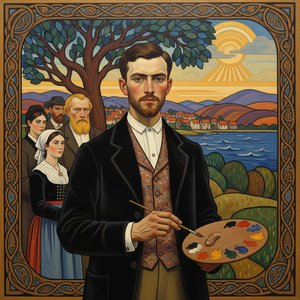
Émile Bernard: En postimpressionistisk pionjär
Tidigt liv och utbildning
- Född: 28 april 1868, i Lille, Frankrike.
- Émile Henri Bernards tidiga år präglades av hans systers sjukdom, vilket innebar att han främst uppfostrades av sin mormor, som drev en tvättinrättning i Lille. Denna stöttande miljö gav näring åt hans konstnärliga böjelser.
- År 1878 flyttade familjen till Paris, där Bernard studerade vid Collège Sainte-Barbe.
- Han påbörjade sina formella konststudier vid École des Arts Décoratifs och anslöt senare till Atelier Cormon år 1884. Här experimenterade han med impressionism och pointillism.
- Hans uttrycksfulla tendenser ledde till en avstängning från École des Beaux-Arts, vilket i sin tur framkallade en formativ vandring genom Bretagne till fots.
Konstnärlig utveckling och influenser
- Bernards konstnärliga utveckling påverkades djupt av hans resor i Bretagne, där han mötte lokala traditioner och landskap som resonerade starkt inom honom.
- En nyckelrelation: Ett avgörande ögonblick inträffade i augusti 1886 när han mötte Paul Gauguin i Pont-Aven. Detta möte tände en nära konstnärlig vänskap och fick en genomgripande inverkan på båda konstnärernas stilar.
- Bernards stil spelade en avgörande roll i formandet av Gauguins mogna verk, särskilt hans utforskande av symbolism och förenklade, platta former.
- Han rörde sig även i kretsen kring Vincent van Gogh och var en del av ”Skolan i Petit-Boulevard” tillsammans med Anquetin och Toulouse-Lautrec.
Centrala konstnärliga rörelser
- Cloisonnism: Bernard betraktas som en pionjär inom cloisonnism, en stil kännetecknad av djärva, platta former separerade av mörka konturer – likt glasmålningar.
- Syntetism: Han spelade även en nyckelroll i utvecklingen av syntetism, som betonade skapandet av konst baserat på subjektiva upplevelser och symbolisk betydelse snarare än direkt observation av naturen.
- Dessa rörelser representerade ett brott med impressionismen och fokuserade istället på struktur, symbolism och emotionellt uttryck.
Betydande verk
- La Grandmère (1887): Ett gripande porträtt av hans mormor som visar konstnärens tidiga mästerskap i uttrycksfull form och färg. Detta verk anses vara ett av hans mest ikoniska.
- Talrika bretonska landskap som fångar essensen av det lantliga livet i Bretagne.
- Religiösa verk såsom ”Hyrdarna tillbedjer Jesusbarnet” som demonstrerar hans utforskande av symboliska teman.
Litterära bidrag och historisk betydelse
- Utöver måleriet var Bernard en flitig skribent som producerade pjäser, poesi och konstkritik. Hans skrifter ger värdefulla förstahandsperspektiv på den moderna konstens utveckling under hans tid.
- Arv: Émile Bernards bidrag till postimpressionismen, särskilt hans roll i att forma cloisonnism och syntetism, lämnade ett bestående avtryck på den moderna konstens gång.
- Hans arbete banade väg för efterföljande rörelser som fauvism och expressionism, och inspirerade generationer av konstnärer att utforska subjektivt uttryck och symbolisk representation.
- Han gick bort 1941 och lämnade efter sig en produktion som fortsätter att hyllas för sin originalitet och konstnärliga innovation.
Frågor och svar
Var hittar man Émile Bernards konstverk sorterade efter färg?
På Färgindex-sidan är Émile Bernards konstverk organiserade efter färg.
I vilken stad och vilket land föddes Émile Bernard?
Émile Bernard föddes i Lille, i Frankrike.
Hur utvecklades Émile Bernards konst över tid?
En kronologisk genomgång av Émile Bernards verk finns tillgänglig på artistens Karriärlinje-sida, där konstverken presenteras i skapelseordning, kapitel för kapitel.