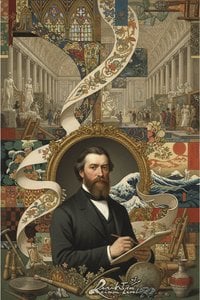
The Life and Academic Training of Édouard Vimont
Born in Paris, France, Édouard Vimont was a painter who received his formal training at the École des beaux-arts de Paris. During his time there, he studied in the ateliers of Alexandre Cabanel and Théodore Maillot. His early talent was evident as he participated in the concours de l'esquisse peinte starting in 1864, notably earning fourth place for his work Reconnaissance d'Electre et Oreste. Throughout his career, Vimont engaged with the prestigious Prix de Rome, presenting several works including Le Soldat de Marathon, which received an honorable mention, and La captivité des juifs à Babylone.
Artistic Contributions and Notable Works
Vimont was recognized for his mastery of large-scale history painting, frequently exhibiting at the Salon. His notable contributions to public spaces include commissions for the town halls of Arcueil-Cachan and Les Lilas, where he painted compositions such as La Jeunesse and La Famille. His diverse body of work spans various subjects, from mythological scenes to religious themes. Some of his documented works include:
Frågor och svar
Finns det en komplett lista över Édouard Vimonts konstverk?
Alla verk av Édouard Vimont på denna webbplats kan utforskas via artistens Samtliga konstverk-sida.
Kan jag studera Édouard Vimonts färgval genom hela det konstnärliga skapandet?
Färgprofilen för Édouard Vimonts verk visas på artistens Palettens genom-sida.
Var kan jag se Édouard Vimonts konstverk sorterade efter stämning?
Konstnärens Känslomässigt rum-sida visar Édouard Vimonts konstverk sorterade efter stämning.
Var kan man hitta Édouard Vimonts konstverk sorterade efter konststil?
Bläddra bland Édouard Vimonts verk efter stilriktning på artistens sida för Alla konststilar.