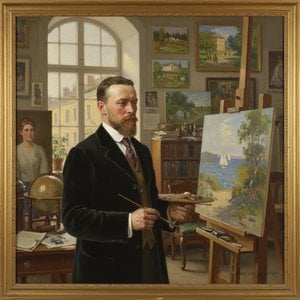
Tidigt liv, familj och utbildning
Albert Edelfelt föddes den 21 juli 1854 i Porvoo, Finland. Hans far, Carl Albert Edelfelt, var en svensktalande finländare och arkitekt, medan hans mor, Alexandra Edelfelt, föddes som Alexandra Brandt. De tidiga åren av hans liv präglades av den stillsamma omgivningen i Porvoo. Redan vid 1869 års ålder ledde hans intresse för teckning honom till den finska konstföreningens teckningsskola för att påbörja sina formella studier.
Hans utbildning sträckte sig långt utanför Finlands gränser i takt med att han sökte en bredare teknisk skolning. Mellan 1873 och 1874 tillbringade han tid vid konstakademin i Antwerpen, där han fokuserade på det historiska måleriets mekanik. Denna studietid lade grunden för hans flytt till Frankrike. År 1874 skrev han in sig vid École Nationale des Beaux-Arts i Paris. Där studerade han under Jean-Léon Gérôme, vilket förfinade hans förmåga att hantera komplexa kompositioner och de specifika kraven inom den akademiska skolningen.
Konstnärlig resa och de parisiska åren
År 1874, i nittonårsåldern, lämnade Edelfelt sitt hemland för att söka lyckan i Paris. Där delade han en liten ateljé på 24 Rue Bonaparte med en vän från Finland. Det var en anspråkslös plats, en fristad där en ung man kunde finna sin egen fot i marken långt borta från hemmet. Vid 1876 hade han flyttat till en ny ateljé på 81 boulevard du Montparnasse. Det var under dessa formativa år som han började frigöra sig från de formella begränsningar som hans tidiga utbildning inneburit, och istället fann ett helt nytt sätt att betrakta ljuset och den värld som omgav honom.
Hans liv i Paris präglades djupt av de människor han mötte i stadens ateljéer och sociala kretsar. Han knöt en nära vänskap med målaren Jules Bastien-Lepage, vars inflytande kom att forma hans sätt att närma sig duken. Han utvecklade även en vänskap med Jean-Baptiste Pasteur, son till den berömda kemisten Louis Pasteur. Dessa kontakter placerade honom mitt i ett konstnärligt landskap i snabb förändring, där fokus skiftade mot att observera livet precis som det faktiskt framträdde. År 1881 slog han sig ner i en ny ateljé på 147 avenue des Villiers, där han under det kommande decenniet fortsatte att förfina sitt konstnärliga uttryck.
Teknik och konstnärlig stil
Hans förhållningssätt till duken var djupt rotat i en naturalistisk stil, där han föredrog ett realistiskt perspektiv som strävade efter att dokumentera livet precis som det framträdde. Denna hängivelse åt observation ledde honom ofta ut i friluftsmåleriet, där han fångade det subtila sätt på vilket ljuset vilar över ett landskap eller ett motiv. I dessa stunder rörde han sig bort från de rigida, formella akademiska traditionerna från hans tidiga utbildning för att istället omfamna mer flytande, impressionistiska tekniker. Detta skifte är tydligt märkbart i hur han hanterade ljus och atmosfär i verk som The Eklöf Boys on the Veranda of Villa Sjökulla.
Han lät ofta historiens tyngd genomsyra sina motiv och använde penseln för att återge de detaljrika och påtagliga spåren av förflutna konflikter. Hans målningar skildrade ofta scener från de långa serier av krig som involverade ryssar, svenskar och finländare, där han lade stor vikt vid tidsepokens texturer och detaljer. Som en framstående gestalt inom den finska konstens guldålder använde han sin tekniska briljans för att överbrygga klyftan mellan det formella historiemåleriet och ett mer modernt, iakttagande sätt att betrakta världen på.
Framstående verk och prestationer
Med sin pensel fångade han den tysta intensiteten i vetenskapliga upptäckter och livets enklaste rörelser. År 1886 målade han Louis Pasteur dans son laboratoire de l, ett verk som med stor närvaro utforskade kemistens arbetsmiljö. Denna koppling till Pasteur-familjen fortsatte genom hans Portrait of Louis Pasteur. Dessa studier av ljus och motiv gav honom stor uppmärksamhet i Frankrike, vilket ledde till att han utnämnes till medlem av Hederslegionen år 1886. Senare, vid världsutställningen i Paris 1889, tilldelades han en guldmedalj.
Det finns en särpräglad stillhet i Boys Playing on the Shore (1884). Det förblir ett av hans mest betydelsefulla målningar, där ett ögonblick av ungdom fångas mot ett vidsträckt landskap. Hans förmåga att observera världen ledde till att han utsågs till kommissionär för det finska deltagandet vid världsutställningen i Paris 1900. Hans konstnärskap rörde sig sömlöst mellan historiemåleriets formella krav och den direkta skildringen av människor i deras naturliga miljöer.
- Louis Pasteur dans son laboratoire de l (1886)
- Boys Playing on the Shore (1884)
- Portrait of Louis Pasteur
Arv och inflytande
Albert Edelfelt var bland de första finska målarna som fann sin plats på den internationella konstscenen. Han förde med sig en känsla av finsk identitet till en bredare europeisk arena och gjorde sin hemkultur synlig långt bortom dess gränser. Hans hängivenhet till den realistiska konströrelsen i Finland bidrog till att forma hur landet såg på sig självt genom penseldragen, i en rörelse bort från idealiserade motiv mot en mer ärlig representation av livet. Detta förhållningssätt hjälpte till att förankra en nations visuella språk under en period av betydande förändring.
Hans närvaro i ateljéerna i Paris och Antwerpen satte djupa spår hos de generationer som följde honom. Yngre finska målare, däribland Akseli Gallen-Kallela och Gunnar Berndtson, blickade mot hans metoder och hans förmåga att navigera i den europeiska konstvärlden. Han hjälpte till att banat väg för dessa konstnärer genom att erbjuda en bro mellan lokala traditioner och kontinentens framväxande stilar. Hans inflytande märktes tydligt i hur de nästa generationerna närmade sig ljuset, landskapet och den mänskliga gestalten.
Inom den finska konsthistorien betraktas han ofta som den mest betydelsefulla gestalten från andra hälften av 1800-talet fram till första hälften av 1900-talet. Hans verk förblir en referenspunkt för utvecklingen av en nationell estetik. Hans förmåga att sammanväva formell akademisk skolning med observationer av vardagslivet var med och definierade den finska konstens guldålder.
Var man kan se hans verk idag
För att uppleva hans penseldrag på nära håll kan man resa till Helsingfors. Ateneum konstmuseum hyser en betydande del av hans produktion, däribland det storslagna verket från 1877, Drottning Bianca. Dessa målningar är en del av landets största samling av finsk konst. Här kan man finna hans skildringar av det lantliga livet och historiska scener, där ljuset ofta efterliknar den stillsamma atmosfär som präglar de landskap han en gång studerade så ingående.
I Paris är hans närvaro påtaglig på flera platser. Musée d'Orsay rymmer hans porträtt av Louis Pasteur från 1885, en lågmäld och koncentrerad studie av mannen i hans arbetsmiljö. I närheten finns även Musée Pasteur, som förvaltar flera av hans verk, varav många fokuserar på familjen och den vetenskapliga värld som omgav honom under hans tid i Frankrike.
- Drottning Bianca (1877)
- Louis Pasteur (1885)
Frågor och svar
I vilken stad och vilket land föddes Albert Edelfelt?
Albert Edelfelt föddes i Kiala gård, i Finland.
Under vilka andra namn är Albert Edelfelt känd?
Albert Edelfelt är även känd under namnen Edelfelt, A. G. A. Edelfelt, A. Edelfelt.
Kan jag bläddra i Albert Edelfelts verk efter stämning?
Känslomässigt rum för Albert Edelfelt är en sida där konstnärens verk är sorterade efter stämning.