

 Förhandsvisa
 Skicka
 Dela
Dela
 Visa detaljer
 Guide
Guide

 Ladda ner
 Liknande objekt
 Röntgen
 Bildspel
 Frågor och svar
 Statistik
Giusto Ferdinando Tenducci


 Visa mer
Giclée / Konsttryck
Giclée- eller canvasprint av museumskvalitet med snabb produktion och flexibla ytbehandlingsalternativ. ( Beställ handmålad reproduktion Byt till digital bild)




P118B Skr10

P118H Skr10

P118W Skr10

P438Z Skr10

P508JH Skr12

P508YH Skr12

P805H Skr10

P805Z Skr10

P919BZ Skr10

P919G Skr10

P919XJ Skr10

P959ZH Skr10

P968JZ Skr12

W106C Skr8

W218G Skr10

W218JH Skr8

W218Y Skr10

W307PJ Skr10

W316G Skr10

W316PJ Skr8

W316Y Skr10

W398PJ Skr8

W4111J Skr10

W500HY Skr15

W500JH Skr15

W692G Skr12

W849H Skr8

W940BG Skr15

W953PJ Skr8




Välj bland våra förinställda storlekar som motsvarar konstverkets ursprungliga proportioner.

Ange den bredd och höjd du behöver för att passa din ram eller vägg. Ett tryck kan endast beskäras, aldrig göras större än originalbilden, vilket innebär att ett format med en annan proportion leder till att en del av bilden går förlorad. Vi skickar en digital mockup för godkännande innan vi påbörjar tryckningen. Bilden som visas på denna sida visar inte den faktiska beskärningen — det är endast mockuppen som gör det.
Leverans över hela världen () på 2 veckor istället för standard 4/5 veckor. (6 november)

Fri expressfrakt över hela världen

Högkvalitativ linnecanvas

Fullständig fraktförsäkring

Garantier för återbetalning av tullavgifter

Garantier för exakt färgåtergivning

100 dagars returrätt (endast vid fel)

100% pengarna tillbaka-garanti

Mängdrabatt erbjuds
 Glasalternativet är endast tillgängligt i storlekar under 110 cm.

Giusto Ferdinando Tenducci
Giclée / Konsttryck
Storlek på reproduktion
-


Slutgiltigt pris
Skr 631
The Enigmatic Voice Captured – Giusto Ferdinando Tenducci
Thomas Gainsborough’s portrait of Giusto Ferdinando Tenducci, painted circa 1773-1775, is more than a simple likeness; it's a carefully constructed tableau brimming with the spirit and allure of the late 18th-century operatic world. The subject himself – a castrato opera singer renowned for his captivating voice and flamboyant personality – embodies a fascinating intersection of artistry, performance, and societal constraints. Tenducci’s stillness, captured in a moment of apparent repose, belies the vibrant energy he undoubtedly possessed on stage, suggesting a brief pause between performances or perhaps a quiet contemplation of his craft.
The painting immediately draws the eye to Tenducci's face – a study in serene composure. His eyes are closed, creating an intimate and almost melancholic effect, as if inviting the viewer into his inner world. The subtle curve of his lips hints at a gentle smile, suggesting a man accustomed to adoration and appreciative applause. Gainsborough masterfully utilizes light and shadow to sculpt Tenducci’s features, emphasizing the delicate structure of his face and the rich texture of his hair – meticulously powdered in the fashionable style of the era. The muted palette, dominated by browns, blues, and creams, contributes to a sense of understated elegance, allowing Tenducci's presence to command attention without resorting to overt display.
A Window into Georgian Society & Opera’s Rise
To fully appreciate this portrait, one must understand the context in which it was created. The 1770s marked a golden age for opera in Britain, fueled by Italian influence and a growing appetite among the aristocracy for lavish theatrical productions. Castrati singers – men who had undergone castration to preserve their vocal range and agility – were immensely popular, commanding enormous fees and attracting devoted audiences. Their voices, often described as possessing an ethereal quality, were considered uniquely beautiful and captivating.
Gainsborough’s fascination with music is evident throughout his oeuvre, and this portrait reflects a deep engagement with the cultural phenomenon of opera. He wasn't merely depicting a singer; he was capturing the essence of performance itself – the anticipation, the artistry, and the connection between performer and audience. The inclusion of the sheet music in Tenducci’s hand serves as a potent symbol of his profession, grounding the portrait within the world of musical creation.
Technique & Gainsborough's Signature Style
Gainsborough’s technique is characterized by its loose brushwork and vibrant color palette. He employed a ‘broken’ style, layering thin washes of paint to create a sense of luminosity and movement. Notice the subtle variations in tone – the delicate highlights on Tenducci’s forehead, the soft shadows that define his features, and the hazy atmosphere surrounding him. These details contribute to the painting's remarkable depth and realism.
The composition is carefully balanced, with Tenducci positioned slightly off-center, creating a sense of dynamism. Gainsborough’s use of light is particularly noteworthy – it appears to emanate from the left side of the canvas, casting gentle shadows on the right, which adds depth and drama to the scene. The artist's signature, “Gainsborough,” is discreetly placed in the lower right corner, a testament to his confidence and skill.
Symbolism & Emotional Resonance
Beyond its technical merits, this portrait resonates with profound symbolism. Tenducci’s closed eyes evoke a sense of introspection and vulnerability, suggesting that beneath the surface of performance lies a complex and perhaps melancholic soul. The sheet music represents not only his profession but also his passion and dedication to his art. The overall mood is one of quiet dignity and understated elegance – a testament to Gainsborough's ability to capture the essence of his subject with remarkable sensitivity.
This painting offers a rare glimpse into the world of Georgian opera, inviting us to contemplate the artistry, the social context, and the emotional depth of a truly exceptional performer. It’s a captivating work that continues to resonate with viewers today, reminding us of the enduring power of music and art to move and inspire.
Frågor och svar
Vad föreställer "Giusto Ferdinando Tenducci" av Thomas Gainsborough?
Teman som återfinns i "Giusto Ferdinando Tenducci" av Thomas Gainsborough inkluderar portraiture, baroque, music, seventeenth century, castrato, england, tenducci. Tillsammans sammanfattar de verkets motiv.
När skapades "Giusto Ferdinando Tenducci" och vilken stilriktning tillhör det?
"Giusto Ferdinando Tenducci" skapades år 1775 inom Rococo Painting-rörelsen.
Vilket motiv och vilken atmosfär förenar "Giusto Ferdinando Tenducci" av Thomas Gainsborough?
"Giusto Ferdinando Tenducci" av Thomas Gainsborough förenar portraiture, baroque, music, seventeenth century, castrato, england, tenducci med en Calm atmosfär.
Liknande konstverk


Konstnärsbiografi
A Suffolk Beginning: The Early Life and Artistic Awakening
The story of Thomas Gainsborough, one of Britain’s most celebrated artists, unfolds not within the confines of a grand academy or bustling metropolis, but in the tranquil market town of Sudbury, Suffolk. Born in 1727, the youngest son of John Gainsborough, a weaver and wool merchant, young Thomas displayed an innate artistic sensibility from a remarkably early age. While his siblings pursued more conventional paths, Thomas’s world rapidly became consumed by drawing and painting – miniature self-portraits and delicate landscapes blossoming from his hand even before he reached ten years old. This precocious talent wasn't merely a childhood pastime; it was the burgeoning of a vision that would reshape British art. His father, recognizing this unique gift, encouraged its development, setting young Thomas on a path diverging sharply from the family trade. The Suffolk countryside itself became his first studio, imbuing his later works with a deep and abiding love for the natural world – a characteristic that would distinguish him throughout his career. This early immersion in landscape wasn’t simply about replicating what he saw; it was about *feeling* the essence of the English countryside, an emotional resonance that would permeate his canvases for decades to come.London and the Shaping of a Style: Influences and Early Commissions
In 1740, at the age of thirteen, Gainsborough journeyed to London, embarking on formal artistic training under Hubert Gravelot, a French engraver renowned for his elegant rococo style. This exposure proved pivotal, introducing him to refined techniques and fashionable aesthetics. However, it was his association with William Hogarth and the St Martin’s Lane Academy that truly began to mold his artistic identity. Initially influenced by Hogarth's narrative approach – often depicting moral tales through crowded scenes – Gainsborough soon charted his own course, developing a distinctive style characterized by its lightness of touch, fluid brushwork, and subtle color palettes. He absorbed lessons from various masters, including the Dutch landscape painters whose atmospheric effects he admired, yet resisted strict adherence to any single school, forging a path that blended observation with imagination. Returning to Sudbury after marrying Margaret Burr in 1746, Gainsborough established himself as a portraitist for the local gentry and mercantile classes. This period honed his skills in capturing likenesses and character, but it was during his subsequent move to Ipswich, and later Bath, that he began attracting a more sophisticated clientele – individuals who appreciated not just accurate representation, but also artistic flair and emotional depth.Bath and Beyond: Portraiture, Landscape, and Royal Patronage
The years spent in Bath (1759-1774) marked a significant turning point in Gainsborough’s career. The city was a hub of fashionable society, providing him with ample opportunities to paint portraits of the wealthy and influential. He quickly gained renown for his ability to capture not only physical resemblance but also the personality and social standing of his sitters. His portraits weren't merely depictions; they were statements about identity and status. He experimented with different lighting techniques and compositions, often incorporating elements of the surrounding landscape to create a sense of depth and atmosphere. However, even amidst the demands of portraiture, Gainsborough never abandoned his passion for landscape painting. In fact, he often seamlessly integrated landscapes into his portraits, creating compositions that celebrated both human subjects and the beauty of the natural world. This innovative approach – a hallmark of his style – set him apart from many of his contemporaries. The culmination of his success came with his move to London in 1774, where he established a studio on Pall Mall and became a founding member of the Royal Academy. He also secured royal patronage, becoming a favourite painter of King George III and Queen Charlotte, further solidifying his position as one of Britain’s leading artists. *Mrs. Thomas Gainsborough*, painted in 1785, exemplifies this period – an elegant portrait showcasing rococo style and muted tones.The Development of His Unique Style
Gainsborough's artistic journey was marked by a constant evolution. Initially influenced by the precision and detail of Dutch masters like Rembrandt, he gradually developed his own distinctive style, characterized by loose brushwork, atmospheric effects, and a subtle use of color. He rejected the rigid formality of earlier portraiture, opting for a more relaxed and intimate approach that captured the essence of his subjects rather than simply their outward appearance. His landscapes were equally innovative, eschewing the meticulous detail of topographical paintings in favor of evocative scenes that conveyed mood and atmosphere. He was particularly adept at capturing the fleeting effects of light and shadow, creating a sense of immediacy and spontaneity. Gainsborough’s ability to synthesize these diverse influences – from Dutch landscape painting to French rococo portraiture – resulted in a truly original style that would have a profound impact on subsequent generations of British artists.A Legacy of Innovation: Enduring Appeal and Influence
Thomas Gainsborough died in 1788, leaving behind a body of work that continues to captivate audiences today. His influence on subsequent generations of British artists is undeniable. He liberated portraiture from rigid formality, infusing it with spontaneity and emotional resonance. His loose brushwork and atmospheric effects paved the way for the Impressionists, while his lyrical landscapes inspired artists like John Constable, who deeply admired Gainsborough’s ability to capture the spirit of the English countryside. Gainsborough's legacy extends beyond technique; it lies in his profound understanding of human character and his unwavering commitment to artistic expression. He wasn’t simply a painter of portraits or landscapes; he was a storyteller, a poet of light and color, and a visionary who transformed British art. His paintings are a testament to the power of observation, imagination, and the enduring allure of the English landscape.
Thomas Gainsborough
1727 - 1788 , Storbritannien
Kortfakta
- Artistic Movement Or Style: Rococo, Porträtt
- Artists Or Movements Influenced By This Artist:
- Constable
- Impressionister
- Artists Who Influenced This Artist:
- Gravelot
- Hogarth
- Date Of Birth: 1727
- Date Of Death: 1788
- Full Name: Thomas Gainsborough
- Nationality: Brittisk
- Notable Artworks:
- Mrs. Gainsborough
- Mr & Mrs Andrews
- Place Of Birth: Sudbury, Storbritannien
Relaterade artiklar

John Singer Sargents 25 Mästerverk: Porträtt & Impressionism för Hemmet | ArtsDot
Utforska John Singer Sargents 25 mest ikoniska målningar! Lär känna porträttkonsten, impressionismen och hans unika ljusspel. Hitta inspiration & köp högkvalitativa konsttryck på ArtsDot.com – för en elegant heminredning.

Rokokons mästerverk: Topp 10 konstverk som definierade epoken | ArtsDot.com
Upptäck rokokons 10 mest ikoniska mästerverk! Lär känna Boucher, Watteau & andra stora konstnärer. Vackra målningar fyllda av pastellfärger och elegans. Hitta din favorit – utforska hela kollektionen online på ArtsDot.com.

The Rococo Style: Aristocratic Leisure & the Pursuit of Delight in 18th-Century Art
Explore the opulent world of Rococo art! Discover Watteau, Boucher & Nattier's masterpieces. Expert insights for collectors seeking museum-quality reproductions and custom portraits at ArtsDot.

The Rococo Aesthetic: Opulence, Rebellion & the Pursuit of Pleasure in 18th-Century Art
Explore the opulent world of Rococo art! Discover its origins, key artists like Watteau & Boucher, and lasting influence on design. Expert insights for collectors & enthusiasts.
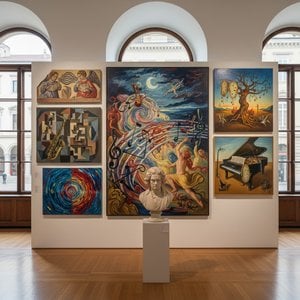
Harmonies on Canvas: Exploring the Visual Representation of Music in Art History
Explore the fascinating history of music's visual representation in art! From ancient symbolism to modern abstraction, discover how artists have captured sound and emotion on canvas. Expert insights & stunning examples.


