


 Förhandsvisa
 Skicka
 Dela
Dela
 Visa detaljer

 Ladda ner
 Liknande objekt
 Röntgen
 Bildspel
 Statistik
Extreme Unction
 Etching
- Rococo
 1755
1755- Early Modern
 57.0 x 44.0 cm
 Los Angeles County Museum of Art
 Visa mer
Handgjord oljereproduktion
Handmålad olja på duk i din valda storlek och ram, tillverkad efter beställning av våra konstnärer. ( Byt till tryck Byt till digital bild)




P118B $10

P118H $10

P118W $10

P438Z $10

P508JH $12

P508YH $12

P805H $10

P805Z $10

P919BZ $10

P919G $10

P919XJ $10

P959ZH $10

P968JZ $12

W106C $8

W218G $10

W218JH $8

W218Y $10

W307PJ $10

W316G $10

W316PJ $8

W316Y $10

W398PJ $8

W4111J $10

W500HY $15

W500JH $15

W692G $12

W849H $8

W940BG $15

W953PJ $8




Välj bland våra förinställda storlekar som motsvarar konstverkets ursprungliga proportioner.

Du kan ange egna mått för att passa en specifik ram eller yta. Om den valda storleken inte matchar originalbildens proportioner kommer vi antingen att beskära konstverket eller utöka målningen med ytterligare handmålade element. En digital skiss skickas till dig för godkännande innan produktionen påbörjas.
Observera att förhandsvisningen på skärmen inte återspeglar den faktiska beskärningen eller utökningen. Endast skissen visar den slutgiltiga kompositionen korrekt.
Även om anpassade storlekar är möjliga, rekommenderar vi att du väljer en dimension från den fördefinierade listan för att bevara originalproportionerna.
Efter beställning kommer ArtsDot.com team att mejla kunden för instruktioner och tillhandahålla en skissförhandsvisning
Leverans över hela världen () på 3–4 veckor istället för standard 5 veckor. (14 september). Inga kompromisser med kvaliteten.

Fri expressfrakt över hela världen

Högkvalitativ linnecanvas

Fullständig fraktförsäkring

Garantier för återbetalning av tullavgifter

Garantier för exakt färgåtergivning

100 dagars returrätt (endast vid defekter)

100% pengarna tillbaka-garanti

Mängdrabatt erbjuds
 Glasalternativet är endast tillgängligt i storlekar under 110 cm.

Extreme Unction
Reproduktionsmedium
Storlek på reproduktion
-


Slutgiltigt pris
$ 263
A Somber Glimpse into Venetian Devotion
In the quiet, shadowed corners of eighteenth-century Venice, life was often defined by its most profound transitions. Pietro Longhi’s 1755 etching, Extreme Unction, serves as a hauntingly beautiful window into these private moments of mortality and faith. Unlike the grand, sweeping canvases of his contemporaries that celebrated the triumphs of gods and heroes, Longhi turned his gaze toward the intimate, often heavy atmosphere of the Venetian domestic sphere. This particular work captures the solemnity of the Last Rites, a sacred ritual where a priest administers the final sacraments to the departing soul. Through the delicate medium of etching, Longhi masterfully orchestrates a scene that is as much about the presence of the divine as it is about the palpable weight of human grief.
The composition draws the viewer into a room thick with tension and reverence. At the heart of the narrative lies the bed, where the patient rests in a state of vulnerability, surrounded by the witnesses of their final journey. The priest, an elder figure draped in heavy, traditional robes, stands as the bridge between the earthly and the eternal. Longhi’s ability to render texture through fine, etched lines allows us to feel the weight of the liturgical garments and the stillness of the air. Scattered throughout the room are the humble artifacts of daily life—cups, bowls, and vases—which, in this context, take on a symbolic significance. These objects, mundane in any other setting, become silent participants in the ritual, grounding the spiritual event in the tangible reality of a Venetian household.
Mastery of Line and Emotional Resonance
Technically, this etching showcases Longhi’s profound command over light and shadow, a skill honed during his early training under Antonio Balestra. The monochromatic palette of the etching does not strip the scene of its depth; rather, it enhances the dramatic chiaroscuro effect, pulling focus to the central figures while allowing the periphery to recede into a mysterious, atmospheric gloom. The interplay of light hitting the surfaces of the ceramic bowls and the metallic glint of a cup creates a sense of three-dimensional space that invites the collector to step directly into the room. For the discerning eye, the precision of the linework reveals a master who understood that the smallest detail—the fold of a sleeve or the tilt of a head—could communicate the deepest complexities of human emotion.
For art lovers and interior designers alike, Extreme Unction offers more than just historical interest; it provides a profound emotional anchor for a curated space. The piece possesses a timeless, melancholic elegance that complements sophisticated, classical interiors. It is a work that demands contemplation, making it an ideal centerpiece for a study, a library, or a gallery wall dedicated to the mastery of printmaking. Owning a high-quality reproduction of this etching allows one to preserve the somber beauty of Longhi’s vision, bringing a sense of historical gravity and quiet, reflective grace into the modern home.
Liknande konstverk


Konstnärsbiografi
Pietro Longhi (1701-1785): A Venetian Chronicler of Daily Life
Pietro Longhi, born Pietro Falca in Venice on November 5th, 1701, wasn’t painting grand historical narratives or mythological scenes; he was capturing the quiet dramas unfolding within the city's elegant homes and bustling streets. He became renowned for his witty genre paintings – intimate glimpses into the lives of 18th-century Venetians, a departure from the prevailing artistic trends of his time. The son of Alessandro Falca, a silversmith, Longhi’s early training began under the Veronese painter Antonio Balestra, who recognized and nurtured the young artist's talent. This foundation in traditional technique would later serve as a subtle counterpoint to the innovative spirit he brought to his chosen subject matter. He adopted the surname “Longhi” upon beginning his artistic career, a symbolic shedding of his father’s trade for the pursuit of painting.Early Influences and Artistic Training
Longhi's formative years were marked by exposure to Venetian artistic traditions. His initial mentor, Antonio Balestra, instilled in him a mastery of Venetian painting techniques—broken brushwork and vibrant color glazes—a stylistic hallmark of the era. This meticulous attention to detail would become evident throughout his oeuvre, particularly in his depictions of interiors and fabrics. Recognizing Longhi’s potential, Balestra recommended him to Giuseppe Maria Crespi, a Bolognese painter who was highly regarded for both religious and genre painting. Crespi's influence encouraged Longhi to explore broader artistic horizons while retaining the core principles of Venetian art. He diligently studied Crespi’s methods, absorbing his understanding of light and color—a crucial element in achieving realism and conveying emotion. This early training solidified Longhi’s commitment to capturing the nuances of everyday life with remarkable accuracy.Religious Beginnings and Transition Towards Genre Painting
Like many artists of his time, Longhi began his artistic career with religious commissions. His 1732 altarpiece for the church of San Pellegrino exemplifies this initial phase—a testament to Balestra’s influence and demonstrating a skillful command of traditional Venetian painting techniques. The composition is carefully balanced, utilizing chiaroscuro to create dramatic depth and highlighting key figures within the scene. However, Longhi's artistic trajectory took an unexpected turn in the late 1730s. Sensing a shift in cultural sensibilities—a growing fascination with the private lives of the bourgeoisie—he deliberately moved away from grand historical narratives and embraced genre painting. This decision represented a bold departure from prevailing artistic conventions and signaled Longhi’s burgeoning independence as an artist. He began to depict scenes of Venetian society, capturing moments of domestic life, social interaction, and theatrical performance.The Venetian Hogarth: Satirical Observation and Artistic Innovation
Longhi quickly established himself as “the Venetian Hogarth,” a moniker bestowed upon him by critics who recognized his uncanny ability to infuse seemingly mundane subjects with layers of social commentary—much like William Hogarth’s unflinching depictions of London life. Unlike Hogarth's moralizing pronouncements, Longhi’s satire possessed a subtle irony and a keen awareness of human folly. His paintings are populated with masked figures – a vibrant reminder of Venice’s Carnival celebrations – engaged in various activities ranging from gambling and flirtation to clandestine meetings and dubious transactions. The Concert, for example, portrays a gathering of Venetian nobles, capturing the atmosphere of aristocratic society with meticulous detail. Longhi's masterful use of light and color—influenced by Caravaggio—further enhanced his artistic innovation, creating an illusionistic depth that captivated audiences. He wasn’t merely recording life as it was; he was offering a perceptive critique of its complexities and contradictions.Legacy and Recognition
Longhi’s oeuvre comprises approximately 150 paintings, predominantly genre scenes depicting Venetian interiors and daily life. His works are characterized by their remarkable realism—a testament to his unwavering dedication to observation and technique. He achieved considerable fame during his lifetime, earning the admiration of fellow artists and critics alike. Notably, Carlo Goldoni praised Longhi’s commitment to truth, emphasizing his ability to portray human behavior with unflinching honesty. His paintings continue to resonate with viewers today, appreciated for their charm, wit, and artistic sophistication. Longhi served as Director of the Academy of Drawing and Carving from 1763, furthering his influence within Venetian art circles and ensuring that his legacy would endure. He died peacefully in Venice on May 8th, 1785, leaving behind a body of work that remains an enduring symbol of Venetian artistic excellence—a true chronicler of the Enlightenment era.
Pietro Longhi
1701 - 1785 , Italien
Kortfakta
- Artistic Movement Or Style: Venetian painting, Rococo
- Artists Or Movements Influenced By This Artist: ['William Hogarth']
- Artists Who Influenced This Artist:
- Antonio Balestra
- Giuseppe Maria Crespi
- Date Of Birth: November 5, 1701
- Date Of Death: May 8, 1785
- Full Name: Pietro Longhi
- Nationality: Italian
- Notable Artworks:
- The Tailor
- The Baptism
- Painter in his studio
- Place Of Birth: Venice, Italy
Relaterade artiklar
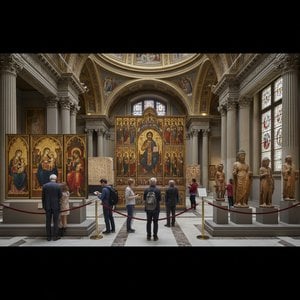
Sacred Narratives Embodied: A Comprehensive Exploration of Religious Iconography in Art History
Explore the rich history of religious iconography in art! Discover symbolism, movements & masterpieces from Byzantine to Renaissance periods. Expert insights for collectors and enthusiasts at ArtsDot.

10 Etser som Förändrade Konsthistorien – Mästverk för Ditt Hem
Utforska 10 legendariska etsningar av Rembrandt, Goya och Dürer! Lär känna historien bakom dessa mästerverk & tekniken som förändrade konsten. Köp reproduktioner av högsta kvalitet på ArtsDot.com – för en tidlös inredning.

Pietro Longhi's Venetian Scenes: A Study of Rococo Society & Domestic Life
Explore the captivating world of Pietro Longhi's Venetian scenes! Discover insightful analysis of his Rococo masterpieces & social commentary on 18th-century life. Learn about this 'Venetian Hogarth' and his lasting artistic legacy.

The Intricate World of Etching: A Historical Survey of Technique, Aesthetic Evolution, and Enduring Artistic Impact
Explore the rich history of etching, from its origins to modern practice. Discover techniques, key artists like Rembrandt, and insights for collectors. A comprehensive guide by ArtsDot.

Etching: A Historical Survey of Technique, Aesthetic Qualities & Enduring Artistic Significance
Explore the rich history of etching, from its origins to Rembrandt's masterful innovations. Discover the technique, aesthetic qualities & enduring legacy of this captivating art form. Expert insights for collectors and enthusiasts.