


The picture follows your choices: , .
Beskrivning av samlarobjekt
 Visa mer
Konstnärens biografi
A Divine Canvas</h2> Michelangelos kanske mest bestående arv ligger inom väggarna i Sixtinska kapellet. År 1508 beställde påven Julius II honom att måla kapellets tak – en uppgift som skulle konsumera fyra år av hans liv och för alltid förändra den västerländska konstens gång. Till en början motvillig
Handgjord oljereproduktion
Handmålad olja på duk i din valda storlek och ram, tillverkad efter beställning av våra konstnärer. ( Byt till tryck Byt till digital bild)
More about this painting
 Förhandsvisa
 Skicka
 Dela
Dela
 Visa detaljer
 Guide
Guide

 Ladda ner
 Liknande objekt
 Röntgen
 Bildspel
 Q&A
Q&A Statistik
Order your painting in four simple steps
Take your time. You can change any answer; the price in your order card follows each choice.
1 Step one of four
Which size would you like?
These sizes keep the proportions of the original painting. The drawing shows your choice on a wall, above a two-metre sofa.
Or give your own measurements
Välj bland våra förinställda storlekar som motsvarar konstverkets ursprungliga proportioner.

Ange den bredd och höjd du behöver för att passa din ram eller din vägg. Eftersom detta är handmålat kan konstnären, vid ett annat format, måla lite mer runt bilden eller beskära den något – det är du som väljer. Vi skickar en digital mockup för godkännande innan målningen påbörjas. Bilden som visas på denna sida representerar inte det slutgiltiga resultatet — det är endast mockuppen som visar det.
2 Step two of four
How should it be prepared: rolled, stretched or framed?
The prices below are for the size you chose in step one.
Choose the edges of the stretched canvas
Choose your frame

White Skr1

Blurside Skr1

Extended Skr1

P118B Skr10

P118H Skr10

P118W Skr10

P438Z Skr10

P508JH Skr12

P508YH Skr12

P805H Skr10

P805Z Skr10

P919BZ Skr10

P919G Skr10

P919XJ Skr10

P959ZH Skr10

P968JZ Skr12

W106C Skr8

W218G Skr10

W218JH Skr8

W218Y Skr10

W307PJ Skr10

W316G Skr10

W316PJ Skr8

W316Y Skr10

W398PJ Skr8

W4111J Skr10

W500HY Skr15

W500JH Skr15

W692G Skr12

W849H Skr8

W940BG Skr15

W953PJ Skr8

H24-GOLD Skr30

H24-SILVER Skr30

H36-GOLD Skr45

H36-SILVER Skr45
Inramad
Moulding: . Overall size with the frame: .
3 Step three of four
Would you like anything changed in the painting?
Most people answer no. Because each painting is made by hand, our artist can also adapt it for you.
After order, ArtsDot.com team will email client for instructions and provide a mockup preview
4 Step four of four
A few finishing options
All of them are optional. The answers already selected cost nothing extra.
Who paints it?
Leverans över hela världen () på 3–4 veckor istället för standard 5 veckor. (3 november). Inga kompromisser med kvaliteten.
A nameplate, as in a museum?
Detaljer för graverad bronsplatta
This elegant plaque features the artist's name and the title of the artwork, finely engraved for a timeless presentation.
It is made from bronze with a refined, elegant finish. The text is precisely laser-engraved for a sharp and permanent result. Measuring 9x2 cm, the plaque is compact yet easy to read. It's built to be durable and scratch-resistant, offering a professional, museum-quality look. Mounting is simple thanks to the included adhesive backing.
Detaljer för transparent akrylplatta
The plaque includes essential engraved details such as the artist's name, the title of the artwork, the date it was created, the type of media used-like oil on canvas or watercolor-a brief description of the piece, and a QR code that links to the complete artwork information.
It is crafted from clear acrylic, offering a sleek, modern appearance. The text is UV-engraved in black to ensure strong visual contrast. With a size of 10x15 cm, it ensures optimal readability. It comes equipped with two metal hooks for secure wall mounting. The plaque is designed to be weather-resistant, making it suitable for various environments, and it includes interactive features that work seamlessly with smartphone scanning.
Detaljer för svart akrylplatta
This elegant plaque includes engraved information such as the artist's name, the title of the artwork, the date it was created, the type of media used (like oil on canvas or watercolor), a short description of the artwork, and a QR code for quick access to more information.
The plaque itself is made from refined black acrylic with a premium finish. The text is laser-engraved in white for high contrast and readability. Its size is 10x15 cm, designed to be easy to read. It comes with two metal hooks for professional mounting. The design is sleek and fits any interior style. It is also weather-resistant and durable, with built-in digital integration for mobile compatibility.
A protective varnish?
When do you need it?
✓ Check and order
Your painting, as you ordered it

Slave (bearded)
Reproduktionsmetod
Storlek på reproduktion
-

Elitkonstnär av högsta klass
Mer detaljrikedom, finess och extra produktionstid
-

Inramning av reproduktion
-
-
För konstverk eller reproduktioner som är större än 105 cm (cirka 41 tum) på någon sida, levereras ramen som ett isärplockat kit. Denna metod säkerställer en trygg leverans och förhindrar skador under transport.
Professionell montering krävs – detta är inte en produkt för självmontering.
Kitet måste monteras och duken spännas av en erfaren professionell inramare med hjälp av trälim (ingår ej), en spänntång för duk och klämmor för att hålla sargen rak medan limmet torkar. Felaktig montering eller ojämn spänning av duken kan orsaka permanenta skador på konstverket och täcks
 För konstverk eller reproduktioner som är större än 105 cm (cirka 41 tum) på någon sida, levereras ramen som ett isärplockat kit. Denna metod säkerställer en trygg leverans och förhindrar skador under transport.
Alla massiva träribbor ingår, exakt tillkapade efter mått.
Monteras med de medföljande skruvarna, samt trälim för hörnfogarna, vilket inte ingår och måste anskaffas av din ramverkare.
Professionella verktyg krävs och ingår ej: en dukspännare och klämmor för att hålla listerna raka medan limmet torkar.
Viktigt:
Hörnjunctionerna kräver trälim, listerna måste hållas på plats med tvingar tills limmet har torkat helt, och för att spänna duken på den monterade ramen krävs en spänntång för duk. Inget av detta ingår i kitet. Vänligen kontakta en erfaren professionell rammakare innan du beställer denna storlek.

Namnskylt
-
-

Skyddande fernissa
Glansig fernissa (förstärker färgerna, skyddar mot ljus och fukt)
-

Anpassa mitt konstverk
Exempel på vad som kan ändras: Byt ut ansiktet mot ett foto från kunden; Lägg till ett husdjur (t.ex. byt ut en katt mot en hund); Inkludera ett dolt meddelande i bakgrunden; Ändra bakgrundens landskap eller detaljer.
-

Expressleverans
Leverans över hela världen () inom 3–4 veckor istället för standardiserade 5 veckor. (3 november). Inga kompromisser med kvaliteten.
-
Expressleverans
Leverans över hela världen () inom 5 veckor. (10 november).
Ingår
Slutgiltigt pris
Skr 2640
Glasalternativet är endast tillgängligt i storlekar under 110 cm.
Included with every order
- Fri expressfrakt över hela världen
- Högkvalitativ linnecanvas
- Fullständig fraktförsäkring
- Garantier för återbetalning av tullavgifter
- Garantier för exakt färgåtergivning
- 100 dagars returrätt (endast vid fel)
- 100% pengarna tillbaka-garanti
- Mängdrabatt erbjuds


The Silent Strength of Stone: Michelangelo’s ‘Slave’
Michelangelo Buonarroti's “Slave (bearded),” conceived in 1519, is more than just a sculpture; it’s an embodiment of the anxieties and aspirations swirling within the heart of the High Renaissance. This remarkable piece, captured in stark black and white photography, offers a poignant glimpse into the artist’s profound exploration of human potential – both its glorious heights and its inherent vulnerability. The photograph itself, with its dramatic lighting emphasizing the texture of the marble, immediately draws us close, inviting an intimate encounter with this figure frozen in contemplation.
The sculpture, believed to be a study for one of the unfinished slaves intended for Pope Julius II’s tomb, is a testament to Michelangelo's mastery of anatomical realism and expressive power. The subject, seated upon a simple pedestal, possesses a quiet dignity that belies his unfinished state. His posture – slightly slumped, head bowed – speaks volumes about the weight of existence, the burdens of labor, and perhaps even the melancholy inherent in contemplating mortality. Notice particularly the detail of the beard; it’s not merely decorative but adds an element of profound realism, grounding the figure in a tangible human experience.
A Study in Form and Emotion
Michelangelo's technique is breathtakingly evident in every curve and contour of this marble figure. He employed a subtractive method, meticulously carving away excess material to reveal the underlying form with astonishing precision. The surface is polished to a luminous sheen, reflecting light and creating an illusion of depth and volume. The contrapposto stance – where the weight is shifted onto one leg – is flawlessly executed, demonstrating his deep understanding of human anatomy and movement. But it’s not just technical skill that defines this work; Michelangelo infused the sculpture with a palpable sense of emotion. The subtle furrowing of the brow, the downward gaze, all contribute to an atmosphere of quiet sorrow and introspective thought.
The choice of depicting a ‘slave,’ even in a preparatory study, is deeply significant within its historical context. Renaissance Italy was rife with social inequality, and the concept of slavery – though often shrouded in euphemisms – was a pervasive reality. Michelangelo’s depiction isn't a glorification of bondage; rather, it’s a meditation on human dignity stripped bare. The figure embodies the potential for greatness that exists within every individual, regardless of circumstance. He is not defined by his servitude but by his inherent humanity.
Symbolism and the Unfinished Ideal
The unfinished nature of “Slave (bearded)” adds another layer of complexity to its interpretation. Michelangelo rarely completed works to his own satisfaction, often leaving them as studies or prototypes. This is particularly evident in the numerous slaves he conceived for the tomb project – figures that were ultimately abandoned due to financial constraints and papal interference. The unfinished state serves as a powerful symbol of unrealized potential, of dreams deferred, and perhaps even of the artist’s own frustrations with the limitations imposed upon him.
Furthermore, the figure's seated position suggests a contemplative role – a being engaged in internal reflection rather than external action. This aligns with Renaissance ideals of humanism, which emphasized the importance of reason, intellect, and moral virtue. The ‘Slave’ becomes a representation of the soul striving for enlightenment, wrestling with its own limitations while retaining an unwavering capacity for dignity and grace.
Bringing Michelangelo to Your Space
ArtsDot offers meticulously crafted hand-painted reproductions of “Slave (bearded),” allowing you to experience the profound beauty and emotional resonance of this iconic sculpture in your own home or office. Our artists replicate Michelangelo’s masterful technique with unparalleled attention to detail, capturing the nuances of light, texture, and expression that make this work so captivating. Whether you are an art enthusiast, a collector seeking to expand your collection, or an interior designer looking for a statement piece, our reproductions provide a faithful representation of this timeless masterpiece – a silent testament to human strength, vulnerability, and enduring artistic genius.
Frågor och svar
Vilket stämningsläge uttrycker "Slave (bearded)" av Michelangelo Buonarroti inom High Renaissance?
Den Melancholic känslan i "Slave (bearded)" ackompanjeras av dess High Renaissance-stil.
Var kan jag hitta konstverk som liknar "Slave (bearded)" av Michelangelo Buonarroti?
Sidan Liknande verk för "Slave (bearded)" av Michelangelo Buonarroti visar liknande konstverk.
Vilken period av Michelangelo Buonarrotis karriär tillhör "Slave (bearded)"?
Inom Michelangelo Buonarrotis karriär tillhör "Slave (bearded)" perioden Mature Period. Denna fas underlättar jämförelser med konstnärens övriga verk.
Liknande konstverk


Michelangelo Buonarroti
1475 - 1564, Italien
Konstnärsbiografi
En Renässans Smidd i Sten och Färg
Michelangelo Buonarroti, ett namn som är synonymt med Högrenässansen, ekar genom århundradena som ett bevis på den mänskliga konstnärliga potentialen. Född den 6 mars 1475 i Caprese Michelangelo, inbäddad i de toskanska kullarna i Italien, var hans liv en extraordinär samverkan av talang, ambition och gudomlig inspiration. Trots initialt motstånd från sin far mot en konstnärlig bana visade den unge Michelangelos inneboende teckningsgåva sig oemotståndlig och satte honom på en kurs för att omdefiniera skulpturens, måleriet och arkitekturens gränser. Hans tidiga lärlingsutbildning under Domenico Ghirlandaio gav grundläggande färdigheter i fresk- och ritsteknik, men det var inom Medici-trädgårdarna – en fristad för klassisk antik – som hans konstnärliga själ verkligen vaknade. Fördjupad i studiet av grekiska och romerska skulpturer absorberade Michelangelo principerna för anatomi, proportioner och idealiserad skönhet som skulle bli kännetecknen på hans stil. Denna formativa period var inte bara teknisk träning; det var en filosofisk fördjupning i de humanistiska idealen som blomstrade under renässansen, ett fokus på mänsklig värdighet och potential som djupt formade hans konstnärliga vision.Från Pietàs Sorg till Davids Styrka
Michelangelos uppgång i konstvärlden var anmärkningsvärt snabb. Redan 1496 hade han rest till Rom, där han mottog sitt första stora uppdrag: skulpturen *Pietà*. Fullbordad 1499 för kardinal Jean de Bilhères, blev detta hisnande marmörmästerverk – nu inhyst i Peterskyrkan – omedelbart etablerat Michelangelo som en skulptör av oöverträffad skicklighet och emotionell djup. Den stilla skönheten och den gripande sorgen fångad i Marias ansikte när hon håller Kristi kropp var revolutionerande, vilket visade en förmåga att ingjuta kall sten med djupa mänskliga känslor. Denna tidiga framgång banade väg för hans nästa monumentala uppdrag: *David*. Huggen mellan 1501 och 1504 ur ett enda block av Carraramarmor blev den över sjutton fot höga statyn en symbol för Florentinska republikanska ideal – en trotsig förkroppsligande av styrka, mod och medborgerlig dygd. Den anatomiska precisionen, den dynamiska poseringen och den psykologiska intensiteten i *David* var utan motstycke, vilket befäste Michelangelos rykte som en mästerskulptör kapabel att väcka sten till liv. Det var inte bara skalan som imponerade; det var den påtagliga känslan av innesluten energi, förväntan på handling fryst i marmor, som fascinerade åskådarna då och fortsätter att göra så idag.Sixtinska Kapellet: En Gudomlig Duk
Kanske Michelangelos mest bestående arv ligger inom väggarna i Sixtinska kapellet. År 1508 gav påven Julius II honom i uppdrag att måla kapellets tak – en uppgift som skulle konsumera fyra år av hans liv och för alltid förändra den västerländska konstens gång. Till en början motvillig, eftersom han betraktade sig främst som skulptör, accepterade Michelangelo ändå utmaningen och gav sig in i en monumental freskcykel som skildrar scener från Genesis. Han arbetade under stränga förhållanden, ofta liggande på rygg i timmar, och målade över 300 figurer med hisnande detaljrikedom och kompositionell briljans. *Adams skapelse*, kanske den mest ikoniska bilden från kapellets tak, fångar den gudomliga gnistan som passerar mellan Gud och mänskligheten – en kraftfull symbol för skapelsen och potentialen. Bortom denna berömda panel är hela cykeln ett bevis på Michelangelos berättarkraft, hans behärskning av anatomi och hans förmåga att förmedla komplexa teologiska begrepp genom visuell storytelling. Samtidigt började han arbeta med påven Julius II:s grav – ett ambitiöst projekt som skulle förbli ofullbordat i sin ursprungliga storslagenhet, men ändå gav kraftfulla skulpturer som *Moses*.Arkitektur, Manierismen och Ett Bestående Inflytande
Under de senare åren av sitt liv sträckte sig Michelangelos talanger till arkitekturen. År 1520 blev han arkitekt för Peterskyrkan i Rom och förändrade Bramantes ursprungliga design väsentligt med en mer imponerande och strukturellt sund plan. Denna övergång markerade ett skifte mot manierismen – en stil som kännetecknas av förlängda former, överdrivna poser och dramatiska kompositioner. Denna stilistiska utveckling är tydligt synlig i *Den sista domen*, målad på altarväggen i Sixtinska kapellet mellan 1536 och 1541. Fresken skildrar Kristi återkomst med en överväldigande känsla av drama och emotionell intensitet, vilket återspeglar ett mer turbulent andligt klimat. Michelangelos inflytande sträckte sig långt bortom hans egen livstid. Han påverkade djupt både Högrenässansens och manierismens konstnärliga rörelser och inspirerade generationer av artister med sin anatomiska precision, dynamiska kompositioner och djupa utforskning av den mänskliga existensen.Ett Arv Etsat i Tiden
Michelangelo dog den 18 februari 1564 i Rom och lämnade efter sig ett oöverträffat verk som fortsätter att fängsla och inspirera. Han förblir en tornfigur inom konsthistorien – den arketypiska ”renässansmannen” – vars skulpturer, målningar och arkitektoniska konstruktioner har format vår förståelse av skönhet, makt och mänsklig potential. Hans arv är inte bara ett av konstnärliga bedrifter; det är ett bevis på den bestående kraften i kreativitet, hängivenhet och det obevekliga sökandet efter perfektion. Han demonstrerade att konsten kunde transcendera ren representation och bli ett verktyg för djup andlig och emotionell uttrycksfullhet. Ekon av hans geni resonerar i museer och kyrkor runt om i världen, vilket säkerställer att Michelangelo Buonarroti för alltid kommer att minnas som en av de största konstnärerna som någonsin levt.- Influenser: Klassisk Antiken (grekisk & romersk skulptur), Renässansens Humanism, Florentinsk konsttradition (Donatello, Masaccio).
- Nyckelverk: *Pietà*, *David*, Sixtinska kapellets takfresker (*Adams skapelse*), *Den sista domen*, Julius II:s grav.
- Konstnärlig stil: Initialt Klassisk Idealism, utvecklas mot en dynamisk och uttrycksfull Manierism.


Relaterade artiklar

Bronsålderns Mästerverk: 10 Skulpturer Som Förändrade Konsthistorien | ArtsDot
Upptäck 10 legendariska brons skulpturer som revolutionerade konsthistorien! Lär känna Rodin, Michelangelo och andra mästare. Köp museumkvalitativa repliker & hitta inspiration för din inredning på ArtsDot.com.

Michelangelos 25 Mästerverk: Konsthistoriens Största Skönheter – ArtsDot
Utforska Michelangelos 25 mest ikoniska konstverk – från Pietà till Sixtinska kapellet. Lär känna renässansens mästare och hans tidlösa skulpturer & målningar. Köp museumkvalitativa reproduktioner på ArtsDot.com.
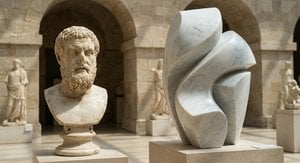
The Enduring Allure of Marble in Art History: From Classical Sculpture to Modern Abstraction
Explore the captivating history of marble sculpture from ancient Greece to modern art. Discover renowned artists like Canova & Michelangelo, carving techniques, and investment insights at ArtsDot.