


 Visa i rummet
 Skicka
 Dela
Dela
 Detaljer
 Studentguide för konstverk

 Ladda ner
 Liknande objekt
 Röntgen
 Bildspel
 Besökstatistik
From Total Space
 Painting
- Neo-Constructivist abstraction
 50.0 x 73.0 cm
 Fondazione Cariplo
 Läs mer
Konstverket som visas på denna sida skyddas av upphovsrättslagen, vilket innebär att vi inte lagligt kan skapa eller sälja en identisk reproduktion. Detta skydd upprätthålls genom internationella avtal såsom den Bernkonventionen och genom nationella lagar, inklusive de som fastställs av Amerikansk upphovsrättslag – Titel 17. Alla rättigheter förbehållna. Återgivning av konstverk är förbjuden utan skriftligt tillstånd från WahooArt.
Denna metod följer fullt ut upphovsrättsliga regler eftersom den inte innebär kopiering eller duplicering av det skyddade konstverket. Istället är det en kreativ nytolkning – en ny målning som är influerad av originalet men inte identisk med det.
Giclée / Konsttryck
Giclée- eller canvasprint av museumskvalitet med snabb produktion och flexibla ytbehandlingsalternativ. ( Köp handmålat konstverk Byt till digital bildförsäljning)




P118B Skr10

P118H Skr10

P118W Skr10

P438Z Skr10

P508JH Skr12

P508YH Skr12

P805H Skr10

P805Z Skr10

P919BZ Skr10

P919G Skr10

P919XJ Skr10

P959ZH Skr10

P968JZ Skr12

W106C Skr8

W218G Skr10

W218JH Skr8

W218Y Skr10

W307PJ Skr10

W316G Skr10

W316PJ Skr8

W316Y Skr10

W398PJ Skr8

W4111J Skr10

W500HY Skr15

W500JH Skr15

W692G Skr12

W849H Skr8

W940BG Skr15

W953PJ Skr8




Välj bland våra förinställda storlekar som motsvarar konstverkets ursprungliga proportioner.

Ange den bredd och höjd du behöver, för att passa din ram eller din vägg. Ett tryck kan endast beskäras, aldrig göras större än bilden, vilket innebär att ett format med en annan formform leder till att en del av bilden går förlorad. Vi skickar en digital mockup för godkännande innan vi trycker något. Bilden som visas på denna sida visar inte den faktiska beskärningen — det är endast mockuppen som gör det.
Leverans över hela världen () på 2 veckor istället för standard 4/5 veckor. (22 oktober)

Fri expressfrakt över hela världen

Högkvalitativ linnecanvas

Fullständig fraktförsäkring

Garantier för återbetalning av tullavgifter

Garantier för exakt färgåtergivning

100 dagars returrätt vid fabrikationsfel

100% pengarna tillbaka-garanti

Mängdrabatt erbjuds
 Glasalternativet är endast tillgängligt i storlekar under 110 cm.

From Total Space
Giclée / Konsttryck
Reproduktionsstorlek
-


Totalpris
Skr 614
The Architecture of Space-Time
Mario Nigro’s From Total Space is not merely a painting; it is an intellectual proposition rendered in pigment and line. Created during the pivotal years between 1953 and 1954, this work stands as a monumental testament to Nigro's decade-long investigation into the very nature of pictorial space. The surface itself seems to vibrate with contained energy, rejecting the illusionistic depth of traditional art in favor of a more rigorous, conceptual reality. Observe how the canvas is crisscrossed by superimposed grids of vibrant yellow lines. These are not decorative flourishes; they are structural vectors, forming intricate trapezoidal planes that challenge the viewer's perception of flatness.
A Dialogue with Modern Physics and Art History
To understand this piece is to trace a lineage through some of the most revolutionary ideas in 20th-century thought. Nigro’s ambition was audacious: to transform the two-dimensional plane into what he conceived as a total space—a visual representation echoing the concept of space-time that dominates modern astrophysics. His artistic vocabulary was deeply informed by giants such as Giacomo Balla, whose Futurist explorations resonated with his own trajectory, and Piet Mondrian’s structural purity. Furthermore, the echoes of Kazimir Malevich suggest a shared commitment to abstraction's purest forms. This Neo-Constructivist approach, nurtured within the Milanese Movimento d’Arte Concreta, demanded that art return to its elemental syntax: line, surface, and color.
Textural Resonance and Color Theory
While the conceptual framework is highly academic, the immediate visual impact is one of vibrant, almost tactile energy. The photo description reveals a fascinating interplay between this geometric abstraction and what appears to be a woven textile quality—a suggestion of fabric patterned with small squares, rectangles, and circles in shades of yellow, orange, green, and blue. This duality is key: Nigro uses the rigid logic of grids to suggest something organic, like draped cloth or an infinitely complex weave. The interplay between the sharp, intellectual lines and the warm, earthy tones creates a dynamic tension, inviting the eye to wander across its patterned surface as if tracing the threads of existence itself.
Emotional Impact and Interior Integration
For the collector or designer, From Total Space offers more than just decoration; it offers conversation. It is a piece that demands contemplation, grounding any room in an atmosphere of sophisticated intellectualism. The predominant yellow and orange hues inject immediate warmth and optimism, while the underlying structure provides necessary visual anchor points. Reproducing this work allows one to bring into a living space not just color, but a dialogue between art, science, and pure form—a vibrant echo of modern thought captured forever on canvas.
Frågor och svar
Vilka är måtten på originalet av "From Total Space"?
Originalet av "From Total Space" av Mario Nigro mäter 50 x 73 cm.
Vilken kontrastnivå uppvisar "From Total Space" av Mario Nigro?
Kontrastnivån i "From Total Space" av Mario Nigro är Gentle.
Vilken konstnär och vilken stil ligger bakom "From Total Space"?
Bakom "From Total Space" står Mario Nigro och Neo-Constructivist abstraction-rörelsen.
Liknande konstverk


Om konstnären
Mario Nigro: A Pioneer of Italian Abstract Art
Born in Pistoia, Italy, in 1917, Mario Nigro’s artistic journey was a fascinating blend of scientific rigor and passionate creativity. His early life, shaped by his father's profession as a mathematics professor, instilled within him a deep appreciation for order and structure – qualities that would profoundly influence his later work in abstract art. While initially pursuing studies in chemistry and pharmacology at the University of Pisa, Nigro’s true calling lay in music and painting, disciplines he pursued with unwavering dedication, often finding parallels between the rhythms of musical composition and the dynamic relationships within visual form.
Nigro's artistic evolution began with a period influenced by post-Cubist movements. However, he quickly moved beyond these precedents, embracing abstraction and joining the influential “Movimento Arte Concreta” (Concrete Art Movement) in the late 1940s. This pivotal association exposed him to a diverse range of artistic styles and approaches, fostering his unique vision – one characterized by a distinctive synthesis of geometric shapes, vibrant colors, and an underlying sense of spontaneity. His relocation to Milan in 1949 marked a crucial turning point, providing access to a thriving artistic community and the opportunity to establish himself as a significant figure within Italian modernism.
The Development of “Total Space” and its Theoretical Underpinnings
Nigro’s most enduring contribution to the art world lies in his groundbreaking concept of “Total Space,” developed throughout the mid-1950s. This theoretical framework, meticulously documented in a series of essays, sought to redefine the relationship between painting, space, and perception. He believed that art should transcend the limitations of the canvas, creating an immersive experience for the viewer – a ‘total’ space where form, color, and rhythm converged. Nigro envisioned this space as dynamic and ever-changing, mirroring the complexities of musical composition. This wasn't merely about depicting objects; it was about constructing a new reality through visual elements.
The “Spazio totale” series, born from these theoretical explorations, became the cornerstone of his artistic output. These works are characterized by their intricate geometric arrangements and bold color palettes, often employing techniques like oil on canvas to achieve remarkable depth and luminosity. Crucially, Nigro’s approach wasn't simply about applying colors; he meticulously calculated their relationships, striving for a harmonious balance that evoked specific emotional responses in the viewer. The influence of his scientific background is palpable here – a desire to impose order and logic onto the realm of artistic expression.
Notable Works and Recognition
Several works stand out as particularly significant examples of Nigro’s artistic vision. “Composizione” (Composition), created in 1950, exemplifies his mastery of abstract form and color, showcasing a dynamic interplay between geometric shapes and vibrant hues. His “Ritmi continui simultanei” (Continuous Simultaneous Rhythms) and “Pannelli a scacchi” (Chequered Panels) series further demonstrated his ability to translate musical concepts into visual terms, creating works that pulsate with energy and movement. These pieces were not static images but rather representations of ongoing processes – echoes of the rhythms he sought to capture in music.
Nigro’s work gained international recognition throughout the 1950s and 60s. He participated in the prestigious Salon des Réalités Nouvelles in Paris in 1951, a key event for showcasing emerging abstract artists. His invitation to the 32nd Venice Biennale in 1964, facilitated by the influential Lucio Fontana, cemented his position as a leading figure in Italian abstract art. In 1968, he was granted a solo room at the Biennale, a testament to his enduring influence and artistic merit. His work is now held in prominent collections including the Galleria Nazionale d’Arte Moderna e Contemporanea in Rome and the Museo di Arte Moderna e Contemporanea in Rome.
Legacy and Historical Significance
Mario Nigro's legacy extends far beyond his individual creations. He played a crucial role in shaping the development of abstract art in Italy, particularly within the context of Concrete Art and later, Informel. His theoretical explorations of “Total Space” offered a new framework for understanding the relationship between art and space, influencing generations of artists. His work continues to be studied and appreciated for its innovative approach to form, color, and composition – a testament to his enduring vision and artistic genius.
Nigro’s life and career represent a remarkable convergence of intellectual curiosity, artistic passion, and unwavering dedication. He was not simply an artist; he was a theorist, a scientist, and a visionary who profoundly impacted the landscape of 20th-century art.

Mario Nigro
1917 - 1992 , Italy
Snabbfakta
- Full Name: Mario Nigro
- Nationality: Italian
- Date Of Birth: 1917
- Date Of Death: 1992
- Place Of Birth: Pistoia, Italy
- Notable Artworks:
- Composizione
- Spazio totale
- Artistic Movement Or Style: Abstract art, Concrete Art
- Artists Who Influenced This Artist: ['Post-Cubist movements']
- Artists Or Movements Influenced By This Artist: ['Lucio Fontana']
Relaterade artiklar

Kandinskys 25 Mästerverk: En Färgstark Resa i Abstrakt Konst | ArtsDot
Utforska Wassily Kandinskys 25 mest ikoniska verk – från expressionism till abstrakt konst. Lär känna historien bakom mästerverken och hitta inspiration för din heminredning med ArtsDot.com. Upptäck hela samlingen online!

Geometrisk Abstraktion: Topp 10 Mästverk som Formade Konsten | ArtsDot.com
Utforska de 10 mästerverk som definierade geometrisk abstraktion! Lär känna Mondrian, Kandinsky & Malevich. Hitta inspiration och museumskvalitativa konsttryck för ditt hem på ArtsDot.com. Upptäck hela samlingen online!
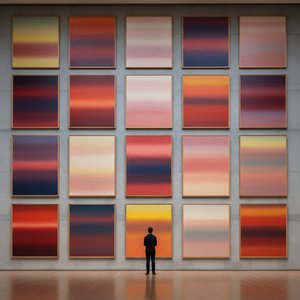
Mark Rothkos 25 Mästerverk: Djupdykning i Färg och Existens | ArtsDot
Utforska Mark Rothkos 25 mest ikoniska målningar – en djupdykning i abstrakt expressionism och färgfältets psykologi. Upptäck historien bakom varje mästerverk och hitta inspiration till ditt hem med ArtsDot.coms exklusiva konsttryck.

Topp 10 mästerverk inom abstrakt expressionism – konst för ditt hem | ArtsDot.com
Utforska de 10 mest inflytelserika verken inom abstrakt expressionism – från Rothkos färgfält till Pollocks action painting. Lär känna konstnärerna och deras teknik. Hitta museumskvalitativa tryck på ArtsDot.com och förvandla ditt hem med tidlös konst!

Abstrakt konst i trånga utrymmen: Strategier för att maximera visuellt intryck utan överväldigande effekt
Lär dig hur du framgångsrikt integrerar abstrakt konst i små utrymmen! Expertguider om färgval, placering och belysning för att maximera visuellt intryck utan att överväldiga. Skapa ett harmoniskt hem med stil.