


 Visa i rummet
 Skicka
 Dela
Dela
 Detaljer
 Studentguide för konstverk

 Ladda ner
 Liknande objekt
 Röntgen
 Bildspel
 Besökstatistik
A la manera de Delvaux


 Läs mer
Konstverket som visas på denna sida skyddas av upphovsrättslagen, vilket innebär att vi inte lagligt kan skapa eller sälja en identisk reproduktion. Detta skydd upprätthålls genom internationella avtal såsom den Bernkonventionen och genom nationella lagar, inklusive de som fastställs av Amerikansk upphovsrättslag – Titel 17. Alla rättigheter förbehållna. Återgivning av konstverk är förbjuden utan skriftligt tillstånd från WahooArt.
Denna metod följer fullt ut upphovsrättsliga regler eftersom den inte innebär kopiering eller duplicering av det skyddade konstverket. Istället är det en kreativ nytolkning – en ny målning som är influerad av originalet men inte identisk med det.
Giclée / Konsttryck
Giclée- eller canvasprint av museumskvalitet med snabb produktion och flexibla ytbehandlingsalternativ. ( Köp handmålat konstverk Byt till digital bildförsäljning)




P118B Skr10

P118H Skr10

P118W Skr10

P438Z Skr10

P508JH Skr12

P508YH Skr12

P805H Skr10

P805Z Skr10

P919BZ Skr10

P919G Skr10

P919XJ Skr10

P959ZH Skr10

P968JZ Skr12

W106C Skr8

W218G Skr10

W218JH Skr8

W218Y Skr10

W307PJ Skr10

W316G Skr10

W316PJ Skr8

W316Y Skr10

W398PJ Skr8

W4111J Skr10

W500HY Skr15

W500JH Skr15

W692G Skr12

W849H Skr8

W940BG Skr15

W953PJ Skr8




Välj bland våra förinställda storlekar som motsvarar konstverkets ursprungliga proportioner.

Ange den bredd och höjd du behöver, för att passa din ram eller din vägg. Ett tryck kan endast beskäras, aldrig göras större än bilden, vilket innebär att ett format med en annan formform leder till att en del av bilden går förlorad. Vi skickar en digital mockup för godkännande innan vi trycker något. Bilden som visas på denna sida visar inte den faktiska beskärningen — det är endast mockuppen som gör det.
Leverans över hela världen () på 2 veckor istället för standard 4/5 veckor. (25 oktober)

Fri expressfrakt över hela världen

Högkvalitativ linnecanvas

Fullständig fraktförsäkring

Garantier för återbetalning av tullavgifter

Garantier för exakt färgåtergivning

100 dagars returrätt vid fabrikationsfel

100% pengarna tillbaka-garanti

Mängdrabatt erbjuds
 Glasalternativet är endast tillgängligt i storlekar under 110 cm.

A la manera de Delvaux
Giclée / Konsttryck
Reproduktionsstorlek
-


Totalpris
Skr 614
A Whisper of Delvaux: Duchamp’s Enigmatic Reverie
Marcel Duchamp's *A la manera de Delvaux* (In the Manner of Delvaux) is not a painting in the traditional sense, but rather a meticulously constructed collage that operates as a fascinating echo of Surrealist painter Paul Delvaux. Created in 1942, this work exists as a subtle yet potent exploration of desire, memory, and the unsettling beauty found within the subconscious. It’s a piece born from exile and artistic questioning, reflecting Duchamp's evolving stance towards representation and the very definition of art itself.
The image centers around a poignant scene: a baby, seemingly nursing from a bottle held by a maternal figure. This intimate act is framed within a larger composition populated by shadowy figures, hinting at a narrative that remains tantalizingly out of reach. The sepia tone imbues the work with a nostalgic quality, evoking faded photographs and half-remembered dreams. Duchamp doesn’t attempt to replicate Delvaux's style directly; instead, he *interprets* it, distilling its essence into a fragmented visual poem. He achieves this through the skillful juxtaposition of found imagery – likely cut from magazines or other printed sources – creating a dreamlike atmosphere that is both alluring and disquieting.
The Shadow of Surrealism and Duchamp’s Conceptual Shift
To understand *A la manera de Delvaux*, one must consider the artistic climate of the time. Duchamp had already shaken the foundations of the art world with his “readymades” – ordinary manufactured objects elevated to the status of art through sheer force of conceptual intent, most famously exemplified by *Fountain* (1917). By 1942, he was living in New York, having fled Europe during World War II. He found himself amidst a burgeoning Surrealist movement, and while not fully embracing its tenets, he engaged with its ideas about the unconscious mind and the power of irrationality. Delvaux’s paintings, with their eerie depictions of classical architecture populated by nude figures and trains, provided a particularly resonant visual language for Duchamp to explore.
However, *A la manera de Delvaux* isn't merely an homage; it’s a subtle critique. Duchamp wasn’t interested in simply mimicking another artist’s style. He was probing the nature of representation itself. By creating a work “in the manner of” Delvaux, he highlights the act of imitation and questions originality. The collage format further emphasizes this deconstruction, breaking down images into their constituent parts and reassembling them to create something new – or rather, something that *comments* on what already exists. It’s a precursor to his later, more ambitious conceptual works, like *Étant donnés*, where the viewer is confronted with a hidden world revealed through a peephole.
Emotional Resonance and Interior Spaces
The emotional impact of *A la manera de Delvaux* is subtle but profound. The image evokes feelings of longing, vulnerability, and perhaps even a touch of melancholy. The nursing baby, a universal symbol of innocence and dependence, is rendered with a delicate ambiguity. Is it a scene of comfort or one of quiet desperation? The shadowy figures surrounding the central subject add to this sense of unease, suggesting hidden anxieties and unspoken desires.
For collectors and interior designers, a reproduction of *A la manera de Delvaux* offers a unique opportunity to introduce a touch of intellectual sophistication into any space. Its muted tones and enigmatic imagery lend themselves well to a variety of settings, from modern lofts to classic libraries. The work’s conceptual depth invites contemplation, making it a conversation starter and a testament to the power of art to challenge our perceptions. It is not simply a decorative piece; it's an invitation to delve into the complexities of the human psyche and the ever-evolving nature of artistic expression.
Frågor och svar
Finns det ett bildspel för "A la manera de Delvaux" av Marcel Duchamp?
"A la manera de Delvaux" av Marcel Duchamp kan visas som ett bildspel på verkets Bildspel-sida.
Vilken teknik och stil kännetecknar "A la manera de Delvaux" av Marcel Duchamp?
"A la manera de Delvaux" av Marcel Duchamp förenar tekniken Acrylic On Canvas med stilen Surrealist Collage. Teknik och epok beskriver verkets utförande och stilistiska uttryck.
Vem har skapat "A la manera de Delvaux" och i vilken stil är den utförd?
"A la manera de Delvaux" skapades av Marcel Duchamp i Surrealist Collage-stil. Konstnären och stilen definierar verkets tradition.
Liknande konstverk


![Genre Allegory [george Washington] — Marcel Duchamp, Surrealism](/media/artworks/images-thumb/90/d9/90d9ce324280fe5002abd42626b6c52f.jpg)


Om konstnären
En revolutionär anda: Marcel Duchamps liv och konst
Marcel Duchamp, född Henri-Robert-Marcel Duchamp 1887 i Blainville-Crevon, Normandie, var mer än bara en konstnär; han var en filosofisk provokatör som fundamentalt förändrade den moderna konstens kurs. Hans tidiga liv, även om det verkade konventionellt – uppfostrad inom en familj som värderade konstnärligt uttryck med båda bröderna med framgångsrika karriärer som konstnärer – antydde den ikonoklasm som skulle komma. Duchamp sökte initialt formell utbildning, bemästrade traditionella tekniker och experimenterade med postimpressionistiska stilar. Denna akademiska grund fungerade dock inte som ett mål i sig, utan som en språngbräda för att ifrågasätta själva konstens natur, dess syfte och dess definition. Han var inte nöjd med att bara avbilda världen; han strävade efter att utmana hur vi uppfattar den och vad som utgör ett konstnärligt värde. Denna rastlösa intellektuella nyfikenhet skulle bli det definierande kännetecknet för hans produktiva karriär.Från kubism till dadaism: Ett avståndstagande från konventionerna
Duchamps konstnärliga resa präglades av en ständig evolution, ett medvetet borttagande av etablerade normer. Hans tidiga engagemang i kubismen, tydligt i verk som Porträtt av schackspelare (1ansi), uppvisade ett intresse för fragmenterade former och multipla perspektiv – ett brott mot traditionell representation. Ändå rörde han sig snabbt bortom rent estetiska frågor, då han insåg att det inte räckte med att bara arrangera om visuella element för att adressera de djupare frågor som bubblade inom honom. Förfärdelserna under första världskriget gav näring åt detta missnöje och ledde Duchamp till att omfamna dadaismen, en rörelse född ur desillusion och ett avvisande av logik, förnuft och traditionella konstnärliga värden. Det var inom den dadaistiska ramen som Duchamp verkligen började montera ner konventionella föreställningar om konst. Han var inte intresserad av att skapa vackra objekt; han ville provocera fram tankar, utmana antaganden och blottlägga det godtyckliga i estetiska omdömen. Denna period såg födelsen av hans mest radikala innovation: ”readymaden”.Readymades och konstens subversion
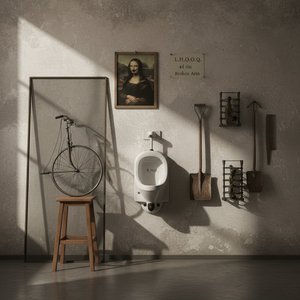
Introduktionen av readymades – vardagliga, massproducerade föremål som valts ut och presenterats som konst – var Duchamps mest betydelsefulla bidrag till 1900-talet. Dessa var inte bara funna föremål; de var medvetna handlingar av konstnärlig subversion. Genom att ta ett vardagligt föremål, som en urinoar (Fontänen, 1917), signera det med ”R. Mutt” och skicka in det till en konstutställning, utmanade Duchamp själva definitionen av konstnärlig skicklighet och upphovsmannaskap. Var det konstnärens hand som skapade verket, eller var det konstnärens idé? Denna fråga blev central för hans praktik och lade grunden för konceptkonsten. Andra betydelsefulla readymades, såsom L.H.O.O.Q. (1919) – en reproduktion av ett vykort av Mona Lisa som vandaliserats med mustasch och bockskägg – var lekfulla men skarpa kritiker av konsthistorien och etablerade kulturella ikoner. Dessa verk var inte tänkta att beundras för sina estetiska kvaliteter; de var avsedda att väcka debatt och tvinga betraktaren att ompröva sina förutfattade meningar om vad som utgör konst. Duchamp trodde att konsten skulle existera i sinnet, inte enbart i ögat.Arv och bestående inflytande
Marcel Duchamps inverkan på efterföljande generationer av konstnärer är omätbar. Han förändrade fundamentalt vår förståelse av konst och banade väg för rörelser som konceptkonst, minimalism, popkonst och många andra. Hans betoning av konstnärens idé – konceptet bakom verket – framför dess estetiska egenskaper fortsätter att inspirera konstnärer än idag.- Kubism: Tidig utforskning av brutna former och rumslig representation.
- Dadaism: Avvisande av logik, förnuft och traditionella konstnärliga värden som svar på första världskriget.
- Konceptkonst: Fokus på idén bakom konstverket snarare än dess estetiska kvaliteter.

Marcel Duchamp
1887 - 1968 , Frankrike
Snabbfakta
- Artistic Movement Or Style:
- Cubism
- Dadaism
- Konceptuell konst
- Artists Or Movements Influenced By This Artist: ['Minimalism']
- Date Of Birth: 28 juli 1887
- Date Of Death: 2 oktober 1968
- Full Name: Marcel Duchamp
- Nationality: Fransk-Amerikansk
- Notable Artworks:
- Fontänen
- El gran vidrio - La novia desnudada por sus solteros
- Fountain
- Place Of Birth: Blainville-sur-Mer, Frankrike
Relaterade artiklar

Dada: A Revolution of Anti-Art & the Rejection of Reason in Early 20th Century Aesthetics
Explore the revolutionary Dada art movement! Discover its origins, key artists like Duchamp & Arp, and lasting impact on modern art. A deep dive into anti-art & challenging conventions.

Dadaism: A Rebellion Against Reason – Exploring the Origins, Characteristics, and Enduring Legacy of an Anti-Art Movement
Explore the revolutionary Dada art movement! Discover its origins in WWI, key artists like Duchamp & Höch, core principles, and lasting impact on modern and contemporary art. A comprehensive guide for enthusiasts.

Echoes of Time: Nostalgia, Technique & Cultural Significance in Vintage Paintings
Explore the captivating world of vintage paintings! Discover key styles, cultural significance & collecting tips from art experts at ArtsDot. Find authentic reproductions and elevate your home décor.

The Enigmatic Realm of Paul Delvaux: Surrealism, Memory & the Poetics of Disquiet
Explore the haunting dreamscapes of Paul Delvaux, a master of Surrealism. Discover his iconic motifs, classical influences & enduring legacy with ArtsDot.com.
Marcel Duchamp: Challenging Conventions & Redefining Art in the 20th Century
Explore the revolutionary art of Marcel Duchamp! Discover how his Dadaist readymades challenged artistic conventions & redefined modern art. A deep dive into 'Fountain', conceptual shifts, and his lasting impact.


