

 Förhandsvisa
 Skicka
 Dela
Dela
 Visa detaljer
 Guide
Guide

 Ladda ner
 Liknande objekt
 Röntgen
 Bildspel
 Frågor och svar
 Statistik
The trap

- 37.0 x 27.0 cm


 Visa mer
Få en utskriftsfärdig fil som vida överträffar webbförhandsvisningen. Varje digital bild vi säljer kommer från en högupplöst master i vår bilddatabas – vanligtvis mellan 5 000 och 15 000 pixlar bred – så att du med trygghet kan göra stora utskrifter, beskära tätt eller återge fina detaljer.
Ingen fil lämnar vår studio utan att ha bearbetats. En digital expert kontrollerar färgerna mot originalmålningen och korrigerar dem vid behov, för att sedan förbättra skärpa och detaljrikedom med professionella retuscheringsverktyg — alltid med full respekt för konstnärens penseldrag och stil. Resultatet är en bild som ser ut som målningen, inte som en filtrerad skanning.
Du godkänner innan arbetet slutförs: vår expert skickar bilden via e-post inom 72 timmar för din granskning. Inte nöjd? Be om förbättringar eller korrigeringar, eller begär återbetalning om kvaliteten inte lever upp till förväntningarna.
Detta är den kvalitet som förlag, designstudior, gallerier och tryckerier litar på.
Digital bild
Ladda ner en högupplöst fil för personlig visning, utskrift och kreativa projekt. ( Byt till tryck Beställ handmålad reproduktion)
Ingår i varje beställning av digital bild
Professionell digital leverans, garanterad
När du väljer ArtsDot.com får du inte bara en bild – du får ett professionellt förädlat digitalt konstverk, skapat med precision och med en garanterad tillfredsställelse. Här är allt som ingår i din beställning, automatiskt:

Snabb leverans via e-post
Din högupplösta digitala bild skickas till dig via e-post inom 72 timmar efter beställning – redo för omedelbar användning.

AI-förbättrad digital fil
Ditt konstverk optimeras professionellt med hjälp av avancerade AI-verktyg och manuell redigering, vilket garanterar maximal detaljrikedom, skärpa och färgnoggrannhet.

Fri livstidsåterleverans
Har du råkat radera eller tappa bort din fil? Ingen oro – vi skickar den kostnadsfritt till dig när som helst.

Inga importavgifter – någonsin
Njut av ditt konstverk omedelbart utan tull, importavgifter eller leveranskostnader – digitala nedladdningar är alltid skattefria.

Garanterad färgåtergivning
Vi säkerställer att din digitala bild återger de ursprungliga färgerna så exakt som möjligt med hjälp av professionella verktyg och färghantering.

100 dagars nöjdhetsgaranti
Om du inte är nöjd med din digitala bild kommer vi att revidera den eller återbetala 100% inom 100 dagar – utan frågor.

100% pengarna-tillbaka-garanti
Inte nöjd? Få full återbetalning inom 100 dagar efter att du mottagit din digitala fil – utan frågor.

Rabatt vid storköp
Köp 3 bilder, spara 10% – Köp 5, spara 15% – Köp 10+, spara 20%. Perfekt för kreativa projekt, gallerier och byråer.
A Dreamscape of Memory and Emotion
In the profound depths of Marc Chagall’s 1962 masterpiece, The Trap, viewers are invited into a realm where the boundaries between the tangible world and the ethereal dream dissolve. This painting is far more than a mere composition of pigment on canvas; it is a distilled essence of memory, emotion, and the artist’s signature ability to weave fantastical visions with grounded, poignant observation. As one gazes upon the canvas, they encounter a scene that feels both intimately personal and universally mythic. The work serves as a lyrical exploration of the human condition, capturing a delicate dance between reality and the subconscious, much like a half-remembered dream that lingers in the mind long after waking.
The composition presents a striking visual dialogue between figures and the cosmos. Two central figures, draped in vibrant hues of crimson and deep azure, stand side by side, their gazes directed upward toward an unseen celestial phenomenon. This upward movement creates a sense of yearning and spiritual aspiration. Adding to the surrealist charm is the presence of an animal figure, also adorned in red, floating near the top of the frame. The backdrop, a profound and enveloping blue, provides a nocturnal, infinite stage that allows the primary colors to pulse with life, creating a color scheme that is as much about emotional temperature as it is about visual balance.
Technique and the Language of Color
Chagall’s approach to technique in The Trap exemplifies his mastery over the expressive potential of paint. Eschewing the rigid constraints of meticulous realism, he employs bold, swirling lines and expressive brushstrokes that imbue the canvas with a palpable, rhythmic energy. The use of tempera on canvas is particularly noteworthy here; this medium allows for a remarkable luminosity and textural depth, giving the colors a translucent quality that feels as though they are glowing from within. This technique is essential in achieving the ethereal, weightless atmosphere that characterizes his most celebrated works.
The palette is a deliberate emotional tool. Chagall utilizes a vibrant spectrum dominated by reds, blues, yellows, and greens—hues that evoke the nostalgic landscapes of his youth in Vitebsk. The intense red of the figures' garments acts as a heartbeat within the cool blue expanse, symbolizing passion, life, and perhaps the very "trap" of human emotion. For collectors and interior designers, this interplay of color offers a sophisticated focal point, capable of injecting both warmth and contemplative depth into a curated space.
Symbolism and the Weight of History
To understand The Trap is to understand the resilience of the human spirit amidst displacement. Created in 1962, following Chagall’s relocation to America after escaping the horrors of Nazi persecution, the painting carries the heavy, silent echoes of loss and survival. The central motif—a stylized cage or trap—serves as a powerful symbol of both physical confinement and psychological imprisonment. It represents the anxieties surrounding mortality, the inescapable grip of fate, and the struggle to maintain one's identity when uprooted from one's homeland.
Yet, even within this theme of entrapment, there is an undeniable sense of transcendence. The upward gazes of the figures suggest a refusal to be broken by the weight of existence. This tension between the "trap" of earthly suffering and the freedom of the imagination is what makes Chagall’s work so enduringly relevant. For those seeking to acquire a high-quality reproduction of this piece, The Trap offers more than just aesthetic beauty; it provides a profound narrative of hope and the eternal human quest for meaning amidst the shadows of history.
Frågor och svar
Vilken storlek rekommenderas för tryck av "The trap"?
Rekommenderad tryckstorlek för "The trap" är Small. Andra storlekar finns tillgängliga med samma proportioner.
Finns det ett faktablad om "The trap" av Marc Chagall för studenter?
En Faktablad för elever-sida finns tillgänglig för "The trap" av Marc Chagall: ett utskrivbart faktablad om konstverket, utformat för studenter och undervisning i klassrummet.
Hur mycket ljus verkar färgerna i "The trap" reflektera?
"The trap" av Marc Chagall har en luminans på Bright Balance. Luminans beskriver hur mycket ljus färgerna tycks reflektera.
Liknande konstverk


Konstnärsbiografi
A Life Painted in Dreams: The World of Marc Chagall
Marc Chagall, born Moishe Shagal in 1887 in the small Belarussian town of Liozna near Vitebsk, wasn’t merely a painter; he was a poet of color, a weaver of dreams, and a chronicler of memory. His life, spanning nearly a century, mirrored the tumultuous currents of the 20th century, yet his art remained steadfastly rooted in a deeply personal vision—one infused with the folklore of his Hasidic Jewish upbringing and an unwavering belief in the power of imagination. Vitebsk itself was more than just a birthplace; it became the emotional core of his artistic universe, a recurring motif populated by flying figures, whimsical animals, and the vibrant hues of remembered landscapes. The town’s unique blend of cultures—Russian Orthodox churches alongside bustling Jewish marketplaces—forged an aesthetic sensibility that would defy easy categorization throughout his long career. Though he sought formal training first with a local sign painter and later in St. Petersburg under Léon Bakst, and then in Paris at the Académie de la Grande Chaumière, Chagall never fully embraced any single artistic movement. He absorbed elements of Cubism, Symbolism, and Fauvism, but always filtered them through his own intensely personal lens, creating a style that was uniquely, unmistakably Chagall.Early Influences and Artistic Beginnings
Chagall’s formative years were marked by the traditions of Vitebsk’s Jewish community—a world steeped in ritual, storytelling, and vibrant visual culture. These influences would permeate his artistic vision throughout his life. His initial training was modest, focusing on practical skills as a sign painter, but he quickly developed an interest in broader artistic concepts. St. Petersburg provided him with access to influential teachers like Léon Bakst, who encouraged experimentation and challenged conventional stylistic norms. This exposure to theatrical design—particularly Ballets Russes productions—would prove crucial in shaping his approach to composition and visual storytelling. However, Chagall resisted the allure of rigid academic doctrines, prioritizing intuition and emotional expression over technical precision. He sought inspiration from Impressionism and Post-Impressionism, particularly Cézanne and Gauguin, recognizing their ability to capture fleeting moments of beauty and emotion.The Symbolist Vision: Fragments of Memory
Chagall’s early paintings—such as I and the Village (1911)—demonstrate his fascination with Symbolism's exploration of psychological states and subconscious imagery. The village isn’t rendered realistically but as a fragmented collection of recollections, imbued with symbolic meaning. Figures float and dance across the canvas, defying gravity and logic, creating a dreamlike atmosphere that invites viewers into his inner world. This stylistic approach wasn’t accidental; it stemmed from a desire to move beyond mere imitation of reality and capture the essence of feeling, the weight of memory, and the power of folklore. The use of color—bold, non-naturalistic hues—served as a conduit for emotion rather than literal representation. Recurring motifs like birds, apples, and musical instruments reflect Chagall’s preoccupation with themes of flight, fertility, and artistic inspiration. These images are not simply decorative; they carry profound symbolic significance, conveying ideas about identity, spirituality, and the relationship between humanity and nature.Cubism's Influence and Artistic Evolution
Despite his rejection of formal academic movements, Chagall absorbed elements of Cubism, particularly Picasso’s pioneering explorations of fractured perspectives. This influence is evident in works like The Musicians (1917), where figures are depicted simultaneously from multiple viewpoints—a technique that disrupts traditional spatial conventions and emphasizes the multiplicity of experience. However, Chagall skillfully blended Cubist principles with his own distinctive visual language, retaining a lyrical quality and emotional depth that distinguishes him from more intellectually rigorous artists. He continued to experiment with color and form throughout his career, refining his style while maintaining its core expressive power. The Russian Revolution profoundly impacted Chagall’s life and artistic practice, returning him to Vitebsk where he established an art school—a brief but significant endeavor aimed at fostering creativity and cultural renewal amidst the upheavals of the era.International Recognition and Legacy
Chagall's emigration to Paris in 1923 marked a turning point in his artistic trajectory, propelling him onto the international stage. He embraced Surrealism’s fascination with dreams and irrationality, producing canvases that pulsate with imaginative energy—works like *White Crucifixion* (1938) reflecting the anxieties of wartime Europe. His subsequent move to New York City during World War II provided him with a new creative impetus, resulting in monumental paintings inspired by biblical narratives and American landscapes. Chagall’s influence extended far beyond his own lifetime, inspiring countless artists across disciplines—painting, sculpture, theater, and film—who sought to emulate his poetic vision and expressive style. His enduring legacy resides not only in his iconic artworks but also in the profound exploration of human emotion and spiritual yearning that characterizes his oeuvre. Marc Chagall remains one of the most celebrated artists of the twentieth century, a testament to the transformative power of imagination and the unwavering pursuit of artistic truth.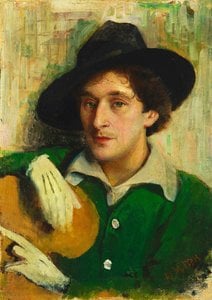
Marc Chagall
1887 - 1985 , Belarus
Kort om konstnären
- Artistic Movement Or Style: Modernism, Kubism
- Artists Or Movements Influenced By This Artist: ['Surrealism']
- Artists Who Influenced This Artist:
- Bakst
- Delaunay
- Borovikovsky
- Date Of Birth: 7 juli 1887
- Date Of Death: 28 mars 1985
- Full Name: Marc Chagall
- Nationality: Russisk, senare fransk
- Notable Artworks:
- I och byen
- Den Liggande Poeten
- Valentina
- Place Of Birth: Liozna, Belarus