


The picture follows your choices: , .
Beskrivning av samlarobjekt
 Visa mer
Konstnärens biografi
Upplev Marc Chagalls drömlika "En sommarnattsdröm" (Midsummer Night's Dream). Ett surrealistiskt mästerverk fyllt av symbolik, kärlek och magi – fånga konstens essens!
Handgjord oljereproduktion
Handmålad olja på duk i din valda storlek och ram, tillverkad efter beställning av våra konstnärer. ( Byt till tryck Byt till digital bild)
Detta konstverk är upphovsrättsligt skyddat
Konstverket som visas på denna sida skyddas av upphovsrättslagen, vilket innebär att vi inte lagligt kan skapa eller sälja en identisk reproduktion. Detta skydd upprätthålls genom internationella avtal såsom den Bernkonventionen och genom nationella lagar, inklusive de som fastställs av Amerikansk upphovsrättslag – Titel 17. Alla rättigheter förbehållna. Återgivning av konstverk är förbjuden utan skriftligt tillstånd från WahooArt.
Som ett respektfullt och lagligt alternativ erbjuder vi skräddarsydda, handmålade konstverk inspirerade av originalet. Våra skickliga och professionella konstnärer studerar noggrant originalets stil, stämning och konstnärliga essens för att skapa ett nytt, unikt verk som väcker samma känsla – samtidigt som det förblir en originell skapelse i egen rätt.
Denna metod följer fullt ut upphovsrättsliga regler eftersom den inte innebär kopiering eller duplicering av det skyddade konstverket. Istället är det en kreativ nytolkning – en ny målning som är influerad av originalet men inte identisk med det.
More about this painting
 Förhandsvisa
 Skicka
 Dela
Dela
 Visa detaljer
 Guide
Guide

 Ladda ner
 Liknande objekt
 Röntgen
 Bildspel
 Q&A
Q&A Statistik
Order your painting in four simple steps
Take your time. You can change any answer; the price in your order card follows each choice.
1 Step one of four
Which size would you like?
These sizes keep the proportions of the original painting. The drawing shows your choice on a wall, above a two-metre sofa.
Or give your own measurements
Välj bland våra förinställda storlekar som motsvarar konstverkets ursprungliga proportioner.

Ange den bredd och höjd du behöver för att passa din ram eller din vägg. Eftersom detta är handmålat kan konstnären, vid ett annat format, måla lite mer runt bilden eller beskära den något – det är du som väljer. Vi skickar en digital mockup för godkännande innan målningen påbörjas. Bilden som visas på denna sida representerar inte det slutgiltiga resultatet — det är endast mockuppen som visar det.
2 Step two of four
How should it be prepared: rolled, stretched or framed?
The prices below are for the size you chose in step one.
Choose the edges of the stretched canvas
Choose your frame

White Skr1

Blurside Skr1

Extended Skr1

P118B Skr10

P118H Skr10

P118W Skr10

P438Z Skr10

P508JH Skr12

P508YH Skr12

P805H Skr10

P805Z Skr10

P919BZ Skr10

P919G Skr10

P919XJ Skr10

P959ZH Skr10

P968JZ Skr12

W106C Skr8

W218G Skr10

W218JH Skr8

W218Y Skr10

W307PJ Skr10

W316G Skr10

W316PJ Skr8

W316Y Skr10

W398PJ Skr8

W4111J Skr10

W500HY Skr15

W500JH Skr15

W692G Skr12

W849H Skr8

W940BG Skr15

W953PJ Skr8

H24-GOLD Skr30

H24-SILVER Skr30

H36-GOLD Skr45

H36-SILVER Skr45
Inramad
Moulding: . Overall size with the frame: .
3 Step three of four
Would you like anything changed in the painting?
Most people answer no. Because each painting is made by hand, our artist can also adapt it for you.
After order, ArtsDot.com team will email client for instructions and provide a mockup preview
4 Step four of four
A few finishing options
All of them are optional. The answers already selected cost nothing extra.
Who paints it?
Leverans över hela världen () på 3–4 veckor istället för standard 5 veckor. (31 oktober). Inga kompromisser med kvaliteten.
A nameplate, as in a museum?
Detaljer för graverad bronsplatta
This elegant plaque features the artist's name and the title of the artwork, finely engraved for a timeless presentation.
It is made from bronze with a refined, elegant finish. The text is precisely laser-engraved for a sharp and permanent result. Measuring 9x2 cm, the plaque is compact yet easy to read. It's built to be durable and scratch-resistant, offering a professional, museum-quality look. Mounting is simple thanks to the included adhesive backing.
Detaljer för transparent akrylplatta
The plaque includes essential engraved details such as the artist's name, the title of the artwork, the date it was created, the type of media used-like oil on canvas or watercolor-a brief description of the piece, and a QR code that links to the complete artwork information.
It is crafted from clear acrylic, offering a sleek, modern appearance. The text is UV-engraved in black to ensure strong visual contrast. With a size of 10x15 cm, it ensures optimal readability. It comes equipped with two metal hooks for secure wall mounting. The plaque is designed to be weather-resistant, making it suitable for various environments, and it includes interactive features that work seamlessly with smartphone scanning.
Detaljer för svart akrylplatta
This elegant plaque includes engraved information such as the artist's name, the title of the artwork, the date it was created, the type of media used (like oil on canvas or watercolor), a short description of the artwork, and a QR code for quick access to more information.
The plaque itself is made from refined black acrylic with a premium finish. The text is laser-engraved in white for high contrast and readability. Its size is 10x15 cm, designed to be easy to read. It comes with two metal hooks for professional mounting. The design is sleek and fits any interior style. It is also weather-resistant and durable, with built-in digital integration for mobile compatibility.
A protective varnish?
When do you need it?
✓ Check and order
Your painting, as you ordered it

Madame Sobakevitch
Reproduktionsmetod
Storlek på reproduktion
-

Elitkonstnär av högsta klass
Mer detaljrikedom, finess och extra produktionstid
-

Inramning av reproduktion
-
-
För konstverk eller reproduktioner som är större än 105 cm (cirka 41 tum) på någon sida, levereras ramen som ett isärplockat kit. Denna metod säkerställer en trygg leverans och förhindrar skador under transport.
Professionell montering krävs – detta är inte en produkt för självmontering.
Kitet måste monteras och duken spännas av en erfaren professionell inramare med hjälp av trälim (ingår ej), en spänntång för duk och klämmor för att hålla sargen rak medan limmet torkar. Felaktig montering eller ojämn spänning av duken kan orsaka permanenta skador på konstverket och täcks
 För konstverk eller reproduktioner som är större än 105 cm (cirka 41 tum) på någon sida, levereras ramen som ett isärplockat kit. Denna metod säkerställer en trygg leverans och förhindrar skador under transport.
Alla massiva träribbor ingår, exakt tillkapade efter mått.
Monteras med de medföljande skruvarna, samt trälim för hörnfogarna, vilket inte ingår och måste anskaffas av din ramverkare.
Professionella verktyg krävs och ingår ej: en dukspännare och klämmor för att hålla listerna raka medan limmet torkar.
Viktigt:
Hörnjunctionerna kräver trälim, listerna måste hållas på plats med tvingar tills limmet har torkat helt, och för att spänna duken på den monterade ramen krävs en spänntång för duk. Inget av detta ingår i kitet. Vänligen kontakta en erfaren professionell rammakare innan du beställer denna storlek.

Namnskylt
-
-

Skyddande fernissa
Glansig fernissa (förstärker färgerna, skyddar mot ljus och fukt)
-

Anpassa mitt konstverk
Exempel på vad som kan ändras: Byt ut ansiktet mot ett foto från kunden; Lägg till ett husdjur (t.ex. byt ut en katt mot en hund); Inkludera ett dolt meddelande i bakgrunden; Ändra bakgrundens landskap eller detaljer.
-

Expressleverans
Leverans över hela världen () inom 3–4 veckor istället för standardiserade 5 veckor. (31 oktober). Inga kompromisser med kvaliteten.
-
Expressleverans
Leverans över hela världen () inom 5 veckor. (7 november).
Ingår
Slutgiltigt pris
Skr 2641
Glasalternativet är endast tillgängligt i storlekar under 110 cm.
Included with every order
- Fri expressfrakt över hela världen
- Högkvalitativ linnecanvas
- Fullständig fraktförsäkring
- Garantier för återbetalning av tullavgifter
- Garantier för exakt färgåtergivning
- 100 dagars returrätt (endast vid fel)
- 100% pengarna tillbaka-garanti
- Mängdrabatt erbjuds


A Dreamscape Portrait by Marc Chagall
Marc Chagall’s “Madame Sobakevitch,” created in 1923, transcends mere representation; it embodies the artist's signature blend of Surrealism and Jewish folklore—a visual poem capturing a moment suspended between memory and imagination. This etching on paper, part of Chagall’s celebrated “Dead Souls” series, exemplifies his masterful manipulation of line and tonal values to convey profound emotional resonance. Produced by Raymond Haasen, Louis Fort, and Ambroise Vollard, the artwork resides in the Tretyakov Gallery, Moscow, Russia, securing its place as a cornerstone of 20th-century art history.Composition and Technique: Embracing Distortion
The vertical orientation immediately establishes a sense of solemn grandeur, mirroring the dignified posture of Madame Sobakevitch herself—a woman whose identity remains deliberately elusive, furthering the artwork’s enigmatic quality. Chagall employs a flattened perspective, characteristic of Naïve Art, prioritizing expressive line over realistic depiction. Hatching and cross-hatching techniques are skillfully deployed to build up tonal gradations, creating depth and texture despite the monochromatic palette. Loose, swirling lines dominate the composition, mirroring the artist's fascination with movement and conveying an underlying feeling of restlessness—a subtle counterpoint to the woman’s stillness. The etching process itself contributes to this textural richness, capturing minute details with remarkable precision.Symbolism and Emotional Resonance: Birds, Cage, and Remembrance
The inclusion of a birdcage perched on Madame Sobakevitch's shoulder is arguably the artwork’s most striking symbolic element. Birdcages frequently represent confinement and longing for freedom—themes prevalent in Chagall’s oeuvre and deeply rooted in Jewish tradition. It speaks to themes of vulnerability and aspiration, hinting at an inner life brimming with unspoken desires. The stylized depiction of Madame Sobakevitch's face – with exaggerated features – reinforces the artist’s rejection of conventional portraiture, prioritizing emotional expression over anatomical accuracy. This deliberate distortion serves not merely as stylistic flourish but as a conduit for conveying nostalgia and remembrance—a palpable sense of revisiting cherished moments from the past.Historical Context: Surrealism and Vitebsk's Influence
“Madame Sobakevitch” emerged during Chagall’s formative years in Vitebsk, Belarus, where he experienced firsthand the confluence of Orthodox Christianity and Jewish culture. This environment profoundly shaped his artistic sensibility, fostering a preoccupation with dreams, myths, and folklore—elements that would permeate his entire oeuvre. The artwork aligns itself squarely within the Surrealist movement, championed by André Breton and fellow artists who sought to liberate art from rational constraints. Chagall’s exploration of subconscious imagery reflects the broader intellectual currents of the time, demonstrating an unwavering commitment to artistic innovation and personal vision.Concluding Impression: An Eternal Echo
Ultimately, “Madame Sobakevitch” remains a testament to Chagall's unparalleled ability to transform observation into emotion—to distill complex psychological states into visual form. Its enduring appeal lies in its capacity to evoke contemplation and wonder, inviting viewers to delve beneath the surface of imagery and confront the profound mysteries of human experience. This exquisite lithograph reproduction captures not just an image but a feeling—a timeless echo of Chagall’s visionary spirit.Frågor och svar
Är bilden av "Madame Sobakevitch" av Marc Chagall fri att återge?
Upphovsrättslig status för "Madame Sobakevitch" av Marc Chagall: verket är fortfarande skyddat av upphovsrätt. Detta avgör om reproduktioner av bilden får framställas fritt.
Vilken färgharmoni uppvisar "Madame Sobakevitch" av Marc Chagall?
Färgerna i "Madame Sobakevitch" av Marc Chagall uppvisar en Discordant Palette harmoni. Harmoni beskriver hur färgerna förhåller sig till varandra.
Vilket rum rekommenderas för "Madame Sobakevitch" av Marc Chagall?
En reproduktion av "Madame Sobakevitch" passar bra i ett Living Room.
Liknande konstverk


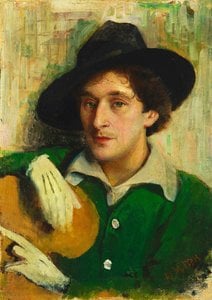
Marc Chagall
1887 - 1985, Belarus
Konstnärsbiografi
A Life Painted in Dreams: The World of Marc Chagall
Marc Chagall, born Moishe Shagal in 1887 in the small Belarussian town of Liozna near Vitebsk, wasn’t merely a painter; he was a poet of color, a weaver of dreams, and a chronicler of memory. His life, spanning nearly a century, mirrored the tumultuous currents of the 20th century, yet his art remained steadfastly rooted in a deeply personal vision—one infused with the folklore of his Hasidic Jewish upbringing and an unwavering belief in the power of imagination. Vitebsk itself was more than just a birthplace; it became the emotional core of his artistic universe, a recurring motif populated by flying figures, whimsical animals, and the vibrant hues of remembered landscapes. The town’s unique blend of cultures—Russian Orthodox churches alongside bustling Jewish marketplaces—forged an aesthetic sensibility that would defy easy categorization throughout his long career. Though he sought formal training first with a local sign painter and later in St. Petersburg under Léon Bakst, and then in Paris at the Académie de la Grande Chaumière, Chagall never fully embraced any single artistic movement. He absorbed elements of Cubism, Symbolism, and Fauvism, but always filtered them through his own intensely personal lens, creating a style that was uniquely, unmistakably Chagall.Early Influences and Artistic Beginnings
Chagall’s formative years were marked by the traditions of Vitebsk’s Jewish community—a world steeped in ritual, storytelling, and vibrant visual culture. These influences would permeate his artistic vision throughout his life. His initial training was modest, focusing on practical skills as a sign painter, but he quickly developed an interest in broader artistic concepts. St. Petersburg provided him with access to influential teachers like Léon Bakst, who encouraged experimentation and challenged conventional stylistic norms. This exposure to theatrical design—particularly Ballets Russes productions—would prove crucial in shaping his approach to composition and visual storytelling. However, Chagall resisted the allure of rigid academic doctrines, prioritizing intuition and emotional expression over technical precision. He sought inspiration from Impressionism and Post-Impressionism, particularly Cézanne and Gauguin, recognizing their ability to capture fleeting moments of beauty and emotion.The Symbolist Vision: Fragments of Memory
Chagall’s early paintings—such as I and the Village (1911)—demonstrate his fascination with Symbolism's exploration of psychological states and subconscious imagery. The village isn’t rendered realistically but as a fragmented collection of recollections, imbued with symbolic meaning. Figures float and dance across the canvas, defying gravity and logic, creating a dreamlike atmosphere that invites viewers into his inner world. This stylistic approach wasn’t accidental; it stemmed from a desire to move beyond mere imitation of reality and capture the essence of feeling, the weight of memory, and the power of folklore. The use of color—bold, non-naturalistic hues—served as a conduit for emotion rather than literal representation. Recurring motifs like birds, apples, and musical instruments reflect Chagall’s preoccupation with themes of flight, fertility, and artistic inspiration. These images are not simply decorative; they carry profound symbolic significance, conveying ideas about identity, spirituality, and the relationship between humanity and nature.Cubism's Influence and Artistic Evolution
Despite his rejection of formal academic movements, Chagall absorbed elements of Cubism, particularly Picasso’s pioneering explorations of fractured perspectives. This influence is evident in works like The Musicians (1917), where figures are depicted simultaneously from multiple viewpoints—a technique that disrupts traditional spatial conventions and emphasizes the multiplicity of experience. However, Chagall skillfully blended Cubist principles with his own distinctive visual language, retaining a lyrical quality and emotional depth that distinguishes him from more intellectually rigorous artists. He continued to experiment with color and form throughout his career, refining his style while maintaining its core expressive power. The Russian Revolution profoundly impacted Chagall’s life and artistic practice, returning him to Vitebsk where he established an art school—a brief but significant endeavor aimed at fostering creativity and cultural renewal amidst the upheavals of the era.International Recognition and Legacy
Chagall's emigration to Paris in 1923 marked a turning point in his artistic trajectory, propelling him onto the international stage. He embraced Surrealism’s fascination with dreams and irrationality, producing canvases that pulsate with imaginative energy—works like *White Crucifixion* (1938) reflecting the anxieties of wartime Europe. His subsequent move to New York City during World War II provided him with a new creative impetus, resulting in monumental paintings inspired by biblical narratives and American landscapes. Chagall’s influence extended far beyond his own lifetime, inspiring countless artists across disciplines—painting, sculpture, theater, and film—who sought to emulate his poetic vision and expressive style. His enduring legacy resides not only in his iconic artworks but also in the profound exploration of human emotion and spiritual yearning that characterizes his oeuvre. Marc Chagall remains one of the most celebrated artists of the twentieth century, a testament to the transformative power of imagination and the unwavering pursuit of artistic truth.


Relaterade artiklar
10 Legendariska Litografier Som Förändrade Konsthistorien – Upptäck Mästerverk Nu!
Utforska 10 legendariska litografier av Toulouse-Lautrec, Munch & Picasso! Upptäck konsthistorien bakom dessa mästerverk och låt dig inspireras. Köp museumkvalitativa reproduktioner på ArtsDot.com – för en stilfull inredning.
Mästverk i svart: Topp 10 målningar som domineras av Mars Black – Konst & Inredning
Utforska 10 ikoniska målningar där Mars Black dominerar – från romantik till expressionism. Lär känna konstnärer, tekniker och historien bakom tidlösa verk. Köp museumkvalitets reproduktioner på ArtsDot.com och förvandla ditt hem med klassisk konst!

Mästverk i svart: Topp 10 målningar som fascinerar – ArtsDot.se
Utforska 10 ikoniska målningar dominerade av svart – från Rembrandts djupa skuggor till Munchs ångest. Lär känna historien bakom mästerverken och hitta inspiration för din inredning på ArtsDot.se. Upptäck hela kollektionen online!