


 Förhandsvisa
 Skicka
 Dela
Dela
 Visa detaljer
 Guide
Guide

 Ladda ner
 Liknande objekt
 Röntgen
 Bildspel
 Statistik
Lisa with a Mandolin


 Visa mer
Konstverket som visas på denna sida skyddas av upphovsrättslagen, vilket innebär att vi inte lagligt kan skapa eller sälja en identisk reproduktion. Detta skydd upprätthålls genom internationella avtal såsom den Bernkonventionen och genom nationella lagar, inklusive de som fastställs av Amerikansk upphovsrättslag – Titel 17. Alla rättigheter förbehållna. Återgivning av konstverk är förbjuden utan skriftligt tillstånd från WahooArt.
Denna metod följer fullt ut upphovsrättsliga regler eftersom den inte innebär kopiering eller duplicering av det skyddade konstverket. Istället är det en kreativ nytolkning – en ny målning som är influerad av originalet men inte identisk med det.
Giclée / Konsttryck
Giclée- eller canvasprint av museumskvalitet med snabb produktion och flexibla ytbehandlingsalternativ. ( Beställ handmålad reproduktion Byt till digital bild)




P118B Skr10

P118H Skr10

P118W Skr10

P438Z Skr10

P508JH Skr12

P508YH Skr12

P805H Skr10

P805Z Skr10

P919BZ Skr10

P919G Skr10

P919XJ Skr10

P959ZH Skr10

P968JZ Skr12

W106C Skr8

W218G Skr10

W218JH Skr8

W218Y Skr10

W307PJ Skr10

W316G Skr10

W316PJ Skr8

W316Y Skr10

W398PJ Skr8

W4111J Skr10

W500HY Skr15

W500JH Skr15

W692G Skr12

W849H Skr8

W940BG Skr15

W953PJ Skr8




Välj bland våra förinställda storlekar som motsvarar konstverkets ursprungliga proportioner.

Ange den bredd och höjd du behöver för att passa din ram eller vägg. Ett tryck kan endast beskäras, aldrig göras större än originalbilden, vilket innebär att ett format med en annan proportion leder till att en del av bilden går förlorad. Vi skickar en digital mockup för godkännande innan vi påbörjar tryckningen. Bilden som visas på denna sida visar inte den faktiska beskärningen — det är endast mockuppen som gör det.
Leverans över hela världen () på 2 veckor istället för standard 4/5 veckor. (27 oktober)

Fri expressfrakt över hela världen

Högkvalitativ linnecanvas

Fullständig fraktförsäkring

Garantier för återbetalning av tullavgifter

Garantier för exakt färgåtergivning

100 dagars returrätt (endast vid fel)

100% pengarna tillbaka-garanti

Mängdrabatt erbjuds
 Glasalternativet är endast tillgängligt i storlekar under 110 cm.

Lisa with a Mandolin
Giclée / Konsttryck
Storlek på reproduktion
-


Slutgiltigt pris
Skr 616
A Dreamscape of Memory: Marc Chagall’s “Lisa with a Mandolin”
Marc Chagall's "Lisa with a Mandolin," painted in 1914, is more than just a portrait; it’s an immersion into the artist’s deeply personal world – a realm where memory and dream intertwine. Born Moishe Shagal in Liozna, Belarus, Chagall’s formative years were steeped in the rich folklore of his Hasidic Jewish community, a heritage that would profoundly shape his artistic vision for decades to come. This particular work exemplifies this influence, transporting us to a space both familiar and fantastical, anchored by the vibrant hues of remembrance and infused with a poignant sense of longing. The painting captures Lisa Rabinovich, a childhood friend of Chagall’s, seated in a chair, lost in the act of playing her mandolin. Her gaze, directed towards an unseen window, suggests contemplation and perhaps a wistful return to cherished moments.Expressionist Techniques and Color as Emotion
Created during a pivotal period in Chagall's artistic development, “Lisa with a Mandolin” firmly establishes his place within the Expressionist movement. While rooted in representational forms, Chagall employs a highly subjective approach to color and perspective, prioritizing emotional impact over strict realism. The bold use of red – dominating the wall behind Lisa – isn’t merely decorative; it pulsates with intensity, conveying passion, perhaps even a hint of melancholy. Chagall's technique is characterized by loose brushstrokes and a flattened picture plane, creating an almost dreamlike quality. He utilizes impasto—thickly applied paint—to build texture and emphasize the physicality of his subjects, particularly Lisa’s hands as they move across the strings of the mandolin. The slightly distorted proportions and unconventional spatial arrangement contribute to the painting's overall sense of unease and emotional depth, hallmarks of Expressionism’s goal to convey inner feelings rather than objective reality.Symbolic Layers: Folklore, Faith, and Intimacy
The symbolism within “Lisa with a Mandolin” is rich and layered, drawing heavily from Chagall's cultural context. The mandolin itself – a traditional Jewish instrument – represents music, joy, and connection to heritage. Lisa’s pose, reminiscent of biblical figures and folk art traditions, further reinforces this connection to faith and storytelling. The presence of the two chairs adds another layer of meaning; one occupied by Lisa, representing her individual experience, while the other in the background suggests a shared space, a memory being revisited. The red wall, often interpreted as symbolizing passion or even danger, could also represent the vibrant energy of the Jewish marketplace where Chagall spent his childhood. The painting is fundamentally an intimate portrait, capturing not just Lisa’s physical appearance but also her inner life and emotional state.A Timeless Masterpiece for Collection and Interior Design
“Lisa with a Mandolin” remains one of Marc Chagall's most beloved works, admired for its evocative power and masterful execution. This hand-painted reproduction captures the essence of the original, offering an exceptional opportunity to bring this iconic artwork into your home or office. Its vibrant colors and dreamlike quality make it a stunning addition to any collection, while its historical significance and artistic merit ensure its enduring appeal. Whether you are an art enthusiast, a collector seeking to expand your portfolio, or an interior designer aiming to create a space of profound beauty and emotional resonance, this reproduction offers a unique window into the visionary world of Marc Chagall. NoneFrågor och svar
Vilken känsla förmedlar Expressionist Portraiture-verket "Lisa with a Mandolin"?
Inom Expressionist Portraiture-rörelsen är "Lisa with a Mandolin" präglad av en Nostalgic ton.
Kan jag se "Lisa with a Mandolin" av Marc Chagall på min egen vägg innan jag köper den?
Sidan för Förhandsvisning i AR av "Lisa with a Mandolin" av Marc Chagall använder förstärkt verklighet (AR) för att visa konstverket i ditt eget utrymme på en kompatibel enhet.
Kan jag beställa en oljereproduktion av "Lisa with a Mandolin"?
"Lisa with a Mandolin" finns tillgänglig som en handmålad oljereproduktion på linneväv. Du kan lägga din beställning på dess Handmålad reproduktion-sida, där du kan välja mellan olika storlekar.
Liknande konstverk


Konstnärsbiografi
A Life Painted in Dreams: The World of Marc Chagall
Marc Chagall, born Moishe Shagal in 1887 in the small Belarussian town of Liozna near Vitebsk, wasn’t merely a painter; he was a poet of color, a weaver of dreams, and a chronicler of memory. His life, spanning nearly a century, mirrored the tumultuous currents of the 20th century, yet his art remained steadfastly rooted in a deeply personal vision—one infused with the folklore of his Hasidic Jewish upbringing and an unwavering belief in the power of imagination. Vitebsk itself was more than just a birthplace; it became the emotional core of his artistic universe, a recurring motif populated by flying figures, whimsical animals, and the vibrant hues of remembered landscapes. The town’s unique blend of cultures—Russian Orthodox churches alongside bustling Jewish marketplaces—forged an aesthetic sensibility that would defy easy categorization throughout his long career. Though he sought formal training first with a local sign painter and later in St. Petersburg under Léon Bakst, and then in Paris at the Académie de la Grande Chaumière, Chagall never fully embraced any single artistic movement. He absorbed elements of Cubism, Symbolism, and Fauvism, but always filtered them through his own intensely personal lens, creating a style that was uniquely, unmistakably Chagall.Early Influences and Artistic Beginnings
Chagall’s formative years were marked by the traditions of Vitebsk’s Jewish community—a world steeped in ritual, storytelling, and vibrant visual culture. These influences would permeate his artistic vision throughout his life. His initial training was modest, focusing on practical skills as a sign painter, but he quickly developed an interest in broader artistic concepts. St. Petersburg provided him with access to influential teachers like Léon Bakst, who encouraged experimentation and challenged conventional stylistic norms. This exposure to theatrical design—particularly Ballets Russes productions—would prove crucial in shaping his approach to composition and visual storytelling. However, Chagall resisted the allure of rigid academic doctrines, prioritizing intuition and emotional expression over technical precision. He sought inspiration from Impressionism and Post-Impressionism, particularly Cézanne and Gauguin, recognizing their ability to capture fleeting moments of beauty and emotion.The Symbolist Vision: Fragments of Memory
Chagall’s early paintings—such as I and the Village (1911)—demonstrate his fascination with Symbolism's exploration of psychological states and subconscious imagery. The village isn’t rendered realistically but as a fragmented collection of recollections, imbued with symbolic meaning. Figures float and dance across the canvas, defying gravity and logic, creating a dreamlike atmosphere that invites viewers into his inner world. This stylistic approach wasn’t accidental; it stemmed from a desire to move beyond mere imitation of reality and capture the essence of feeling, the weight of memory, and the power of folklore. The use of color—bold, non-naturalistic hues—served as a conduit for emotion rather than literal representation. Recurring motifs like birds, apples, and musical instruments reflect Chagall’s preoccupation with themes of flight, fertility, and artistic inspiration. These images are not simply decorative; they carry profound symbolic significance, conveying ideas about identity, spirituality, and the relationship between humanity and nature.Cubism's Influence and Artistic Evolution
Despite his rejection of formal academic movements, Chagall absorbed elements of Cubism, particularly Picasso’s pioneering explorations of fractured perspectives. This influence is evident in works like The Musicians (1917), where figures are depicted simultaneously from multiple viewpoints—a technique that disrupts traditional spatial conventions and emphasizes the multiplicity of experience. However, Chagall skillfully blended Cubist principles with his own distinctive visual language, retaining a lyrical quality and emotional depth that distinguishes him from more intellectually rigorous artists. He continued to experiment with color and form throughout his career, refining his style while maintaining its core expressive power. The Russian Revolution profoundly impacted Chagall’s life and artistic practice, returning him to Vitebsk where he established an art school—a brief but significant endeavor aimed at fostering creativity and cultural renewal amidst the upheavals of the era.International Recognition and Legacy
Chagall's emigration to Paris in 1923 marked a turning point in his artistic trajectory, propelling him onto the international stage. He embraced Surrealism’s fascination with dreams and irrationality, producing canvases that pulsate with imaginative energy—works like *White Crucifixion* (1938) reflecting the anxieties of wartime Europe. His subsequent move to New York City during World War II provided him with a new creative impetus, resulting in monumental paintings inspired by biblical narratives and American landscapes. Chagall’s influence extended far beyond his own lifetime, inspiring countless artists across disciplines—painting, sculpture, theater, and film—who sought to emulate his poetic vision and expressive style. His enduring legacy resides not only in his iconic artworks but also in the profound exploration of human emotion and spiritual yearning that characterizes his oeuvre. Marc Chagall remains one of the most celebrated artists of the twentieth century, a testament to the transformative power of imagination and the unwavering pursuit of artistic truth.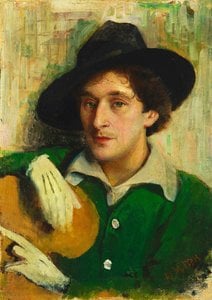
Marc Chagall
1887 - 1985 , Belarus
Kortfakta
- Artistic Movement Or Style: Modernism, Kubism
- Artists Or Movements Influenced By This Artist: ['Surrealism']
- Artists Who Influenced This Artist:
- Bakst
- Delaunay
- Borovikovsky
- Date Of Birth: 7 juli 1887
- Date Of Death: 28 mars 1985
- Full Name: Marc Chagall
- Nationality: Russisk, senare fransk
- Notable Artworks:
- I och byen
- Den Liggande Poeten
- Valentina
- Place Of Birth: Liozna, Belarus
Relaterade artiklar

Transforming Spaces: A Comprehensive Exploration of Wall Decor Through Art History & Contemporary Practice
Explore the art of transforming spaces with our comprehensive guide to wall decor. From historical movements to contemporary trends, discover how to curate impactful interiors and commission bespoke artwork for a truly personalized aesthetic.

Echoes of Time: Exploring the Enduring Appeal & Historical Context of Vintage Art Prints
Explore the captivating world of vintage art prints! Discover their history, collecting tips & enduring appeal. Expert insights on chromolithography and building a legacy collection with ArtsDot.

Giclée Prints: Archival Quality & Aesthetic Nuances for the Discerning Collector
Explore the world of giclée prints with ArtsDot. Learn about archival quality, aesthetic nuances & investment potential. Expert guidance for discerning art collectors seeking museum-quality reproductions and lasting value.

Freskernas Återkomst: Väggmålningens Nya Roll i Lyxig Inredningsdesign
Upptäck hur väggmålningar lyfter hotellinredningen! Expertguider om materialval, skräddarsydd design & underhåll. Skapa unika upplevelser med konst – från fresker till modern muralmålning.

Andy Warhols 25 Mästerverk: Ikoniska Konstverk för Ditt Hem | ArtsDot
Utforska Andy Warhols 25 mest ikoniska konstverk! Lär känna historien bakom popkonstens mästerverk – från Marilyn Monroe till Campbell's Soup Cans. Köp högkvalitativa reproduktioner och hitta inspiration för ditt hem på ArtsDot.com.


