


 Visa i rummet
 Skicka
 Dela
Dela
 Detaljer
 Studentguide för konstverk

 Ladda ner
 Liknande objekt
 Röntgen
 Bildspel
 Besökstatistik
Forest Landscape
 Etching
- Baroque
 1643
1643- Early Modern
 27.0 x 32.0 cm
 Szépművészeti Múzeum
 Läs mer
Giclée / Konsttryck
Giclée- eller canvasprint av museumskvalitet med snabb produktion och flexibla ytbehandlingsalternativ. ( Köp handmålat konstverk Byt till digital bildförsäljning)




P118B Skr10

P118H Skr10

P118W Skr10

P438Z Skr10

P508JH Skr12

P508YH Skr12

P805H Skr10

P805Z Skr10

P919BZ Skr10

P919G Skr10

P919XJ Skr10

P959ZH Skr10

P968JZ Skr12

W106C Skr8

W218G Skr10

W218JH Skr8

W218Y Skr10

W307PJ Skr10

W316G Skr10

W316PJ Skr8

W316Y Skr10

W398PJ Skr8

W4111J Skr10

W500HY Skr15

W500JH Skr15

W692G Skr12

W849H Skr8

W940BG Skr15

W953PJ Skr8




Välj bland våra förinställda storlekar som motsvarar konstverkets ursprungliga proportioner.

Ange den bredd och höjd du behöver, för att passa din ram eller din vägg. Ett tryck kan endast beskäras, aldrig göras större än bilden, vilket innebär att ett format med en annan formform leder till att en del av bilden går förlorad. Vi skickar en digital mockup för godkännande innan vi trycker något. Bilden som visas på denna sida visar inte den faktiska beskärningen — det är endast mockuppen som gör det.
Leverans över hela världen () på 2 veckor istället för standard 4/5 veckor. (24 oktober)

Fri expressfrakt över hela världen

Högkvalitativ linnecanvas

Fullständig fraktförsäkring

Garantier för återbetalning av tullavgifter

Garantier för exakt färgåtergivning

100 dagars returrätt vid fabrikationsfel

100% pengarna tillbaka-garanti

Mängdrabatt erbjuds
 Glasalternativet är endast tillgängligt i storlekar under 110 cm.

Forest Landscape
Giclée / Konsttryck
Reproduktionsstorlek
-


Totalpris
Skr 615
A Journey into the Italianate Dream
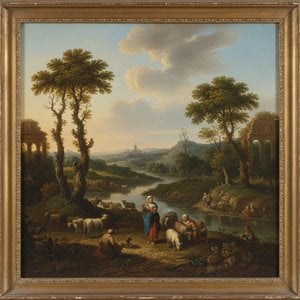
To gaze upon this depiction of a forest landscape is to step across the threshold of time, transported to the sun-dappled, yet subtly shadowed corners of Italia in the early seventeenth century. This piece captures the very essence of the Dutch fascination with the Mediterranean world—a yearning for the classical grandeur and luminous atmosphere that beckoned Northern European artists away from their familiar northern skies. It speaks volumes about the cultural currents of the time, when study trips to Italy were not merely leisure pursuits but vital academic pilgrimages for painters seeking mastery.
The Hand of Jan Both: Mastering Mediterranean Light
Created around 1643 by Jan Both, this work places us squarely within his mature period. Both was a key figure in the "Dutch Italianate" movement, an artistic current defined by its deep absorption of Roman and Venetian landscape ideals. While the subject matter is profoundly natural—a gently sloping hillside descending toward placid waters, framed by dense, brooding foliage—the execution reveals a meticulous technical prowess. The style leans heavily into the detailed realism characteristic of Dutch Golden Age drawing or etching. Notice how the lines themselves become carriers of light and shadow; they are not merely outlines but carefully modulated tonal passages built through expert hatching and cross-hatching.
Technique and Atmosphere: An Etcher's Precision
The physical evidence suggests a technique rooted in drypoint or fine etching upon copper plate. This medium allowed Both to achieve an astonishing level of linear precision, giving the forest its palpable texture. The light is not harsh; rather, it is diffused, suggesting the soft veil of an overcast day or the deep cool shade beneath a canopy. This masterful handling of shadow creates an incredible sense of depth—a visual recession where foreground details give way to atmospheric haze in the distance. The organic shapes of the trees and the water’s edge are rendered with such care that one can almost hear the quiet murmur of the stream.
Symbolism of Solitude and Nature's Embrace
Beyond its technical brilliance, the painting resonates with profound emotional undertones. The subtle inclusion of small figures wandering through the woods transforms the scene from a mere topographical study into a meditation on human experience. These travelers seem absorbed in their own contemplation, dwarfed by the immensity and tranquility of nature. This quietude speaks to an era grappling with both intense artistic patronage (as Both himself experienced) and a growing appreciation for the sublime power of the natural world—a refuge from the bustling life of the city.
Bringing the Italianate Spirit Home
For the collector or designer, this reproduction offers more than just decoration; it offers an atmosphere. It is a window into scholarly aspiration, a celebration of masterful draftsmanship, and an invitation to pause. The deep greens, muted earth tones, and the silvery quality of the water lend themselves beautifully to creating a space that feels both historically rich and serenely contemporary—a perfect anchor for any room seeking the quiet dignity of a classical landscape.
Frågor och svar
Vilken är den dominerande färgen i "Forest Landscape" av Jan Both?
Black (#050504) är den dominerande färgen i "Forest Landscape" av Jan Both.
Vilket motiv och vilken atmosfär förenar "Forest Landscape" av Jan Both?
"Forest Landscape" av Jan Both förenar forest landscape, dutch art, 17th century scene, serene nature, detailed drawing, italian influence, monochromatic tone med en Serene atmosfär.
Under vilken period skapades "Forest Landscape" av Jan Both?
Den historiska perioden för "Forest Landscape" av Jan Both är Early Modern. Denna klassificering placerar verket i konsthistorien.
Liknande konstverk


Om konstnären
Jan Both (1610-1652): Mästaren av det medelhavsinspirerade ljuset
Jan Dirksz Both var en nederländsk målare, tecknare och etsare som klev fram som en av de främsta gestalterna inom den framväxande ”italienska” landskapsrörelsen under den nederländska guldåldern. Han föddes omkring 1615/1618 i Utrecht och var yngre bror till Andries Both. Deras far, Dirck Both, som arbetade som glasmålare, ingöt tidigt en djup uppskattning för konstnärligt hantverk hos sina söner. Även om de biografiska detaljerna är något knappa, tyder forskning på att Jans utbildning omfattade undervisning av mästare som Abraham Bloemaert och Gerrit van Honthorst, vilket placerade honom bland sin tids mest inflytelserika konstnärer.- Tidiga år och utbildning: Boths formativa år tillbringades i Utrecht, där han förfinade sina färdigheter tillsammans med sin bror Andries. Genom sin fars verksamhet inom glasmålning absorberade han tekniker djupt rotade i flamländska traditioner.
- Romerskt inflytande: Omkring 1638 påbörjade Jan och Andries en transformativ resa till Rom via Frankrike. Där sänkte de sig ner i det konstnärliga sjudandet vid det påvliga hovet och mötte storheter som Bloemaert och Gerrit van Honthorst, en exponering som i grunden formade deras stilistiska sinnen.
Den romerska stilen och samarbetet med Lorrain
Rom kom att fungera som en smältdegel för Boths konstnärliga utveckling. Medan Andries fokuserade på genremåleri i Pieter van Laers anda, ägnade sig Jan främst åt landskapsmåleri – en stil som stod i stor tacksamhetsskuld till Claude Lorrain. Med en oöverträffad behärskning av ljus och färg lyckades han fånga den eteriska skönheten i medelhavsregionen. Särskilt anmärkningsvärt var hans nära samarbete med Herman van Swanevelt vid ett monumentalt projekt för Buen Retiro-palatset i Madrid, vilket demonstrerade hans ambition och konstnärliga förmåga inom de högsta skikten av europeiskt mecenatskap. Detta partnerskap befäste Boths rykte som en ledande innovatist inom landskapsmåleriet.Framstående verk och konstnärliga särdrag
Boths samlade produktion kännetecknas av vidsträckta, fantasifulla landskap badade i ett lysande gyllene ljus – ett signum för Lorrains stil och en indikation på de bredare konstnärliga strömningar som rörde sig genom Europa. Hans mästerverk, ”Landskap med banditer som leder fångar” (Museum of Fine Arts, Boston), exemplifierar denna estetiska briljans. Den diagonala vägen drar betraktarens blick in i scenen och ställer realistiska figurer mot en fond av idylliska vyer fyllda av minutiöst återgivna växter. Återkommande motiv inkluderar religiösa eller mytologiska gestalter, som i ”Paris omdömme” (London, National Gallery), ofta utförda av medkonstnärer från Utrecht såsom Cornelis van Poelenburch, vilket understryker Boths engagemang för humanistiska ideal och konstnärliga konventioner.Arv och inflytande
Jan Boths bror Andries gick tragiskt bort i sjukdom i Venedig under deras hemresa från Rom. Trots ett kort liv etablerade sig Andries som en respekterad konstnär specialiserad på bondescener – en genre som speglade tidens sociala realiteter. Jan Boths konstnärliga arv sträcker sig dock bortom de enskilda målningarna; han fungerade som lärare för talangfulla elever som Barend Bispinck och Willem de Heusch, vilket säkerställde att hans stilistiska innovationer fortsatte att inspirera generationer av konstnärer. Hans verk hyllas än idag för sin stämningsfulla atmosfär, sin mästerliga teknik och sitt bidrag till utvecklingen av det nederländska landskapsmålandet – ett bevis på Boths bestående inflytande på den europeiska konsthistorien.Samlingar
- Fitzwilliam Museum vid University of Cambridge
- Hermitage, Sankt Petersburg
- Kunsthistorisches Museum, Wien
- Louvre, Paris
- Mauritshuis Royal Picture Gallery

Jan Both
1610 - 1652 , Nederländerna
Snabbfakta
- Artistic Movement Or Style: Italiensk landskapsmålning
- Artists Or Movements Influenced By This Artist: ['Claude Lorrain']
- Artists Who Influenced This Artist:
- Abraham Bloemaert
- Gerrit van Honthorst
- Date Of Birth: Utrecht, Nederländerna (1610)
- Date Of Death: 9 augusti 1652
- Full Name: Jan Dirksz Both
- Nationality: Holländsk
- Notable Artworks:
- Sankta Anna med Jungfru Marias och Jesus barn
- Landskap med banditer som för fångar
- Paris omdöme
- Place Of Birth: Utrecht
Relaterade artiklar

Nederländsk Guldålder: Topp 10 mästerverk som definierade epoken – konst & heminredning
Utforska de 10 ikoniska mästerverken från den nederländska guldåldern! Lär känna Rembrandt, Vermeer och Hals – deras teknik & berättelser. Hitta konsttryck och inspiration för din heminredning på ArtsDot.com. Upptäck hela samlingen online!

Golden Light & Dutch Skies: Bringing the Magic of Dutch Golden Age Landscapes into Your Home
Transform your home with the breathtaking light of Dutch Golden Age landscapes. Discover how hand-painted oil reproductions of masterworks like Ruisdael and Vermeer bring timeless elegance, atmosphere, and soulful texture to modern interiors. Elevate your space with museum-quality art.

Charles Leickert: Capturing the Dutch Golden Age Light – A Comprehensive Study of Technique, Context, and Legacy
Explore the captivating winter landscapes of Charles Leickert, a master of Dutch Golden Age light & atmosphere. Discover his techniques, symbolism, and lasting legacy – a comprehensive study for art enthusiasts and collectors.
Nicolaes Berchem: Dutch Golden Age Pastoralism & the Evolution of Landscape Painting
Explore the captivating world of Nicolaes Berchem, a leading Dutch Golden Age painter. Discover his idyllic landscapes, masterful technique & lasting influence on art history. Learn more at ArtsDot.

Golden Age Reflections: Dutch Baroque Painting & Cultural Innovation
Explore the Dutch Golden Age of painting! Discover key artists like Vermeer & ter Borch, their innovative techniques, and the rich cultural context behind these Baroque masterpieces. Learn about collecting & appreciating this iconic art period.
