

 Förhandsvisa
 Skicka
 Dela
Dela
 Visa detaljer
 Guide
Guide

 Ladda ner
 Liknande objekt
 Röntgen
 Bildspel
 Q&A
Q&A Statistik
The Annunciation

- 237.0 x 164.0 cm


 Visa mer
Giclée / Konsttryck
Giclée- eller canvasprint av museumskvalitet med snabb produktion och flexibla ytbehandlingsalternativ. ( Beställ handmålad reproduktion Byt till digital bild)




P118B Skr10

P118H Skr10

P118W Skr10

P438Z Skr10

P508JH Skr12

P508YH Skr12

P805H Skr10

P805Z Skr10

P919BZ Skr10

P919G Skr10

P919XJ Skr10

P959ZH Skr10

P968JZ Skr12

W106C Skr8

W218G Skr10

W218JH Skr8

W218Y Skr10

W307PJ Skr10

W316G Skr10

W316PJ Skr8

W316Y Skr10

W398PJ Skr8

W4111J Skr10

W500HY Skr15

W500JH Skr15

W692G Skr12

W849H Skr8

W940BG Skr15

W953PJ Skr8




Välj bland våra förinställda storlekar som motsvarar konstverkets ursprungliga proportioner.

Ange den bredd och höjd du behöver för att passa din ram eller vägg. Ett tryck kan endast beskäras, aldrig göras större än originalbilden, vilket innebär att ett format med en annan proportion leder till att en del av bilden går förlorad. Vi skickar en digital mockup för godkännande innan vi påbörjar tryckningen. Bilden som visas på denna sida visar inte den faktiska beskärningen — det är endast mockuppen som gör det.
Leverans över hela världen () på 2 veckor istället för standard 4/5 veckor. (3 november)

Fri expressfrakt över hela världen

Högkvalitativ linnecanvas

Fullständig fraktförsäkring

Garantier för återbetalning av tullavgifter

Garantier för exakt färgåtergivning

100 dagars returrätt (endast vid fel)

100% pengarna tillbaka-garanti

Mängdrabatt erbjuds
 Glasalternativet är endast tillgängligt i storlekar under 110 cm.

The Annunciation
Giclée / Konsttryck
Storlek på reproduktion
-


Slutgiltigt pris
Skr 622
A Moment of Divine Revelation
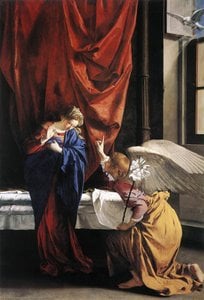
In the masterpiece The Annunciation, created in 1620, Giulio Cesare Procaccini captures the profound moment when the angel Gabriel announces to the Virgin Mary that she will bear a son, Jesus. The composition is defined by a sense of movement and energy, with the figures of Gabriel and Mary arranged along a diagonal line. Through the masterful use of chiaroscuro, the artist employs strong contrasts between light and dark to instill the scene with drama and tension, adding significant depth and volume to the figures.
The painting is rich with symbolic elements that deepen its narrative impact. A lily is featured as a symbol of purity and innocence, while a book represents knowledge and wisdom. The vibrant colors and intricate details highlight Procaccini's technical skill, particularly in how light and shadow interact within the frame.
Visual Composition and Detail
The foreground of this oil on canvas features two central figures: a woman dressed in blue robes and a man wearing red garments. The woman is depicted kneeling before the man, who holds a book or manuscript, suggesting an interaction of revelation. Above these figures, three cherubs are seen playing with a butterfly, adding an element of joy and innocence to the scene.
The background presents a dark landscape situated under a cloudy sky, providing a sharp contrast to the brightly lit figures in the foreground. The use of vibrant blues and reds draws the viewer's attention to the importance of the central characters within the composition.
Frågor och svar
Vad rekommenderas för användning av ett tryck av "The Annunciation"?
En reproduktion av "The Annunciation" av Giulio Cesare Procaccini rekommenderas för Accent. Detta förslag grundar sig på verkets motiv, stämning och färger.
Vilken känsla förmedlar "The Annunciation"?
"The Annunciation" förknippas med en Romantic känsla. Den emotionella tonen beskriver det intryck som verket förmedlar.
Vem har skapat "The Annunciation" och i vilken stil är den utförd?
Giulio Cesare Procaccini skapade "The Annunciation" inom Baroque-rörelsen.
Liknande konstverk


Konstnärsbiografi
The Master of Milanese Drama: The Life and Legacy of Giulio Cesare Procaccini
Giulio Cesare Procaccini stands as a pivotal figure in the burgeoning artistic landscape of early Baroque Milan, marking a decisive transition from Mannerist formalism to the expressive dynamism that would define an era. Born in Bologna in 1574, he descended from a lineage steeped in profound artistic tradition; his father, Ercole Procaccini the Elder, was himself a notable Mannerist painter. This heritage profoundly shaped his formative years, instilling within him an appreciation for nuanced stylistic complexities and a technical rigor that would later allow him to masterfully blend grace with grandeur. Around 1585, spurred by the influential patronage of Pierro Visconti, the family relocated to Milan, establishing a crucial connection with one of Italy’s wealthiest art collectors and fostering an environment ripe for the artistic experimentation that would become Procaccini's hallmark.
The artist's creative journey began not with the brush, but with the chisel. His early training was rooted in sculptural endeavors, primarily focused on the sacred spaces of the Milanese Duomo and Santa Maria presso San Celso. This tactile foundation in sculpture left an indelible mark on his later paintings, manifesting in a unique sense of volume, weight, and anatomical presence. However, he eventually transitioned to painting, recognizing its unparalleled capacity for conveying intense emotion and celestial light. During this period of development, Procaccini moved within the highest intellectual circles of Milan, associating with luminaries such as Giovanni Battista Crespi, known as Il Cerano, and Pier Francesco Mazzucchelli, or Il Morazzone. Under the spiritual and material guidance of Cardinal Federico Borromeo, Procaccini's creative output was propelled toward greatness, allowing him to capture the very spirit of the Counter-Reformation.
A Symphony of Light and Devotion
Procaccini’s mature style is a breathtaking synthesis of various European influences, most notably the vibrant colorism of the Venetian school and the sweeping, energetic compositions of Peter Paul Rubens. His works are characterized by a dramatic use of chiaroscuro, where deep shadows dance against luminous highlights to create a sense of theatrical movement. In masterpieces such as The Annunciation, one can witness this Baroque drama firsthand, as vibrant colors and swirling drapery evoke a profound sense of divine intervention. His ability to manipulate light allowed him to breathe life into religious narratives, transforming static icons into living, breathing moments of spiritual ecstasy.
His technical prowess is perhaps most evident in his large-scale religious commissions, which served both as artistic triumphs and instruments of faith. Notable examples include:
- Madonna and Child with Sts Francis and Dominic and Angels: A monumental oil on canvas commissioned for the church of Madonna dei Miracoli in Corbetta, where he masterfully blends Mannerist elegance with a new, surging Baroque energy.
- The Six Quadroni: Perhaps his most celebrated achievement, these large canvases depicting Saint Charles Borromeo were commissioned for the Basilica della Santissima Annunziata del Vastato in Genoa, showcasing his ability to handle epic, monumental scale.
- St Sebastian Tended by Angels: A work that highlights his delicate touch and his ability to weave together themes of suffering and divine tenderness through fluid, rhythmic compositions.
Historical Significance and Artistic Triumph
The historical significance of Giulio Cesare Procaccini lies in his role as a bridge between two worlds. He took the sophisticated, often artificial elegance of the Mannerist period and infused it with a new, visceral humanity that resonated with the religious fervor of 17th-century Italy. His work does not merely depict a scene; it invites the viewer into a sensory experience of the divine. Through his mastery of color, light, and movement, he helped establish Milan as a major center of Baroque excellence, leaving behind a legacy of altarpieces and frescoes that continue to captivate the modern imagination with their profound emotional depth and technical brilliance.

Giulio Cesare Procaccini
1574 - 1625 , Italy
Kortfakta
- Full Name: Giulio Cesare Procaccini
- Nationality: Italian
- Date Of Birth: 1574
- Date Of Death: 1625
- Place Of Birth: Bologna, Italy
- Notable Artworks:
- St Sebastian Tended by Angels
- Holy Family with John the Baptist and an Angel
- Circumcision
- Last Supper
- Scourging of Christ
- Ecce Homo
- Artistic Movement Or Style: Baroque
- Artists Who Influenced This Artist: ['Ercole Procaccini']
- Artists Or Movements Influenced By This Artist: ['Rubens']
Relaterade artiklar

Barockens dramatik: En expertguide till 1600-talets kraftfulla konst och känslor
Lär dig allt om barockens dramatiska ljus och teknik genom vår expertguide. Upptäck 1600-talets mästerverk här.

The Dramatic Flourish: Exploring the Baroque Movement's Enduring Legacy in Art History
Explore the dramatic world of Baroque art! Discover iconic artists like Caravaggio & Rubens, defining techniques, and its lasting impact on art history. Expert insights for collectors & enthusiasts at ArtsDot.

Topp 10 legendariska oljemålningar på panel som förändrade konsten – ArtsDot.com
Utforska de 10 mest legendariska oljemålningarna på panel som revolutionerade konsten! Lär känna mästerverk från renässans till impressionism. Hitta inspiration & köp museumkvalitets konsttryck hos ArtsDot.com – din källa för tidlös skönhet.

Barockens Mästerverk: Topp 10 konstverk som definierade en epok – ArtsDot.se
Upptäck barockens 10 största mästerverk! Caravaggio, Rembrandt, Bernini och fler. Lär känna historien bakom ikoniska målningar & skulpturer. Köp reproduktioner av hög kvalitet på ArtsDot.com – för en lyxig heminredning.

Barockens Mästerverk: Topp 10 målningar som definierade epoken – ArtsDot.se
Upptäck barockens 10 mest ikoniska målningar! Lär känna Karavaggio, Rembrandt och Rubens – deras teknik & berättelser. Köp museumkvalitativa reproduktioner och hitta inspiration till din inredning på ArtsDot.com.