


 Förhandsvisa
 Skicka
 Dela
Dela
 Visa detaljer

 Ladda ner
 Liknande objekt
 Röntgen
 Bildspel
 Statistik
The Procuress


 Visa mer
Handgjord oljereproduktion
Handmålad olja på duk i din valda storlek och ram, tillverkad efter beställning av våra konstnärer. ( Byt till tryck Byt till digital bild)




P118B $10

P118H $10

P118W $10

P438Z $10

P508JH $12

P508YH $12

P805H $10

P805Z $10

P919BZ $10

P919G $10

P919XJ $10

P959ZH $10

P968JZ $12

W106C $8

W218G $10

W218JH $8

W218Y $10

W307PJ $10

W316G $10

W316PJ $8

W316Y $10

W398PJ $8

W4111J $10

W500HY $15

W500JH $15

W692G $12

W849H $8

W940BG $15

W953PJ $8




Välj bland våra förinställda storlekar som motsvarar konstverkets ursprungliga proportioner.

Du kan ange egna mått för att passa en specifik ram eller yta. Om den valda storleken inte matchar originalbildens proportioner kommer vi antingen att beskära konstverket eller utöka målningen med ytterligare handmålade element. En digital skiss skickas till dig för godkännande innan produktionen påbörjas.
Observera att förhandsvisningen på skärmen inte återspeglar den faktiska beskärningen eller utökningen. Endast skissen visar den slutgiltiga kompositionen korrekt.
Även om anpassade storlekar är möjliga, rekommenderar vi att du väljer en dimension från den fördefinierade listan för att bevara originalproportionerna.
Efter beställning kommer ArtsDot.com team att mejla kunden för instruktioner och tillhandahålla en skissförhandsvisning
Leverans över hela världen () på 3–4 veckor istället för standard 5 veckor. (15 september). Inga kompromisser med kvaliteten.

Fri expressfrakt över hela världen

Högkvalitativ linnecanvas

Fullständig fraktförsäkring

Garantier för återbetalning av tullavgifter

Garantier för exakt färgåtergivning

100 dagars returrätt (endast vid defekter)

100% pengarna tillbaka-garanti

Mängdrabatt erbjuds
 Glasalternativet är endast tillgängligt i storlekar under 110 cm.

The Procuress
Reproduktionsmedium
Storlek på reproduktion
-


Slutgiltigt pris
$ 263
A Nocturnal Drama Unveiled
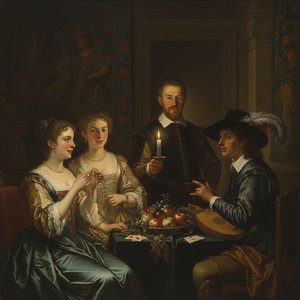
In the flickering glow of an unseen flame, Gerard van Honthorst’s The Procuress invites the viewer into a clandestine world of whispered secrets and moral ambiguity. Painted in 1625, this masterpiece serves as a breathtaking testament to the Dutch Golden Age, capturing a moment of theatrical tension that feels almost voyeuristic. The scene unfolds within a dimly lit interior, where the boundaries between light and shadow are not merely stylistic choices but narrative protagonists. As one gazes upon the composition, the eye is immediately drawn to the interplay of figures: a young woman with a provocative allure, an older woman acting as the intermediary, and a man whose presence suggests a transaction of much more than mere currency. It is a painting that does not just depict a scene; it breathes with the heavy, humid atmosphere of a Roman night.
The emotional resonance of the work lies in its ability to evoke a sense of palpable suspense. There is an intimacy here that borders on the uncomfortable, pulling the observer into a private encounter where social graces are stripped away by the raw necessity of desire and greed. For the collector or the lover of fine art, this piece offers more than just visual beauty; it provides a window into the psychological complexities of the human condition, making it an intellectually stimulating addition to any curated collection.
The Mastery of Tenebrism and Light
To understand The Procuress is to understand the genius of the man known as Gherardo delle Notti—Gerard of the Nights. Honthorst’s technical prowess is defined by his profound command of tenebrism, a technique characterized by violent contrasts between deep, impenetrable shadows and brilliant, localized highlights. Influenced heavily by the revolutionary Caravaggio, Honthorst mastered the art of "artificial lighting," where the light source—often a candle or a small lamp hidden from view—sculpts the figures out of the darkness. This method creates a sculptural quality in the flesh tones and a luxurious texture in the fabrics, from the shimmering silks to the heavy velvets.
The technique serves a dual purpose: it directs the viewer's gaze with surgical precision and heightens the dramatic stakes of the narrative. The way light catches the edge of a porcelain bowl or illuminates a seductive smile creates a rhythmic movement across the canvas, ensuring that the eye never rests too long on one spot but instead wanders through the shadows, searching for the next revelation. For interior designers, this dramatic use of chiaroscuro offers an unparalleled sense of depth and luxury, providing a focal point that can anchor a room with its profound architectural weight and classical elegance.
Symbolism and the Moral Landscape
Beyond its technical brilliance, The Procuress is a rich tapestry of social commentary and symbolic meaning. During the 17th century, such genre paintings often functioned as moralizing tales, warning against the vices of lust and avarice. The very title suggests a transaction of questionable morality, where the "matchmaker" facilitates encounters driven by passion and profit. Every element within the frame—the way a hand rests near a purse, the specific arrangement of objects on the table, and the suggestive glances exchanged between characters—contributes to a larger discourse on the fragility of virtue in an era of burgeoning mercantile wealth.
The painting captures the tension of the Dutch Golden Age, a period where unprecedented prosperity met deep-seated religious and ethical scrutiny. By bringing these themes into a domestic setting, Honthorst makes the high drama of morality accessible and intensely personal. Owning a reproduction of such a work is an opportunity to possess a piece of history that continues to provoke thought, offering a sophisticated layer of storytelling to any living space. It is a celebration of the shadows as much as the light, reminding us that the most compelling truths are often found in the dimmest corners of our existence.
Liknande konstverk


Konstnärsbiografi
A Master of Light and Shadow: The Life and Art of Gerard van Honthorst
Gerard van Honthorst emerged from Utrecht in 1592, a pivotal figure poised to illuminate the Dutch Golden Age with his dramatic artistry. Initially guided by his father, a decorative painter, young Gerard’s talent blossomed under the tutelage of Abraham Bloemaert, establishing a solid foundation in draftsmanship and composition. However, it was a transformative journey to Rome that irrevocably altered the course of his artistic development. There, amidst the fervent energy of the Italian Baroque, he encountered the groundbreaking work of Caravaggio – an encounter that would define his signature style and earn him the evocative nickname “Gherardo delle Notti,” or Gerard of the Nights. The dramatic use of *tenebrism*, a technique employing stark contrasts between light and dark, became Honthorst’s hallmark, imbuing his canvases with a palpable sense of drama and emotional intensity. He wasn't merely imitating Caravaggio; he was translating the Italian master’s innovations into a distinctly Dutch sensibility, focusing on intimate scenes illuminated by artificial light sources – candles, lamps, and fires – creating an atmosphere both realistic and deeply theatrical. This mastery over light wasn’t simply technical skill; it was a means of revealing character, of drawing the viewer into the emotional core of each scene. Honthorst's early works in Rome showcased this talent brilliantly, capturing the bustling streets and shadowy interiors with remarkable realism and psychological insight.Early Life and Artistic Training
Gerard van Honthorst was born in Utrecht, the son of a decorative painter, and received his initial artistic training from his father. This foundation provided him with a strong grounding in draftsmanship and composition – essential skills for any aspiring artist. However, it was Abraham Bloemaert, a respected master painter in Utrecht, who truly nurtured Honthorst’s talent, guiding him through the intricacies of perspective, color theory, and anatomical accuracy. Bloemaert's influence shaped Honthorst’s early style, characterized by a meticulous attention to detail and a classical sensibility. Yet, it was the decision to travel to Italy around 1616 that proved to be the catalyst for his artistic transformation. This journey marked a pivotal moment in his career, exposing him to the revolutionary techniques of the Italian Baroque and setting him on a path toward developing his unique style. The vibrant colors, dramatic lighting, and emotionally charged scenes of Caravaggio’s paintings profoundly impacted Honthorst's approach to art.The Roman Period: Influence and Innovation
Honthorst’s time in Rome was marked by considerable success and patronage. He quickly established himself as a talented painter, attracting the attention of wealthy collectors and influential figures within the city’s artistic circles. Notably, he found favor amongst Vincenzo Giustiniani, for whom he created the powerful “Christ Before the High Priest,” a work that exemplifies his masterful command of light and shadow. This painting, now residing in London’s National Gallery, showcases not only his technical skill but also his ability to convey profound psychological depth within his figures. Honthorst's exposure to Caravaggio’s radical style—particularly his use of *chiaroscuro*—was transformative. He didn’t simply copy Caravaggio; he adapted and refined the Italian master’s innovations, imbuing them with a distinctly Dutch sensibility. His paintings often featured intimate scenes illuminated by candlelight or lamplight, creating an atmosphere of both realism and theatrical drama. This period saw Honthorst develop his signature style—a blend of classical restraint and Baroque dynamism—that would define his career.Return to the Netherlands and Royal Commissions
Upon returning to Utrecht around 1620, Honthorst quickly established himself as a leading portrait painter in the Dutch Republic. His ability to capture not just physical likeness but also the character and social standing of his sitters made him highly sought after by wealthy merchants, nobles, and even royalty. He became president of the Guild of St. Luke in Utrecht in 1623, a testament to his growing influence within the artistic community. This period saw a flourishing of commissions, allowing Honthorst to refine his style and establish a distinctive voice within Dutch painting. He also undertook significant projects for the court, including elaborate ceiling paintings depicting allegorical scenes—a skill that demonstrated both his technical prowess and his understanding of symbolism. His willingness to collaborate with other artists, such as Rembrandt van Rijn, further solidified his position as a leading figure in the Dutch art world.Legacy and Artistic Significance
Gerard van Honthorst’s influence resonated far beyond his lifetime. He was a key figure in the *Utrecht Caravaggisti* movement – a group of Dutch painters who embraced Caravaggio's dramatic realism and *tenebrism*. Alongside artists like Hendrick ter Brugghen and Dirck van Baburen, he helped to establish a distinctly Dutch interpretation of Italian Baroque style. His emphasis on genre scenes illuminated by artificial light, his masterful portraits, and his ability to convey emotional depth through skillful use of chiaroscuro left an indelible mark on the development of Dutch Golden Age painting. Even his brother, Willem van Honthorst, followed in his footsteps, though often with works initially misattributed to Gerard due to stylistic similarities. His paintings continue to captivate audiences today, offering a glimpse into the dramatic and emotionally charged world he created. He cemented his place as a pivotal figure in art history, demonstrating how artistic influences can be both transformative and uniquely adapted to a new cultural context.
Gerard van Honthorst
1590 - 1656 , Nederländerna
Kortfakta
- Artistic Movement Or Style: Barock, Caravaggism
- Artists Or Movements Influenced By This Artist: ['Utrechts Caravaggisti']
- Artists Who Influenced This Artist: ['Caravaggio']
- Date Of Birth: 1590
- Date Of Death: 1656
- Full Name: Gerard van Honthorst
- Nationality: Nederländsk
- Notable Artworks:
- Kristus för Hövdingen
- Födelsen i Florens
- Place Of Birth: Utrecht, Nederländerna
Relaterade artiklar
Gerard van Honthorst: Illuminating the Dutch Golden Age with Caravaggism & Courtly Grace
Explore the captivating world of Gerard van Honthorst, a Dutch Golden Age master renowned for his dramatic chiaroscuro & courtly portraits. Discover his life, art, and lasting influence on Baroque painting.

Golden Age Reflections: Dutch Baroque Painting & Cultural Innovation
Explore the Dutch Golden Age of painting! Discover key artists like Vermeer & ter Borch, their innovative techniques, and the rich cultural context behind these Baroque masterpieces. Learn about collecting & appreciating this iconic art period.

Nederländsk Guldålder: Topp 10 mästerverk som definierade epoken – konst & heminredning
Utforska de 10 ikoniska mästerverken från den nederländska guldåldern! Lär känna Rembrandt, Vermeer och Hals – deras teknik & berättelser. Hitta konsttryck och inspiration för din heminredning på ArtsDot.com. Upptäck hela samlingen online!

Rembrandts 25 Mästerverk: En Konsthistorisk Resa för Hemmet
Utforska Rembrandts 25 mest ikoniska målningar! Lär känna historien bakom mästerverken, hans unika teknik och barockens ljusspel. Köp exklusiva konsttryck & tavlor online på ArtsDot.com – för en tidlös inredning.

Nederländsk Barock: Topp 10 Mästerverk som Definierade Epoken – Konst & Inredning
Upptäck de 10 ikoniska mästerverken som definierade nederländsk barock! Lär känna Rembrandt, Vermeer och andra stora konstnärer. Hitta inspiration & museumkvalitativa reproduktioner på ArtsDot.com – för ditt hem eller din samling.
