


 Visa i rummet
 Skicka
 Dela
Dela
 Detaljer
 Guide
Guide

 Ladda ner
 Liknande objekt
 Röntgen
 Bildspel
 Besökstatistik
Edinburgh from the Castle
 Acrylic On Canvas
- WallArt
- Oriental Romanticism
 1847
1847 122.0 x 213.0 cm
 Yale Center for British Art
 Läs mer
Handgjord oljereproduktion
Handmålad olja på duk i din valda storlek och ram, tillverkad efter beställning av våra konstnärer. ( Byt till tryckta exemplar Byt till digital bildförsäljning)




P118B $10

P118H $10

P118W $10

P438Z $10

P508JH $12

P508YH $12

P805H $10

P805Z $10

P919BZ $10

P919G $10

P919XJ $10

P959ZH $10

P968JZ $12

W106C $8

W218G $10

W218JH $8

W218Y $10

W307PJ $10

W316G $10

W316PJ $8

W316Y $10

W398PJ $8

W4111J $10

W500HY $15

W500JH $15

W692G $12

W849H $8

W940BG $15

W953PJ $8




Välj bland våra förinställda storlekar som motsvarar konstverkets ursprungliga proportioner.

Du kan ange egna mått för att passa en specifik ram eller yta. Om den valda storleken inte matchar originalbildens proportioner kommer vi antingen att beskära konstverket eller utöka målningen med ytterligare handmålade element. En digital skiss skickas till dig för godkännande innan produktionen påbörjas.
Observera att förhandsvisningen på skärmen inte återspeglar den faktiska beskärningen eller utökningen. Endast skissen visar den slutgiltiga kompositionen korrekt.
Även om anpassade storlekar är möjliga, rekommenderar vi att du väljer en dimension från den fördefinierade listan för att bevara originalproportionerna.
Efter beställning kommer ArtsDot.com team att mejla kunden för instruktioner och tillhandahålla en skissförhandsvisning
Leverans över hela världen () på 3–4 veckor istället för standard 5 veckor. (23 september). Inga kompromisser med kvaliteten.

Fri expressfrakt över hela världen

Högkvalitativ linnecanvas

Fullständig fraktförsäkring

Garantier för återbetalning av tullavgifter

Garantier för exakt färgåtergivning

100 dagars returrätt vid fabrikationsfel

100% pengarna tillbaka-garanti

Mängdrabatt erbjuds
 Glasalternativet är endast tillgängligt i storlekar under 110 cm.

Edinburgh from the Castle
Tryckteknik
Reproduktionsstorlek
-


Totalpris
$ 263
Edinburgh from the Castle by David Roberts
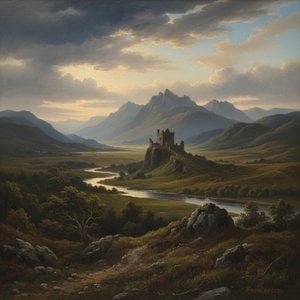
David Roberts’s “Edinburgh from the Castle” stands as a cornerstone of Victorian landscape painting and a testament to the artist's meticulous observation and masterful execution. Completed in 1847, this monumental oil on canvas captures a panoramic vista of Edinburgh city viewed from Arthur’s Seat, offering viewers an unparalleled glimpse into Scotland’s capital during a period of significant urban expansion and artistic fervor.A Vision of Victorian Grandeur
Roberts's style embodies the Romantic spirit tempered by scientific accuracy—a hallmark of the era. He eschewed fantastical embellishments in favor of a rigorously detailed depiction of the cityscape, prioritizing topographical precision alongside atmospheric perspective. The painting’s ambition wasn’t merely to record what was seen; it aimed to convey the grandeur and dynamism of Edinburgh's burgeoning industrial age against the backdrop of Scotland’s ancient hills. This juxtaposition speaks volumes about Victorian sensibilities – a fascination with both progress and heritage.Technique and Detail: Roberts's Legacy
Roberts employed a technique characterized by smooth, blended brushstrokes—a hallmark of his style—allowing him to achieve remarkable tonal gradation and convincingly simulate the hazy air of the Scottish highlands. Layers upon layers of pigment were applied with painstaking care, capturing the subtle nuances of light and shadow across the castle walls and rooftops. The artist’s meticulous attention to detail extends beyond mere representation; it imbues the scene with a palpable sense of presence, inviting contemplation on the scale and beauty of the natural world alongside human settlement. Roberts's use of glazing techniques further enhanced the luminosity and depth of color, resulting in an image that glows with warmth and vibrancy.Symbolism Within the Landscape
Arthur’s Seat dominates the composition, representing Scotland’s geological history and serving as a visual anchor for the viewer’s gaze. The castle itself symbolizes power, authority, and tradition—elements crucial to understanding Victorian Britain's social and political landscape. Furthermore, the scattered figures within the painting – laborers, merchants, and tourists – embody the diverse population of Edinburgh at the time, reflecting the city’s role as a hub of commerce and culture. Roberts subtly communicates these ideas through his careful positioning of elements within the frame.Emotional Resonance: Capturing the Spirit of Place
“Edinburgh from the Castle” transcends mere visual representation; it evokes a profound emotional response. The painting's expansive scale inspires awe, while its luminous colors convey a sense of optimism and vitality. It captures not only the physical beauty of Edinburgh but also its spirit—a blend of rugged wilderness and civilized sophistication. This artwork continues to resonate with audiences today because it successfully communicates the grandeur of Victorian Scotland and remains an enduring symbol of artistic excellence. Its impact on subsequent landscape painters is undeniable, cementing Roberts’s place as one of Scotland's most celebrated artists.Liknande konstverk


Om konstnären
David Roberts: A Life in Art
David Roberts (1796–1864) was a Scottish painter celebrated for his detailed Orientalist scenes and meticulous lithographs. His work provides invaluable visual documentation of the Middle East during the 19th century, bridging artistic representation with historical record. He remains one of Scotland’s most important artists of the Victorian era.Early Life and Career
Born on October 24, 1796, in Stockbridge near Edinburgh, Roberts’s early life was marked by practical training. At the age of ten, he began an apprenticeship with house painter and decorator Gavin Beugo. This foundational experience instilled a strong technical skill set, which he supplemented through evening art studies. He diligently honed his craft, absorbing techniques from master painters and decorators—a skillset that would prove invaluable throughout his artistic journey. His father, John Roberts, was an impoverished shoemaker, who, with his wife Christine, tried to support five children in a small house on Duncan’s Land by the Water of Leith. The house remains standing today as a testament to their modest beginnings.His initial professional work included redecorating Scone Palace in 1815—a prestigious commission that showcased his burgeoning talent and established him within Edinburgh's artistic circles.
Artistic Journey and Influences
Roberts’ artistic development was shaped by a growing fascination with different cultures and landscapes. While initially focused on theatrical scenery, he gradually shifted towards more independent artistic pursuits. His travels to Spain in 1832 were formative, sparking an interest in architectural detail and exotic locales—a passion that would fuel his later expeditions into Egypt and the Near East. He meticulously sketched buildings and monuments, capturing their grandeur with unwavering precision.However, it was his extensive tours of Egypt and the Near East (1838–1840) that truly defined his career. These journeys provided him with a wealth of sketches and observations which he later translated into his most famous works. His style wasn’t heavily influenced by any single artist, but rather developed from careful observation and technical mastery—a hallmark of his distinctive approach.
Notable Works and Achievements
Roberts is best known for The Holy Land, Syria, Idumea, Arabia, Egypt, and Nubia – a series of meticulously detailed lithograph prints. These images captured the grandeur of ancient sites and the vibrancy of contemporary life in the region. He skillfully combined bold design with precise observation—resulting in breathtaking panoramas that transported viewers to distant lands. The six-volume set became an instant bestseller and cemented his reputation as a leading exponent of Orientalist art.- Lithographs: His lithographs were widely circulated and became highly influential in shaping European perceptions of the Middle East.
He also produced numerous oil paintings, often large-scale works depicting expansive landscapes and architectural marvels—demonstrating his versatility as an artist.
Legacy and Historical Significance
David Roberts’s work played a crucial role in popularizing the Middle East among European audiences. His images provided a visual window into a region that was largely unknown to many, influencing travel, scholarship, and artistic representation. He left an indelible mark on the art world, inspiring subsequent generations of artists and continuing to captivate viewers today—a legacy secured by his enduring contribution to Victorian landscape painting and his pioneering exploration of Orientalist themes.
David Roberts
1796 - 1864 , Storbritannien
Snabbfakta
- Artistic Movement Or Style: Orientalism
- Artists Who Influenced This Artist: ['']
- Date Of Birth: October 24, 1796
- Date Of Death: November 25, 1864
- Full Name: David Roberts
- Nationality: Scottish
- Notable Artworks: ['The Holy Land, Syria, Idumea, Arabia, Egypt, and Nubia']
- Place Of Birth: Stockbridge
Relaterade artiklar
Alexander Nasmyth: Picturing Scotland's Romantic Landscape – Innovation & Identity
Explore the life & art of Alexander Nasmyth, a pivotal figure in Scottish Romantic landscape painting. Discover his iconic works, including portraits of Robert Burns, and learn about his lasting influence on national identity. Fine art reproductions available.

David Roberts: A Scottish Pioneer of Topographical Art & Orientalist Vision
Explore the captivating world of David Roberts, a pioneering Scottish painter renowned for his detailed Orientalist scenes & stunning Egyptian landscapes. Discover his legacy and find museum-quality reproductions at ArtsDot.

Francis Cadell: A Study in Scottish Colourism & Intimate Portraiture
Explore the captivating world of Francis Campbell Cadell, a leading Scottish Colourist. Discover his elegant Edinburgh interiors, vibrant portraits & unique style. Learn about his influences and enduring legacy with ArtsDot.

Hubert Robert: Picturing Ruins, Preserving Memory – A Study of Romantic Antiquarianism & Artistic Innovation
Explore the captivating world of Hubert Robert, master of Romantic landscape painting & 'capriccio' ruins. Discover his historical context, artistic innovations, and collecting insights with ArtsDot.

George Paul Chalmers: Rediscovering the Angus Rembrandt & Scottish Colourist Roots
Explore the captivating world of George Paul Chalmers (1833-1878), a pivotal Scottish painter. Discover his landscapes, portraits & connection to the Aesthetic Movement and Colourists. Learn about this 'Angus Rembrandt's' legacy with ArtsDot.
