

 Skicka
 Dela
Dela
 Visa detaljer
 Guide
Guide

 Ladda ner
 Liknande objekt
 Bildspel
 Frågor och svar
 Statistik
Moder och barn


 Visa mer
Konstverket som visas på denna sida skyddas av upphovsrättslagen, vilket innebär att vi inte lagligt kan skapa eller sälja en identisk reproduktion. Detta skydd upprätthålls genom internationella avtal såsom den Bernkonventionen och genom nationella lagar, inklusive de som fastställs av Amerikansk upphovsrättslag – Titel 17. Alla rättigheter förbehållna. Återgivning av konstverk är förbjuden utan skriftligt tillstånd från WahooArt.
Denna metod följer fullt ut upphovsrättsliga regler eftersom den inte innebär kopiering eller duplicering av det skyddade konstverket. Istället är det en kreativ nytolkning – en ny målning som är influerad av originalet men inte identisk med det.
Giclée / Konsttryck
Giclée- eller canvasprint av museumskvalitet med snabb produktion och flexibla ytbehandlingsalternativ. ( Beställ handmålad reproduktion Byt till digital bild)




































Välj bland våra förinställda storlekar som motsvarar konstverkets ursprungliga proportioner.

Ange den bredd och höjd du behöver för att passa din ram eller vägg. Ett tryck kan endast beskäras, aldrig göras större än originalbilden, vilket innebär att ett format med en annan proportion leder till att en del av bilden går förlorad. Vi skickar en digital mockup för godkännande innan vi påbörjar tryckningen. Bilden som visas på denna sida visar inte den faktiska beskärningen — det är endast mockuppen som gör det.
Leverans över hela världen () på 2 veckor istället för standard 4/5 veckor. (6 november)

Fri expressfrakt över hela världen

Högkvalitativ linnecanvas

Fullständig fraktförsäkring

Garantier för återbetalning av tullavgifter

Garantier för exakt färgåtergivning

100 dagars returrätt (endast vid fel)

100% pengarna tillbaka-garanti

Mängdrabatt erbjuds
 Glasalternativet är endast tillgängligt i storlekar under 110 cm.

Moder och barn
Giclée / Konsttryck
Storlek på reproduktion
-


Slutgiltigt pris
Skr 631
Barbara Hepworth och hennes ikoniska verk "Moder och Barn"
Barbara Hepworth (1903–1975) är en brittisk konstnär och skulptör vars arbete präglas av modernistens kärna – enkelhet, abstraktion och ett fokus på grundläggande former. Hon föddes i Wakefield, Yorkshire, och studerade vid Leeds Konstskola innan hon fick ett stipendium till Kungliga Konstakademin (RCA) i London där hon tog examen 1924. Hepworths konstnärliga resa är särskilt betydelsefull för sin tid eftersom hon var en av få kvinnliga konstnärer som nådde internationell framgång och blev en pionjär inom abstrakt skulptur.- Konststil: Hepworth tillhör den abstrakta skulpturen och arbetade ofta med stora, organiska former gjorda av sten och marmor. Hennes stil kännetecknas av ett lugnt uttryck och en förmåga att fånga komplexa rörelser och dynamik genom enkla geometriska linjer.
- Teknik: Hepworth använde ofta tekniker som brytning och slipning för att skapa släta ytor och avslöja formens kärna. Detta krävde stor precision och kontroll över materialet samt en djup förståelse för fysikens principer.
- Historisk Kontext: Hepworths verk skapades under andra världskriget och efteråt när Europa genomgick stora förändringar både kulturellt och politiskt. Konstnärer som Hepworth försökte skapa konst som reflekterade den komplexa världen omkring dem samtidigt som de sökte ett eget språk för att uttrycka sina idéer.
- Symbolism: Hepworths verk är ofta fyllda med symboliska betydelser som utforskar teman om kvinnlighet, maternitet och relationen mellan människa och natur. Formen på hennes skulpturer kan ses som ett sätt att förmedla dessa idéer genom abstrakta bilder.
Frågor och svar
Är Barbara Hepworth, skaparen av "Moder och barn", känd under andra namn?
Barbara Hepworth är även känd under namnen Dame Barbara Hepworth.
Vilken känsla förmedlar "Moder och barn" av Barbara Hepworth?
Den emotionella tonen som har registrerats för "Moder och barn" av Barbara Hepworth är Lugn och ro. Den sammanfattar den känsla som verket uttrycker.
Vilken är den övergripande stämningen i "Moder och barn" av Barbara Hepworth?
"Moder och barn" har en Harmonisk atmosfär.
Liknande konstverk


Konstnärsbiografi
Barbara Hepworth: Pioneer of Abstract Sculpture
Barbara Hepworth (1903–1975) stands as one of the most influential figures in twentieth-century British art, recognized for her groundbreaking contributions to modern sculpture and her unwavering dedication to exploring the relationship between form and space. Born Jocelyn Barbara Hepworth in Wakefield, Yorkshire, she possessed an innate fascination with natural forms—particularly pebbles and seashells—which would profoundly shape her artistic vision throughout her prolific career. Her formative years were marked by a deep connection to the rugged landscape of West Yorkshire, fostering a sensitivity for texture and materiality that would become central to her sculptural practice.- Early Influences: Hepworth’s artistic journey began with studies at Leeds School of Art in 1920, where she encountered Henry Moore, establishing a collaborative spirit that would endure throughout their lives. This formative period instilled in her an appreciation for geometric abstraction and the exploration of fundamental visual principles.
- Royal College of Art & Surrealism: Continuing her education at the Royal College of Art from 1921 until she graduated in 1924, Hepworth embraced the burgeoning avant-garde movement of Surrealism, collaborating with Ben Nicholson and Paul Nash. This exposure to surrealist ideas fueled her experimentation with unconventional materials and techniques.
The Unit One Movement & Early Sculptural Innovations
Hepworth’s artistic breakthrough arrived in 1933 with the formation of Unit One, alongside Nicholson, Nash, and others—a collective dedicated to uniting Surrealism and abstraction. This movement championed a radical departure from representational art, prioritizing pure form and exploring its inherent dynamism. Hepworth's early sculptures – notably *Oval Form* (Trezion) – exemplify this aesthetic ethos, characterized by smooth surfaces and subtly curving shapes that defy easy categorization.- Material Exploration: Hepworth’s mastery lay in her ability to transform raw materials—primarily stone and bronze—into evocative forms. She meticulously honed her craft, mastering techniques of carving and casting to achieve unparalleled precision and expressive power.
- Influence of Moore & Nicholson: Hepworth's artistic dialogue with Henry Moore and Ben Nicholson proved invaluable in shaping her aesthetic sensibilities. Their shared commitment to exploring the interplay between organic and geometric forms propelled her creative endeavors forward.
Mature Style & Monumental Commissions
Throughout the 1940s and 1950s, Hepworth’s sculptural output intensified, reflecting a deepening engagement with both landscape and human figure. Her distinctive style—characterized by concentric circles and voids—became synonymous with modern sculpture.- Landscape as Inspiration: Hepworth drew inspiration from the Yorkshire countryside, translating its contours and textures into monumental sculptures that captured the essence of natural forms. Pieces like *Two Forms* and *Totem* stand as testament to her ability to convey profound emotional resonance.
- Public Recognition & Legacy: Hepworth’s work garnered international acclaim, securing prestigious commissions—including Winged Figure for John Lewis—and cementing her place among the foremost sculptors of her time. Her enduring influence continues to inspire artists today.
The Hepworth Wakefield & Continuing Artistic Exploration
Today, Barbara Hepworth’s legacy resides prominently at The Hepworth Wakefield, where a comprehensive collection showcases her oeuvre—spanning from early explorations of abstraction to monumental sculptures that redefine the boundaries of artistic expression.- A Singular Vision: Hepworth's unwavering dedication to exploring form and space—coupled with her profound sensitivity for materials—established her as an unparalleled innovator in modern sculpture. Her work remains a beacon of creativity, inviting viewers to contemplate the fundamental questions of art and existence.

Barbara Hepworth
1903 - 1975 , Storbritannien
Kortfakta
- Artistic Movement Or Style: Modernism
- Artists Or Movements Influenced By This Artist: ['Abstraction']
- Artists Who Influenced This Artist: ['Henry Moore']
- Date Of Birth: 10 januari 1903
- Full Name: Barbara Hepworth
- Nationality: Brittisk
- Notable Artworks:
- Oval Form
- Two Forms
- Totem
- Place Of Birth: Wakefield, England
Relaterade artiklar
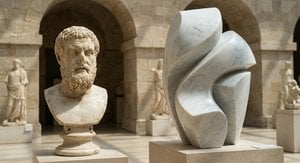
The Enduring Allure of Marble in Art History: From Classical Sculpture to Modern Abstraction
Explore the captivating history of marble sculpture from ancient Greece to modern art. Discover renowned artists like Canova & Michelangelo, carving techniques, and investment insights at ArtsDot.

The Enduring Form: Sculpture Across History, Technique & Emotional Resonance
Explore the rich history of sculpture with ArtsDot. Discover key techniques, influential artists & investment potential for discerning collectors. Expert insights into valuing and collecting timeless masterpieces.

Bronsålderns Mästerverk: 10 Skulpturer Som Förändrade Konsthistorien | ArtsDot
Upptäck 10 legendariska brons skulpturer som revolutionerade konsthistorien! Lär känna Rodin, Michelangelo och andra mästare. Köp museumkvalitativa repliker & hitta inspiration för din inredning på ArtsDot.com.

Barbara Hepworth: A Sculptural Dialogue with Form, Space & the Human Condition
Explore the profound world of Barbara Hepworth's sculpture. Discover her artistic evolution, iconic forms, and lasting influence on modern art. A guide for collectors & enthusiasts.

Geometrisk Abstraktion: Topp 10 Mästverk som Formade Konsten | ArtsDot.com
Utforska de 10 mästerverk som definierade geometrisk abstraktion! Lär känna Mondrian, Kandinsky & Malevich. Hitta inspiration och museumskvalitativa konsttryck för ditt hem på ArtsDot.com. Upptäck hela samlingen online!


