


 Visa i rummet
 Skicka
 Dela
Dela
 Detaljer
 Studentguide för konstverk

 Ladda ner
 Liknande objekt
 Röntgen
 Bildspel
 Besökstatistik
untitled (4490)


 Läs mer
Giclée / Konsttryck
Giclée- eller canvasprint av museumskvalitet med snabb produktion och flexibla ytbehandlingsalternativ. ( Köp handmålat konstverk Byt till digital bildförsäljning)




P118B $10

P118H $10

P118W $10

P438Z $10

P508JH $12

P508YH $12

P805H $10

P805Z $10

P919BZ $10

P919G $10

P919XJ $10

P959ZH $10

P968JZ $12

W106C $8

W218G $10

W218JH $8

W218Y $10

W307PJ $10

W316G $10

W316PJ $8

W316Y $10

W398PJ $8

W4111J $10

W500HY $15

W500JH $15

W692G $12

W849H $8

W940BG $15

W953PJ $8




Välj bland våra förinställda storlekar som motsvarar konstverkets ursprungliga proportioner.

Du kan ange egna mått för att passa en specifik ram eller yta. Om det valda måttet inte överensstämmer med originalbildens proportioner kommer vi antingen att beskära konstverket eller utöka bilden med en speglad eller enfärgad kant. En digital mockup skickas för ditt godkännande innan produktionen påbörjas.
Vänligen notera att förhandsvisningen på skärmen inte återspeglar den faktiska beskärningen eller utökningen. Endast mockuppen visar den slutgiltiga kompositionen korrekt.
Även om anpassade storlekar är möjliga, rekommenderar vi att du väljer ett mått från den fördefinierade listan för att bevara de ursprungliga proportionerna.
Leverans över hela världen () på 2 veckor istället för standard 4/5 veckor. (25 september)

Fri expressfrakt över hela världen

Högkvalitativ linnecanvas

Fullständig fraktförsäkring

Garantier för återbetalning av tullavgifter

Garantier för exakt färgåtergivning

100 dagars returrätt vid fabrikationsfel

100% pengarna tillbaka-garanti

Mängdrabatt erbjuds
 Glasalternativet är endast tillgängligt i storlekar under 110 cm.

untitled (4490)
Giclée / Konsttryck
Reproduktionsstorlek
-


Totalpris
$ 62
A Vision of Noble Composure
In the quiet, commanding presence of Agnolo Bronzino’s "untitled (4490)", we are transported back to the height of the Italian Renaissance, a period where portraiture served as both a mirror of status and a window into the soul. This masterful work captures a moment of profound stillness, featuring a man clad in an intricate suit of armor, seated with a dignified poise that speaks of both strength and restraint. The composition is anchored by the central figure, whose metallic attire reflects the light with a precision that highlights Bronzical mastery of texture and form. Beside him, a loyal dog rests at his side, its gaze fixed upon its master with an unmistakable sense of devotion. This subtle interaction between man and beast softens the martial rigidity of the armor, introducing a tender layer of companionship that breathes life into the cold steel.
The artistry of Bronzino, a defining figure of the Mannerist movement, is on full display through his meticulous attention to detail. Every plate of the armor and every fold of the surrounding fabric is rendered with a clarity that borders on the hyper-realistic, yet it is infused with the refined elegance for which the Florentine master was renowned. Unlike the more turbulent emotionality found in the works of his predecessor Pontormo, Bronzino’s technique here emphasizes a cool, polished surface and a controlled palette. This approach creates an atmosphere of eternal stability, making the painting not merely a depiction of a person, but an enduring monument to a specific social identity—that of the knight or warrior-nobleman.
Symbolism and the Spirit of the Renaissance
Beyond its visual splendor, "untitled (4410)" is rich with the symbolic language of the 16th century. The suit of armor is far more than a protective garment; it is a profound statement of rank, duty, and the martial virtues expected of the aristocracy. The presence of a sword nearby further reinforces this narrative of nobility and readiness. Yet, the inclusion of the dog serves as a poignant counterpoint to these symbols of war. In Renaissance iconography, the dog often represents fidelity and loyalty, suggesting that while the man may be a warrior in the external world, he possesses a steadfast heart within his private sphere. This duality between the public persona of the armored knight and the private moment of companionship creates a compelling emotional resonance that continues to captivate viewers centuries later.
For the discerning collector or interior designer, this piece offers an unparalleled opportunity to introduce a sense of historical gravity and sophisticated grace into a living space. A high-quality oil painting reproduction of this work does more than decorate a wall; it serves as a conversation piece that invites contemplation on themes of legacy, devotion, and the timeless nature of human connection. Whether placed in a formal study or a grand hallway, the commanding presence of Bronzino’s subject brings an air of classical prestige and intellectual depth to any curated environment.
Liknande konstverk


Om konstnären
Agnolo Bronzino – Florentine Mannerist Master & Court Painter
Agnolo di Cosimo, known to history as Bronzino, emerged from the vibrant artistic landscape of Renaissance Florence in 1503, a period already brimming with genius. Born the son of a butcher, his path diverged sharply from familial trade, guided instead by an innate talent that would see him become one of the most sought-after portraitists of his era and a defining figure of Mannerism. His early training began with Raffaellino del Garbo, but it was under the tutelage of Jacopo da Pontormo that Bronzino’s artistic sensibilities truly took shape. While absorbing Pontormo's innovative style, he ultimately forged his own distinct voice—one characterized by a cool composure and refined detail markedly different from his teacher’s often emotionally charged works. This early period was also influenced by studies with Andrea del Sarto, exposing him to the legacies of Michelangelo and Leonardo da Vinci, foundational influences that would subtly permeate his mature style. The young Bronzino quickly demonstrated an aptitude for capturing not just physical likeness but a certain psychological depth, even in his earliest commissions.Early Influences & Artistic Formation
Bronzino’s formative years were marked by exposure to the artistic currents of Florence under Pontormo and Sarto. Pontormo's expressive style—characterized by swirling draperies, distorted perspectives, and emotionally charged figures—challenged the prevailing conventions of High Renaissance art. Bronzino absorbed these innovations, adapting them into his own distinctive aesthetic. Simultaneously, he studied Michelangelo’s monumental sculptures and Leonardo da Vinci’s meticulous anatomical drawings, imbibing their mastery of form and observation. These influences instilled in him a profound respect for technical precision and an unwavering commitment to conveying psychological complexity—traits that would become hallmarks of his artistic practice. His early portraits already hinted at the stylistic refinements that would characterize his later oeuvre.Ascension at the Medici Court
Bronzino’s career ascended dramatically with the patronage of Cosimo I de’ Medici, Duke of Tuscany. This relationship, solidified after Bronzino contributed to the lavish decorations celebrating Cosimo’s wedding to Eleonora di Toledo in 1539—a spectacle designed to impress both domestic and foreign dignitaries—cemented his position as the official court painter for much of his life. It was a role he fulfilled with unwavering dedication and remarkable skill. The portraits emanating from this period are not merely likenesses; they are carefully constructed statements of power, status, and dynastic ambition. Cosimo and Eleonora themselves became frequent subjects, immortalized in paintings that exude an aristocratic aloofness and polished elegance. These works weren’t simply about capturing physical resemblance but crafting enduring symbols of Medici authority—visual representations intended to convey prestige and reinforce the ruler's dominion. He skillfully utilized techniques such as sfumato (a subtle blending of colors) and chiaroscuro (the dramatic interplay of light and shadow) to heighten emotional impact and create an illusionistic depth that captivated viewers.The Mannerist Style – Refinement & Innovation
Bronzino’s artistic style is quintessentially Mannerist—a movement that flourished in Italy during the mid-16th century as a reaction against the High Renaissance's emphasis on naturalism and harmonious balance. He embraced elongated forms, stylized poses, and an often cool, detached emotionality. His figures are rarely caught in moments of spontaneous action; instead, they appear carefully posed, almost sculptural in their stillness. This deliberate distancing from naturalistic representation—a hallmark of Mannerist aesthetics—was achieved through meticulous attention to detail and a masterful manipulation of visual illusion. Bronzino’s palette was subdued compared to the vibrant hues favored by his predecessors, prioritizing tonal harmonies and subtle gradations of color. He employed techniques such as glazing—applying thin layers of translucent pigment over underlying colors—to create luminous surfaces and enhance textural richness. His portraits are renowned for their meticulous attention to detail—the textures of fabrics, the gleam of jewels, the subtle nuances of expression—all rendered with an almost enamel-like precision. This dedication to surface refinement and intellectual complexity distinguishes Bronzino’s work from that of his contemporaries. He wasn't interested in simply replicating reality; he sought to elevate it through artifice and stylistic control.Legacy & Enduring Influence
Bronzino’s influence extended far beyond Florence, impacting court portraiture throughout Europe for generations. The cool elegance and refined technique he championed became hallmarks of aristocratic representation—a deliberate departure from the emotional fervor of earlier artistic traditions. His masterful compositions and meticulous rendering of detail continue to inspire admiration among art historians and collectors alike. Though his style fell somewhat out of favor during periods that prioritized more emotive or naturalistic approaches, Bronzino’s work has experienced a resurgence in appreciation in recent decades. Scholars now recognize the intellectual depth and stylistic innovation inherent in his art—a testament to his enduring contribution to Renaissance painting and a symbol of Florentine artistic excellence. He passed away in Florence in 1572, leaving behind a legacy as one of the most important Mannerist painters—a master of reserved elegance whose portraits continue to captivate and intrigue viewers centuries later.
Agnolo Bronzino
1503 - 1572 , Italien
Snabbfakta
- Artistic Movement Or Style: Mannerism
- Artists Who Influenced This Artist:
- Pontormo
- Michelangelo
- Leonardo da Vinci
- Date Of Birth: November 17, 1503
- Date Of Death: November 23, 1572
- Full Name: Agnolo di Cosimo
- Nationality: Italien
- Notable Artworks:
- Venus, Cupid och Tid
- Ugolino Martelli
- The Holy Family
- Place Of Birth: Florence, Italien
Relaterade artiklar

Daniel Ridgway Knight: A Study in Victorian Genre Painting & Rural Idealism
Explore the captivating world of Daniel Ridgway Knight, a master of Victorian genre painting. Discover his serene rural scenes, realistic technique & lasting influence on American Impressionism. Learn about his life, art, and collectibility.

Agnolo Bronzino: Mastering Courtly Portraiture & the Enigmatic Gaze of Renaissance Florence
Explore the captivating world of Agnolo Bronzino, Renaissance master portraitist. Discover his elegant style, symbolic depth & lasting influence on art history. Expert insights for collectors.

National Gallerys 25 Mästerverk: Konsthistoriens Höjdpunkter för Ditt Hem
Utforska National Gallery Londons 25 mest ikoniska målningar! Lär känna Van Gogh, Monet, Rembrandt och andra mästare. Hitta inspiration & köp museumkvalitativa konsttryck för ditt hem på ArtsDot.com.
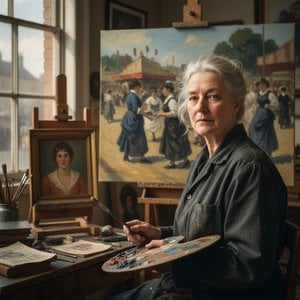
Dame Laura Knight: Reclaiming the Female Gaze in Modern British Art
Explore the life & work of Dame Laura Knight, a pioneering British artist who challenged conventions with her vibrant depictions of theatre, ballet, and wartime scenes. Discover her feminist legacy & artistic innovations.

Hablot Knight Browne: Phiz & the Victorian Social Canvas – A Critical Legacy
Explore the life & art of Hablot Knight Browne ('Phiz'), Dickens's iconic illustrator. Discover his masterful social commentary, technical innovations, and enduring legacy in Victorian illustration. A critical examination for history lovers.


