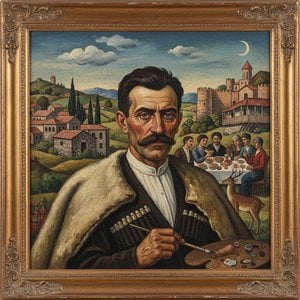
The Sculptor of Form and Shadow
Stepan Taryan was a man of many disciplines, a figure whose creative output spanned the physical weight of sculpture and the ephemeral design of the stage. Born in 1899 in Tiflis, his early training took him to the art school in Tiflis, where he completed his studies in 1918. His life was defined by a quiet, persistent movement through the artistic landscapes of the era, eventually earning him the title of Honored Artist of the Armenian SSR. He was a creator who understood both the permanence of bronze and the fleeting nature of theatrical decoration.
His work often captured a sense of stillness, a quality most visible in his sculptural contributions. In the 1930s, he produced a plaster model for a piece titled Waiting, a work that would eventually find its permanent expression in bronze. This bronze sculpture, standing 1.8 meters tall upon a granite pedestal, remains a fixture in Yerevan's Circular Park. It is a rare instance of a work being cast by the artist's own children, Suren and Anna Taryans, ensuring a familial continuity in the physical life of the object.
A Life in Multiple Dimensions
Taryan’s professional identity was never confined to a single medium. He navigated the technical demands of various artistic roles, moving between the tactile world of three-dimensional form and the visual requirements of the theater. His career was marked by several distinct professional facets:
- Sculptor of bronze and plaster works
- Theatrical decorator for stage productions
- Draftsman and illustrator
The breadth of his skill was recognized through exhibitions of his drawings, such as those held at the National Gallery of Armenia. These works offered a different perspective on his vision, moving away from the heavy presence of his public monuments toward the delicate precision of line and sketch.
The Weight of Memory
The legacy of Stepan Taryan is held within the collections of the National Gallery of Armenia, Yerevan, where his drawings and sketches are preserved. His presence in the public sphere is felt through the monuments that occupy the urban space of Yerevan, providing a sense of continuity to the city's visual history. He died in 1954, leaving behind a body of work that bridges the gap between the private sketch and the public monument.
Pitanja i odgovori
Mogu li da pregledam dela umetnika Stepan Taryan prema raspoloženju?
Radove umetnika Stepan Taryan možete istražiti prema raspoloženju na njegovoj stranici Soba po raspoloženju, gde su dela organizovana prema njihovom raspoloženju.
Postoji li hronološki pregled radova umetnika Stepan Taryan?
Karijera umetnika Stepan Taryan razvija se period po period na stranici Hronika: kroz horizontalnu vremensku liniju dela, grupisanih u poglavlja prema periodima stvaranja.
Pod kojim drugim imenima je Stepan Taryan poznat/a?
Stepan Taryan se pojavljuje i pod drugim imenima: Stepan Tarkhararyan.
Koliko je umetničkih dela autora Stepan Taryan dostupno u katalogu?
Možete pregledati 14 umetnička dela dela umetnika Stepan Taryan na stranici Sva umetnička dela.