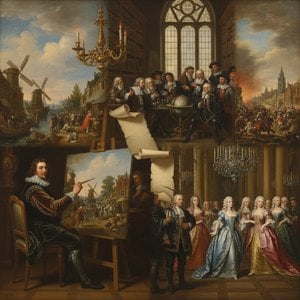
A Legacy of Color and Line: The Life of Sara Troost
In the vibrant, bustling atmosphere of the eighteenth-century Dutch Republic, a period marked by both intellectual rigor and social elegance, the name Sara Troost—also known as Sara Ploos van Amstel—resonates with the quiet strength of an artist deeply embedded in the heart of Amsterdam’s cultural fabric. Born in 1732, Sara was not merely a witness to the artistic flourishing of her era but a participant in its very lineage. As the daughter of the celebrated painter Cornelis Troost and the talented actress and embroiderer Susanna Maria van der Duyn, she was raised amidst the scent of oil paints and the dramatic flair of the Amsterdam stage. This heritage provided her with an intimate connection to the Rococo sensibilities that defined her generation, allowing her to absorb the nuances of light, texture, and social grace from a very young age.
Her life was a tapestry woven through the most influential artistic circles of the Dutch Republic. Beyond her biological connections, Sara’s role as an educator and a practitioner allowed her to maintain a vital link to the traditions of her father. She served as a teacher to her cousin, Christina Chalon, ensuring that the technical precision and aesthetic values of the Troost lineage were passed down through generations. Her marriage to the printer Jacob Ploos van Amiente further solidified her position within a family of intellectuals and creators; her sister Elisabeth’s union with his brother, Cornelis Ploos van Amstel, created a domestic sphere where art, printmaking, and literature converged.
The Artistry of the Miniature and the Masterful Copy
While much of the historical spotlight often falls upon the grand theatrical scenes of her father, Sara Troost carved out a specialized and highly skilled niche within the artistic community. She became particularly renowned for her mastery of watercolor, a medium that demands both spontaneity and extreme control. Her work is most notably characterized by her ability to produce exquisite watercolor copies of masterpieces from the seventeenth century. This practice was far more than mere imitation; it was an act of preservation and deep study. By recreating the works of the Dutch Golden Age masters, Sara engaged in a profound dialogue with the past, translating the heavy oils of previous centuries into the delicate, translucent washes of the Rococo period.
In these endeavors, her technique revealed a sophisticated understanding of color theory and light. To capture the essence of a much older work through watercolor requires an artist to distill complex shadows and textures into fluid, rhythmic strokes. Her ability to mimic the depth and atmosphere of 17th-century compositions demonstrated a level of technical virtuosity that earned her respect among her contemporaries. Through these copies, she helped sustain the visual memory of the Dutch masters, making the grandeur of the previous century accessible through the refined, lighter aesthetic of her own time.
Historical Significance and Artistic Endurance
The significance of Sara Troost lies not only in her individual hand but in her role as a bridge between eras. She stood at the intersection of the Dutch Golden Age and the Rococo period, acting as a custodian of tradition while operating within a modernizing society. Her life in Amsterdam, a city that was simultaneously a hub of global trade and a center for refined artistic expression, allowed her to embody the very essence of eighteenth-century Dutch identity.
Though much of her work remains intimately tied to the legacy of her father and her family, her contribution to the art of watercolor and the tradition of masterly reproduction remains a testament to her skill. Her life reminds us that the history of art is not only composed of singular, revolutionary breakthroughs but also of the dedicated practitioners who refine, teach, and preserve the beauty of the ages before them. Through her delicate brushwork, Sara Troost ensured that the brilliance of the past continued to shimmer in the light of the present.
Pitanja i odgovori
U kom istorijskom periodu je stvarao/la Sara Troost?
Sara Troost je radila u periodu Early Modern. Ovaj period smešta umetnikov rad u istorijski kontekst.
Gde se mogu pronaći dela umetnika Sara Troost klasifikovana prema temi?
Atlas tema za Sara Troost je stranica koja mapira umetnikova dela prema njihovim motivima.
Gde mogu da pogledam sva dela autora Sara Troost?
Sva dela umetnika Sara Troost na ovaj sajt možete pregledati na njegovoj/njenoj stranici sa Sva umetnička dela.
Koje je boje Sara Troost najčešće koristio/la?
Kolorit dela umetnika Sara Troost možete videti na njegovoj stranici Genom palete.