A Visionary of the Dutch Golden Age
Pieter de Molijn stands as a luminous figure within the pantheon of the Dutch Golden Age, a painter whose brush captured the very soul of the Low Countries' landscape. Born around 1595, his origins possess a captivating ambiguity; while he was baptized in the Dutch Reformed Austin Friars church in London, suggesting an English upbringing, his lineage whispers of Flemish roots. He was the son of Pieter de Moijn, hailing from Ghent, and Lynken van den Bossche, from Brussels. This tapestry of identities—English birth, Flemish descent, and Dutch professional life—mirrors the cosmopolitan spirit of the era. His career, spanning nearly seven decades, was a profound exploration of the natural world, marked by an unwavering dedication to the dramatic vistas and atmospheric nuances of the Holland countryside.
The early years of de Molijn’s life remain partially veiled in the mists of history, yet his professional ascent was clearly defined. In 1616, he formally joined the prestigious Haarlem Guild of St. Luke, a milestone that anchored him within the heart of the Dutch artistic community. While much of his formative training remains a mystery, scholars often speculate on the influence of Flemish masters or perhaps even a journey to Italy, which would have provided him with a classical foundation in light and perspective. This period of development was characterized by an increasing mastery over the elements, as he learned to manipulate oil pigments to evoke the heavy moisture of the Dutch air and the shifting shadows of passing clouds.
Mastery of Light and Landscape
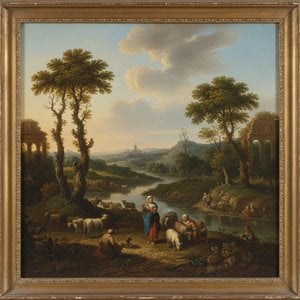
De Molijn’s oeuvre is a testament to the power of observation. He was not merely a recorder of scenery but an interpreter of atmosphere. His landscapes often feature a sophisticated use of atmospheric perspective, where distant horizons dissolve into soft, hazy blues, creating an immense sense of depth and scale. Whether depicting a tranquil woodland, a rugged coastline, or a pastoral scene with humble cottages, his work possesses an emotive resonance that transcends simple topography. He had a particular talent for capturing the interplay of light and shadow, often using dramatic sky compositions to anchor his landscapes with a sense of impending weather or quiet serenity.
Beyond the purely naturalistic, de Molijn’s versatility extended into genre scenes and marine art. His ability to weave human elements—such as travelers, laborers, or small groups of figures—into the vastness of the landscape allowed him to explore the relationship between humanity and the environment. Some of his works, such as Wool Making, offer glimpses into the industrious life of the period, showcasing a meticulous attention to detail in the depiction of textures and processes. This breadth of subject matter ensured that his influence was felt across various niches of the Dutch art market.
Legacy and Artistic Lineage
The historical significance of Pieter de Molijn lies not only in his individual achievements but also in his role as a cornerstone of a burgeoning artistic movement. He was a contemporary of great masters and a mentor to others; notably, the renowned painter Gerard ter Borch the Elder is recorded as having been his pupil. This lineage helped disseminate his stylistic innovations throughout the Netherlands. Furthermore, his personal life and family connections intertwined with the very fabric of Dutch society, from his marriages that established roots in Delft to his connections within the ceramic and textile industries.
Though history occasionally places him in the shadow of titans like Rembrandt or Vermeer, de Molijn’s contribution to the development of landscape painting is undeniable. He helped pioneer a style that moved away from rigid, stylized depictions toward a more organic, sensory experience of nature. His legacy survives through:
- The evolution of atmospheric perspective in Dutch landscape traditions.
- A profound influence on subsequent generations of Haarlem and Delft painters.
- The creation of a visual vocabulary for the Dutch countryside that remains iconic to this day.
Pitanja i odgovori
Postoji li hronološki pregled radova umetnika Pieter De Molijn?
Hronika umetnika Pieter De Molijn predstavlja hronološku vremensku liniju koja se pomera uz skrolovanje i prikazuje dela umetnika po hronološkom redu, grupisana u poglavlja prema periodima stvaralaštva.
Gde mogu da vidim dela umetnika Pieter De Molijn u 3D galeriji?
3D galerija umetnika Pieter De Molijn je stranica koja prikazuje umetnikova dela u virtuelnoj trodimenzionalnoj galeriji.
Koliko je umetničkih dela autora Pieter De Molijn dostupno u katalogu?
Možete pregledati 33 umetnička dela dela umetnika Pieter De Molijn na stranici Sva umetnička dela.