Early Life, Training and Musical Beginnings
To understand the visual output of Otto Lange, one must first acknowledge the musicality that defined his early years. Born in Delmenhorst, Germany, in 1924, he was a child driven by an intense enthusiasm for music. This was not a mere hobby; he developed technical proficiency across several instruments, specifically the flute, the cello, and the piano. His early life was shaped by this rhythmic discipline, a foundation that would later inform his approach to composition and color.
The trajectory of his life shifted violently with the onset of the Second World War. During this period, Lange’s musical training took on a functional, military context as he played in an orchestra of the Wehrmacht. The discipline of the ensemble was quickly replaced by the chaos of combat. At the age of 20, he was wounded on the Eastern Front, an event that led to his capture by Soviet forces. He spent his formative years in captivity in Kazakhstan, a period of survival that fundamentally altered his path.
Life After the War and Career
Lange’s return from Russia in 1949 marked a definitive shift toward a structured, domestic existence. He married Irmgard, the sister of a fellow prisoner, and the couple had two children. This period was defined by a pragmatic pivot away from the intensity of his earlier years. He chose to expand his father's poultry farming business, a decision that demanded significant time and physical labor. This commitment to agriculture meant that his creative output was often sidelined by the requirements of the farm.
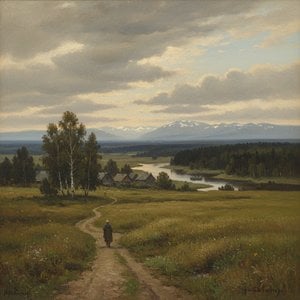
The tension between his livelihood and his visual practice lasted for decades. While the poultry business proved successful, it functioned as a practical necessity rather than a creative choice. It was not until 1983 that he finally abandoned the business entirely. This departure allowed him to relocate to the Ligurian coast in Northern Italy, a move that signaled a final, concentrated period of production. Away from the demands of the farm, his focus shifted toward the composition of colors in his landscapes and still lifes.
Later Years and Death
The steady rhythm of Lange’s creative output faced significant disruption in the mid-1990s. A series of severe illnesses interrupted his ability to paint, forcing a hiatus from the canvas. Between the mid-1990s and 1998, he underwent several serious operations to combat these health challenges. This period of medical struggle fundamentally altered the consistency of his later output.
In 2005, Lange moved to the Taunus region. He remained there until his death on December 24, 2008, in Eppstein. His passing marked the end of a life defined by both musical and visual discipline, even when physical health threatened his ability to maintain his practice.
Pitanja i odgovori
Kako mogu da pronađem sva dela umetnika Otto Lange prema određenom mediju?
Radove umetnika Otto Lange možete pregledati prema tehnici na stranici Svi mediji.
U kom gradu i državi je rođen/a Otto Lange?
Otto Lange je rođen/a u gradu Delmenhorst, u državi Germany.
Mogu li da proučim način na koji Otto Lange koristi boju u svim svojim delima?
Genom palete umetnika Otto Lange je stranica koja predstavlja koloristički profil celokupnog umetničkog dela ovog autora.
Gde se mogu pronaći dela umetnika Otto Lange organizovana po boji?
Stranica Spektar boja organizuje dela umetnika Otto Lange prema boji.