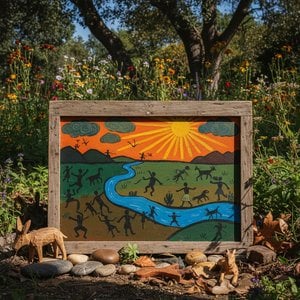
Henri Emile Rousseau (1875 – 1933): The Enchanted Vision of Primitive Beauty
Henri Emile Rousseau, born in Lyon, France, in 1875, defied the conventions of Impressionism and Post-Impressionism to forge a singular artistic path—one characterized by an uncompromising embrace of Naïve Art. His canvases depict fantastical landscapes populated by animals and humans rendered with childlike simplicity and vibrant color palettes, transporting viewers into dreamlike realms brimming with symbolic resonance. Rousseau’s upbringing in a working-class family instilled in him a deep appreciation for the natural world and folklore, influences that would profoundly shape his artistic vision. Despite facing considerable skepticism from critics of his time—who dismissed his style as amateurish—Rousseau persevered, establishing himself as one of France's most distinctive painters and securing a place among the pioneers of Modern Art.- Early Life & Artistic Beginnings: Rousseau’s formal artistic training was minimal; he largely self-taught, honing his skills through sketching outdoors and studying prints. He initially pursued commercial illustration work to support himself, but his passion for painting remained unwavering.
- The Influence of Primitive Art: Rousseau's fascination with African masks and tribal art—particularly those collected by Alexandre Cabanel—served as a catalyst for his stylistic evolution. These artworks captivated him with their bold colors, stylized forms, and rejection of academic realism, inspiring him to abandon traditional techniques in favor of a more direct and expressive approach.
- Key Paintings & Artistic Style: Rousseau’s oeuvre is dominated by monumental landscapes infused with mythological elements and populated by animals imbued with spiritual significance. Notable works include “The Sleeping Venus” (1890), “The Promised Land” (1893), “The Concert” (1897), and “The Shepherdess,” which exemplifies his signature style—characterized by flattened perspectives, luminous colors, and a deliberate blurring of outlines.
- Recognition & Legacy: Despite initial rejection by the Parisian avant-garde, Rousseau gained recognition in 1905 thanks to the patronage of Ambroise Vollard, who championed his work and secured exhibitions at Galerie Bernheim-Jeune. His paintings gradually attracted admirers among artists like Picasso and Matisse, cementing his reputation as a visionary artist whose uncompromising vision anticipated Surrealism.
- Death & Enduring Influence: Rousseau died in Étampes in 1933, leaving behind a legacy of approximately 800 paintings—a remarkable achievement considering his unconventional methods. His distinctive Naïve Art style continues to inspire artists today, demonstrating the enduring power of imagination and the beauty found in unfiltered observation.
Exploring Rousseau’s Palette & Technique
Rousseau's artistic technique was remarkably simple yet profoundly effective. He eschewed meticulous detail, opting instead for bold brushstrokes and vibrant hues—often achieved through layering thin glazes of color onto a toned ground. This method allowed him to capture the essence of his subjects with remarkable immediacy and luminosity, conveying emotion and atmosphere as much as visual representation. His use of complementary colors—such as reds and greens—created striking contrasts that heightened the dramatic impact of his compositions. Furthermore, Rousseau’s deliberate flattening of perspective—a technique borrowed from African art—reinforced the dreamlike quality of his landscapes and contributed to their captivating allure.Pitanja i odgovori
Koji dela umetnika Henri Emilien Rousseau imaju najviše pregleda?
Postoji Statistika stranica za Henri Emilien Rousseau, koja prikazuje statistiku o umetnikovim delima na ovaj veb-sajt.
U kojim je umetničkim pravcima Henri Emilien Rousseau stvarala/stvarao?
Stranica Svi pravci grupiše dela umetnika Henri Emilien Rousseau prema umetničkom pravcu.
Koliko je umetničkih dela autora Henri Emilien Rousseau dostupno za pregled?
Možete pregledati 21 umetničkih dela dela umetnika Henri Emilien Rousseau na stranici Sva umetnička dela.
Koja raspoloženja izražavaju dela umetnika Henri Emilien Rousseau?
Stranica Soba raspoloženja prikazuje umetnička dela autora Henri Emilien Rousseau poređana prema njihovoj atmosferi.
Kako mogu pratiti rad umetnika Henri Emilien Rousseau godinu po godinu?
Radove umetnika Henri Emilien Rousseau možete videti hronološkim redosledom na stranici Hronologija dela umetnika.
Gde se mogu pronaći dela umetnika Henri Emilien Rousseau grupisanom prema ključnim rečima?
Radove umetnika Henri Emilien Rousseau možete istražiti putem ključnih reči na njegovoj stranici Preko ključnih reči. Svaka ključna reč grupiše srodna dela.
Gde mogu da pogledam sva dela umetnika Henri Emilien Rousseau?
Sva dela umetnika Henri Emilien Rousseau na ovaj veb-sajt mogu se pregledati na stranici Sva umetnička dela umetnika.
Mogu li da proučim način na koji Henri Emilien Rousseau koristi boju u svim svojim delima?
Kolorit dela umetnika Henri Emilien Rousseau prikazan je na njegovoj stranici Genom palete.