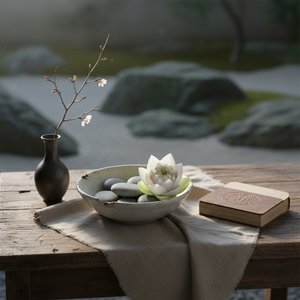
A Bloom of Serenity: The World of Georgios Kosmadopoulos
Georgios Kosmadopoulos emerges as a contemporary voice in the tradition of still life and landscape painting, an artist whose work quietly resonates with a deep appreciation for the natural world. While biographical details remain intentionally focused on his art itself – a testament to his preference for allowing the paintings speak directly to the viewer – Kosmadopoulos’s presence is powerfully felt through the evocative canvases he creates. He operates from ArtsDot, not as a historical figure steeped in anecdote, but as a vital, living artist shaping a unique visual language centered on floral beauty and tranquil scenes. His art isn't about recounting a life story; it’s an invitation into a feeling, a moment of peaceful contemplation captured in oil and canvas.
The Language of Flowers and Light
Kosmadopoulos’s artistic focus is immediately apparent: he paints flowers with a sensitivity that borders on reverence. These are not merely botanical studies; they are explorations of form, color, and the ephemeral nature of beauty. His compositions often feature arrangements of blooms – roses, lilies, peonies – rendered in soft, diffused light. He masterfully employs layering techniques to create depth and texture, giving each petal a palpable sense of weight and fragility. Beyond individual flowers, Kosmadopoulos extends his vision to broader landscapes, frequently depicting serene fields, sun-dappled meadows, and quiet gardens. These scenes share the same delicate touch and harmonious color palettes as his still lifes, creating a cohesive body of work unified by its tranquil mood. His paintings are not simply representations of nature; they are distillations of its essence. The influence of Impressionism is subtly present in his handling of light and color, yet Kosmadopoulos avoids direct imitation, forging a style that feels both timeless and distinctly his own.
Technique and Inspiration
Kosmadopoulos works primarily in oil paints, favoring a smooth application and subtle blending of tones. He builds up layers gradually, allowing colors to interact and create luminous effects. His technique is rooted in observation but transcends mere realism. The artist’s inspiration clearly stems from a profound connection with nature – a love for the changing seasons, the delicate structure of flowers, and the play of light across landscapes. While he doesn't explicitly cite specific artistic influences, one can detect echoes of Dutch Golden Ageflower painting in his meticulous detail and harmonious compositions, as well as the atmospheric qualities found in the works of Claude Monet and Camille Pissarro. However, Kosmadopoulos’s work is not defined by imitation; it represents a contemporary interpretation of these traditions, infused with a personal sensibility that prioritizes serenity and emotional resonance.
A Contemporary Resonance
In an era often characterized by fast-paced change and digital stimulation, Georgios Kosmadopoulos offers a welcome respite – a space for quiet contemplation and appreciation of beauty. His paintings are not demanding or provocative; they simply invite the viewer to pause, breathe, and connect with the natural world.
His art appeals to those seeking tranquility and harmony in their surroundings.
The subject matter – flowers and landscapes – is universally appealing, resonating across cultures and generations.
Kosmadopoulos’s skillful technique and harmonious color palettes create a sense of timeless beauty.
His work has found a growing audience through platforms like ArtsDot, demonstrating a desire for art that offers solace and emotional connection. While he may not be a product of formal artistic movements or grand narratives, Kosmadopoulos’s significance lies in his ability to create paintings that touch the soul – works that remind us of the beauty and fragility of life itself. He represents a continuation of the still life and landscape traditions, revitalized with a contemporary sensibility and a deeply personal vision.
Explore the profound beauty of serenity in art history & contemporary works. Discover how artists evoke calm through color, composition & minimalism. Find artwork to cultivate peace and wellbeing.
Da li su radovi autora Georgios Kosmadopoulos i dalje zaštićeni autorskim pravima?
Da, dela ovog umetnika su i dalje zaštićena autorskim pravima.
Po kojim drugim imenima je Georgios Kosmadopoulos poznat/a?
G. Kosmadopoulos, Kosmadopoulos, Γεώργιος Κοσμαδόπουλος
Koja je najbolje rangirana slika autora Georgios Kosmadopoulos na platformi ArtsDot.com?
Flowers from the Field
Ko je Georgios Kosmadopoulos?
A Bloom of Serenity: The World of Georgios Kosmadopoulos
Georgios Kosmadopoulos emerges as a contemporary voice in the tradition of still life and landscape painting, an artist whose work quietly resonates with a deep appreciation for the natural world. While biographical details remain intentionally focused on his art itself – a testament to his preference for allowing the paintings speak directly to the viewer – Kosmadopoulos’s presence is powerfully felt through the evocative canvases he cre
Koliko je Georgios Kosmadopoulos-ovih slika dostupno na ArtsDot.com?
1
Koje je boje Georgios Kosmadopoulos najčešće koristio/la?