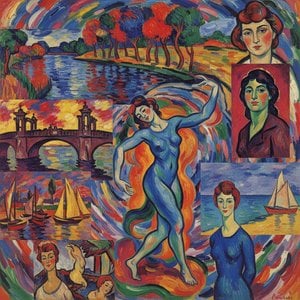
The Hand and the Board
In the bustling streets of Amsterdam, a creative spirit began to stir in 1930. Fon Klement did not follow the traditional paths of the academy, choosing instead to cultivate his vision through the raw, direct experience of a self-taught artist. His early years were defined by a deep engagement with the physical world, where he found his voice through the heavy weight of woodcarving and the deliberate strokes of figurative painting. This period of discovery was marked by a search for form, as he moved between the Netherlands and the quiet landscapes of France, even spending time studying in Sweden to refine his understanding of shape and space.
As the decades passed, his hands sought new ways to translate thought into matter. By 1960, he had moved beyond simple carvings to develop a technique that would become his signature: the multicolor letterpress board cut. This method allowed him to layer color and texture in ways that felt both structured and spontaneous. His work began to shift, moving away from the recognizable shapes of his youth toward a more stripped-back, abstract language. He embraced a sober palette, letting the composition speak through the tension of color and line rather than the literal depiction of subjects.
A Life of Form and Color
The evolution of his style was never a straight line, but rather a series of rhythmic returns. After finding success with his abstract explorations, he experienced a resurgence in his painting, often returning to the natural world. His time in France provided a backdrop for these later works, where he turned his attention to the organic beauty of flowers. This period saw a shift toward brighter tones and a renewed interest in the botanical, blending the precision of his graphic training with a more fluid, painterly approach.
His technical mastery was recognized through various mediums and honors:
- The intricate process of hardboard cuts and silkscreen printing.
- Membership in the international association of woodcarvers, Xylon.
- The creation of Leporello albums, such as the one featuring the poems of Marion Bloem.
- Public recognition through audience awards at major graphic biennales.
His presence in the art world was felt far beyond the borders of the Netherlands. His graphic works traveled across the United States, reaching audiences through traveling exhibitions that showcased the strength of Dutch printmaking. Whether through a large-scale mural or a delicate print, his work remained a constant dialogue between the artist's intent and the physical resistance of his materials.
The Legacy of the Graphic Mark
By the time he reached his later years, Fon Klement had established a body of work that spanned the spectrum from the strictly figurative to the purely abstract. His exhibitions at the Museum van Bommel-Van Dam in Venlo and the Singer Museum in Laren marked significant moments in a career defined by constant movement. He was a man who understood the weight of a line and the power of a single color, whether he was working on a small graphic sheet or a large canvas. When he passed away in 2000, he left behind a record of a life lived through the tactile, transformative power of art.
Pitanja i odgovori
Kako mogu da pronađem sva dela umetnika Fon Klement prema određenom mediju?
Radove umetnika Fon Klement možete pregledati prema tehnici na stranici Svi mediji.
Mogu li da proučim način na koji Fon Klement koristi boju u svim svojim delima?
Kolorit dela umetnika Fon Klement možete videti na njegovoj stranici Genom palete.
U kom istorijskom periodu je stvarao/la Fon Klement?
Fon Klement je radila u periodu Modern. Ovaj period smešta umetnikov rad u istorijski kontekst.
Gde mogu da vidim dela umetnika Fon Klement u 3D galeriji?
3D galerija umetnika Fon Klement je stranica koja prikazuje umetnikova dela u virtuelnoj trodimenzionalnoj galeriji.