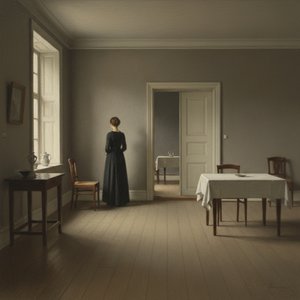
Early Life and Artistic Training
Emil Gregersen was born on February 22, 1921, in Balling, Denmark. His entry into the visual arts was not through the traditional academic route, but through the practical discipline of a house painter. This early vocational training provided a grounded, technical foundation that would later inform his approach to color and space. He was a man of action during a period of intense national struggle, serving as a resistance fighter. This involvement in the resistance movement added a layer of lived tension to his early years, a reality that would eventually manifest in the expressive figural works of his early career.
His formal transition from tradesman to fine artist occurred under the guidance of Immanuel Ibsen. Between 1943 and 1944, Gregersen studied with Ibsen, a period that marked his shift toward professional painting. This mentorship provided the necessary technical refinement to move beyond decorative application and into the realm of serious composition. His development during these years was shaped by the intersection of formal instruction and the immediate, pressing realities of occupied Denmark. He did not merely learn to paint; he learned to translate the weight of his environment onto canvas.
Artistic Career and Exhibitions
Gregersen’s professional trajectory was defined by a steady presence within the Danish institutional framework. He made his formal debut at the Kunstnernes Efterårsudstilling in 1946. This entry into the exhibition circuit was followed by a long-term engagement with the Vrå exhibition, which he participated in from 1957 onwards. His work during these years moved from early interior and cityscape subjects toward more expressive figurative compositions that processed the tensions of the occupation period.
His standing within the Danish art community was solidified through his affiliations with established exhibition groups. He held membership in Grønningen between 1964 and 1970. Following this period, he transitioned to Den Frie Udstilling. These memberships were not merely titles; they placed his evolving visual language in direct dialogue with the contemporary standards of the time.
- Kvinde med barn (1950)
Public Commissions and Colorist Work
Gregersen’s influence extended far beyond the canvas and into the functional architecture of Danish public life. From 1960, he operated as a colorist and decorator, working alongside the architecture firm Friis & Moltke. This collaboration saw him applying his aesthetic sensibilities to a wide range of institutional spaces, including numerous hotels, schools, and town halls. His work in these settings was not merely decorative; it was an integration of color into the structural identity of the buildings themselves.
His large-scale environmental work is best seen in his contributions to significant Danish landmarks. In 1978, he served as the colorist for Nordjyllands Amtsgård in Aalborg. His reach also included the Musikhuset Aarhus, where his work was twofold. He acted as the colorist for the venue's large hall in 1982, and in that same year, he collaborated with Vibeke Klint to create the drapery for the space. These projects demonstrate a capacity to handle color as a spatial element, moving from the intimacy of a painting to the vastness of public halls.
Notable Works and Collections
Gregersen’s presence in major Danish institutions confirms the lasting relevance of his visual output. His work is held in the permanent collections of the Statens Museum for Kunst in Copenhagen, Vendsyssel Kunstmuseum, and ARoS. These holdings include his oil on canvas piece, Kvinde med barn, produced in 1950. The Statens Museum for Kunst also maintains his Red Still Life, a work dating from about 1962.
Beyond large-scale canvases, his technical range extended into printmaking. He produced lithographs featuring female figures, specifically signed and numbered editions such as 58/76. These works demonstrate a controlled approach to composition that complements his more expressive figurative studies. His ability to translate form across different media ensures his work remains a fixture in significant regional and national collections.
Pitanja i odgovori
Gde mogu pronaći statistiku o delima umetnika Emil Gregersen?
Statistika o delima umetnika Emil Gregersen dostupna je na njegovoj stranici Statistika.
Gde se mogu pronaći dela umetnika Emil Gregersen grupisanja po paleti boja?
Stranica Preko palete boja grupiše dela umetnika Emil Gregersen prema njihovim paletama boja.
Gde mogu da vidim koloristički profil radova umetnika Emil Gregersen?
Genom palete umetnika Emil Gregersen je stranica koja predstavlja koloristički profil celokupnog umetničkog dela ovog autora.
Gde se mogu pronaći dela umetnika Emil Gregersen grupisanja po tehnici?
Da biste pronašli sva dela umetnika Emil Gregersen u određenoj tehnici, posetite stranicu Svi mediji na profilu umetnika.