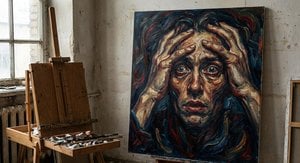
The Mediterranean Light and the Birth of a Vision
Born under the radiant, salt-kissed sun of Marseille in 1879, Charles Camoin’s early life was an immersion in the luminous textures of the Mediterranean landscape. This coastal cradle provided more than just a scenic backdrop; it offered a primary palette of brilliant blues and warm ochres that would forever haunt his canvases. While his initial artistic sensibilities were nurtured by the soft, atmospheric nuances of Impressionism—drawing inspiration from the delicate touch of Monet and Sisley—Camoin possessed an underlying restlessness that sought something far more visceral.The trajectory of his life shifted irrevocably when he moved to Paris to study at Gustave Moreau's École des Beaux-Arts. It was within these hallowed halls that a fateful encounter occurred: the meeting with Henri Matisse. This connection was not merely a professional acquaintance but a profound artistic kinship. Under the guidance of Moreau, whose teaching encouraged students to wander "off the roads" of tradition, Camoin found the courage to abandon the muted, polite tones of his predecessors in favor of a much more daring, experimental spirit.
A Chromatic Rebellion: The Fauve Spirit
As the twentieth century dawned, Camoin emerged as a central figure in one of art history's most explosive movements: Fauvism. Alongside luminaries such as Matisse, André Derain, and Maurice de Vlaminck, he became part of a collective of artists famously branded by critics as the wild beasts. This was not an insult, but a testament to their revolutionary use of color. For Camoin and his contemporaries, color was no longer a tool for mere description; it became the very soul of the painting, used with an unrestrained intensity to evoke raw emotion and psychological depth.This period of rebellion saw the rejection of academic constraints in favor of chromatic liberation. The group’s approach was characterized by:
- The use of bold, often clashing hues that defied naturalistic representation.
- A departure from traditional perspective in favor of flattened, expressive planes.
- An emphasis on the physical presence of paint through thick, energetic brushwork.
The Texture of Provence and a Lasting Legacy
Throughout his long and prolific career, which spanned until 1965, Camoin’s work remained deeply anchored in the landscapes of his youth. He possessed a singular ability to translate the rugged beauty of the Provençal countryside into a language of texture and light. Whether capturing the tranquil harbor of Cassis or the winding village streets of Collioure, his paintings are characterized by a heavy impasto technique. This method allowed him to build up layers of pigment, creating a tactile surface where the physicality of the paint itself becomes part of the narrative.His evolution as an artist was marked by a continuous refinement of this expressive power. While his early works vibrated with the shock of Fauvist color, his later landscapes achieved a more nuanced harmony, blending intense hues with a profound sense of atmosphere and permanence. Today, Charles Camoin is remembered not just as a member of a famous movement, but as a master of light who captured the very essence of the French spirit. His works, held in prestigious collections such as the Centre Pompidou, continue to invite viewers into a world where color and emotion are inextricably entwined, leaving an indelible mark on the history of twentieth-century art.
Pitanja i odgovori
Mogu li da pregledam dela umetnika Charles Camoin prema umetničkom pravcu?
Stranica Svi pravci grupiše dela umetnika Charles Camoin prema umetničkom pravcu.
Postoji li potpuna lista dela umetnika Charles Camoin?
Sva dela umetnika Charles Camoin na ovaj veb-sajt mogu se pregledati na stranici Sva umetnička dela umetnika.
Koji dela umetnika Charles Camoin imaju najviše pregleda?
Stranica Statistika umetnika Charles Camoin prikazuje statistiku izračunatu na osnovu umetničkih dela tog autora koja su navedena na ovaj veb-sajt.