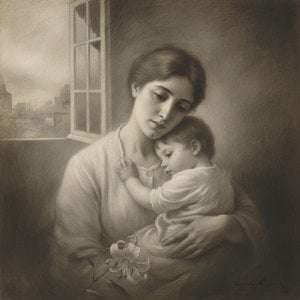
A Life Rooted in Lyon
Born in Lyon in 1846, Aimé Perret entered a world where the French art scene was undergoing profound shifts. His early years were shaped by the local atmosphere of the School of Fine Arts in Lyon, an institution that provided the foundational discipline for his developing hand. He did not work in isolation; instead, he sought the guidance of established figures such as Joseph Benoit Guichard and Antoine Vollon. This period of apprenticeship allowed him to absorb the technical rigors of the era before moving toward a more personal expression.
His arrival on the Parisian stage was marked by immediate recognition. In 1869, he made his debut at the Salon of French Artists, an event that would become a recurring milestone in his career. The reception was favorable, earning him a Medal of Honor for two consecutive years. These early successes established him as a painter of significant promise within the Société des Artistes Français.
The Dignity of the Rural Scene
Perret’s brush found its most meaningful expression in the quietude of the countryside. While his repertoire included portraits and genre scenes, it was his treatment of the landscape that defined his contribution to nineteenth-century painting. He looked toward the earth, focusing on the activities of peasants and the subtle shifts of light across rural terrain. His work often mirrored the gravity found in the works of Jean-François Millet, capturing a sense of solitude and quiet strength in the figures he depicted.
There is a specific weight to his landscapes. They are not merely observations of nature but settings where human labor and existence are given a certain dignity. His compositions often utilized soft colors to render the atmosphere of the French countryside, creating scenes that felt grounded and real. Even contemporaries like Vincent Van Gogh noted Perret’s influence, mentioning the practice of making copies after his works in 1883.
Recognition and Later Years
The trajectory of Perret's career was marked by steady, earned accolades. Beyond his early Salon honors, he achieved further distinction at the Exposition Universelle of Paris in 1889, where he was awarded a bronze medal. This recognition placed him among the respected practitioners of his generation, capable of navigating both the academic traditions and the changing tastes of the late nineteenth century.
By the time of his death in 1927, Perret had left behind a body of work held within several French museums. His paintings remain as records of a specific way of seeing—a way that found importance in the humble, the rural, and the unadorned. He remains a figure of the Lyon school, a painter who looked at the landscape and saw the quiet persistence of life.
Pitanja i odgovori
Gde mogu da vidim koloristički profil radova umetnika Aimé Perret?
Genom palete umetnika Aimé Perret je stranica koja predstavlja koloristički profil celokupnog umetničkog dela ovog autora.
Gde mogu pronaći statistiku o delima umetnika Aimé Perret?
Statistika o delima umetnika Aimé Perret dostupna je na njegovoj stranici Statistika.
Otkud je Aimé Perret?
Aimé Perret je rođen/a u France.
Gde se mogu pronaći dela umetnika Aimé Perret grupisanja po tehnici?
Da biste pronašli sva dela umetnika Aimé Perret u određenoj tehnici, posetite stranicu Svi mediji na profilu umetnika.