

 Pregledaj u prostoru
 Pošalji
 Podeli
 Detalji o delu

 Преузми
 Slični predmeti
 Rendgenski snimak
 Slajdovi
Beatrice
 Acrylic On Canvas
- WallArt
- Symbolism
 1905
1905 5.0 x 48.0 cm
 Kunsthaus Zürich
 Pročitaj više
Ručno rađena uljana reprodukcija
Ručno oslikano uljanim bojama na platnu u dimenzijama i okviru po vašem izboru, izrađeno po porudžbini od strane naših umetnika. ( Kupi print Kupi digitalnu sliku)




P118B $10

P118H $10

P118W $10

P438Z $10

P508JH $12

P508YH $12

P805H $10

P805Z $10

P919BZ $10

P919G $10

P919XJ $10

P959ZH $10

P968JZ $12

W106C $8

W218G $10

W218JH $8

W218Y $10

W307PJ $10

W316G $10

W316PJ $8

W316Y $10

W398PJ $8

W4111J $10

W500HY $15

W500JH $15

W692G $12

W849H $8

W940BG $15

W953PJ $8




Izaberite jednu od naših unapred definisanih veličina koje odgovaraju originalnim proporcijama umetničkog dela.

Можете унети сопствене димензије како бисте прилагодили дело одређеном оквиру или простору. Ако одабрана величина не одговара пропорцијама оригинала, слика ће бити исечена или проширена додатним елементима који се ручно насликавају. Дигитални prikaz ће вам бити послат на одобрење пре почетка производње.
Имајте на уму да преглед на екрану не одражава стварно исецање или проширење. Само приказ (mockup) ће тачно приказати коначну композицију.
Иако су доступне прилагођене величине, препоручујемо да одаберете димензију из дефинисане листе како бисте сачували оригиналне пропорције.
Nakon narudžbine, tim ArtsDot.com će klijentu putem e-pošte poslati uputstva i dostaviti prikaz predloženog rešenja
Isporuka širom sveta () za 3/4 nedelje umesto uobičajenih 5 nedelja. (16 август). Bez kompromisa po pitanju kvaliteta.

Besplatna ekspresna dostava širom sveta

Visokokvalitetno laneno platno

Kompletno osiguranje transporta

Garancija povraćaja carine i uvoznih dažbina

Garancija vernosti boja

Politika povrata u roku od 60 dana (samo u slučaju nedostataka)

Garancija povrata novca od 100%

Popust pri grupnoj kupovini
 Opcija sa staklom dostupna je samo za dimenzije manje od 110 cm

Beatrice
Tehnika reprodukcije
Dimenzije reprodukcije
-


Konačna cena
$ 263
Opis umetničkog dela
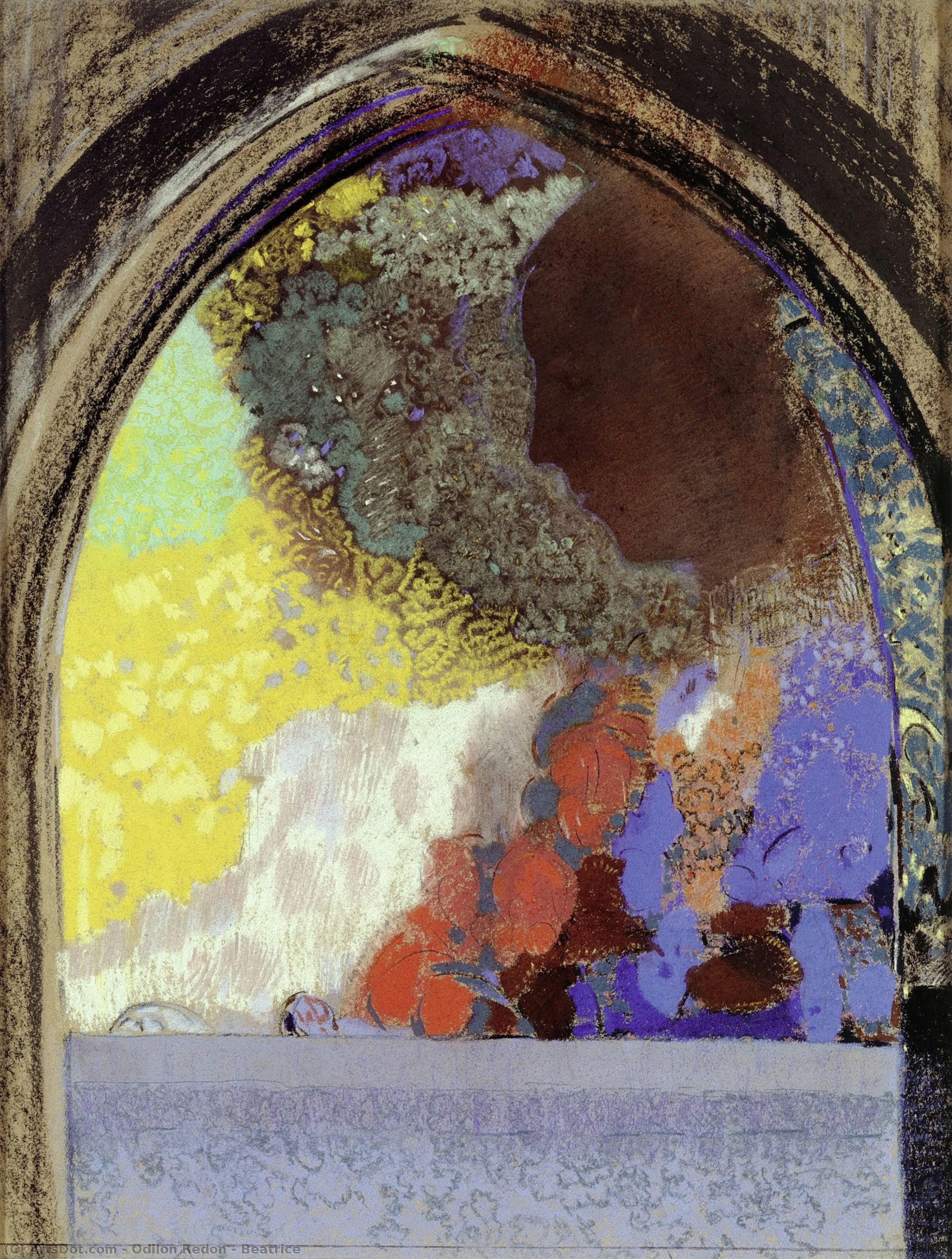
The Enigmatic Face of Beatrice
Odilon Redon’s “Beatrice,” painted in 1905, isn't merely a portrait; it’s an invitation to a realm beyond the visible, a shimmering glimpse into the artist’s profoundly personal and often unsettling inner world. The painting immediately arrests the viewer with its arresting color palette – vibrant reds bleeding into deep blues and purples, punctuated by flashes of yellow—a deliberate orchestration designed to evoke both passion and melancholy. But it is the central figure, a woman whose face seems to dissolve or melt away, that truly commands attention. This isn’t a depiction of physical beauty in the conventional sense; instead, Redon presents an image of profound vulnerability and perhaps even disintegration. The distortion, far from being a flaw, becomes the very essence of the work, suggesting a state of emotional turmoil, a surrender to the subconscious, or a fleeting moment of existential questioning.
Image of Beatrice by Odilon Redon
A Symbolist Vision: Roots in the Unseen
Redon’s artistic journey was deeply rooted in Symbolism, a movement that rejected realism and embraced subjective experience, dreams, and the mystical. Influenced by artists like Gustave Moreau and Émile Bernard, Redon sought to capture not what he *saw*, but what he *felt* – the hidden emotions and anxieties lurking beneath the surface of reality. His early work, particularly his “noirs” (black paintings), established this preoccupation with the shadowy, the obscure, and the psychologically charged. The stained-glass window backdrop, a recurring motif in Redon’s oeuvre, isn't a literal representation but rather an evocative device—a portal to another dimension, a symbolic echo of the dreamlike atmosphere enveloping the central figure. The archway itself suggests a transition, a passage between worlds, mirroring the woman’s own internal transformation.
The painting’s creation coincided with Redon's exploration of Japanese art and its influence on his work. He was fascinated by the flattened perspective, bold colors, and symbolic imagery found in Japanese prints, which he incorporated into his own style to create a unique visual language. This fusion of European Symbolism and Japanese aesthetics is evident in “Beatrice,” contributing to the painting’s otherworldly quality.
Technique and Material: The Alchemy of Pastel
Redon masterfully employed pastel on paper, a medium that allowed him to achieve remarkable luminosity and textural complexity. He built up layers of color with delicate strokes, creating an almost velvety surface—a tactile invitation for the viewer to engage with the painting’s emotional depth. The loose application of pigment contributes to the sense of fluidity and instability, mirroring the woman's dissolving features. The artist’s meticulous attention to detail is evident in the subtle gradations of color and the delicate rendering of the background elements, creating a harmonious balance between chaos and control.
Notably, Redon abandoned his earlier “noir” style around 1900, embracing pastel and oil as his preferred mediums. This shift reflects a move towards brighter colors and a greater emphasis on capturing fleeting moments of emotion and sensation. “Beatrice” exemplifies this new approach, showcasing Redon’s ability to evoke profound psychological states through the skillful manipulation of color and texture.
A Portrait of Inner Turmoil
Ultimately, “Beatrice” is a haunting meditation on beauty, decay, and the fragility of human experience. The melting face isn't simply an artistic experiment; it’s a potent symbol of vulnerability, loss, and the inevitable passage of time. The two figures in the background—a man and a woman—seem to observe this internal drama with a mixture of concern and detachment, suggesting that Beatrice’s transformation is not merely personal but also reflects broader anxieties about mortality and identity. Redon's masterpiece invites us to contemplate our own inner landscapes, prompting us to confront the hidden depths of our emotions and the unsettling beauty of the human condition.
Srodna umetnička dela


Biografija umetnika
Odilon Redon (1840-1916): Between Shadow and Light
Odilon Redon, born Bertrand Jean Redon in Bordeaux, France, on April 20, 1840, was an artist whose profound engagement with the unseen realms of imagination solidified his place as a pivotal figure in Symbolism—a movement that anticipated the Surrealist explorations of the subconscious decades later. His artistic journey began not with grand ambition but with quiet observation; at just ten years old he won a drawing prize—a foreshadowing of the visual sensitivity that would permeate his entire life’s work. Though familial expectations initially steered him toward architecture, Redon's true vocation blossomed amidst instruction from Jean-Léon Gérôme and Rodolphe Bresdin, who instilled in him the meticulous techniques of etching and lithography – skills that became foundational to his early explorations and allowed him to translate the intangible into tangible form. The disruption of the Franco-Prussian War briefly compelled him into military service, yet it was upon his return to Paris that Redon’s artistic vision truly coalesced, shaping a distinctive oeuvre characterized by haunting beauty and unsettling mystery.Early Life & Artistic Training
Redon's childhood was marked by a peculiar blend of solitude and fascination with the natural world. Raised in Bordeaux near his uncle—a botanist who nurtured his intellectual curiosity—he developed an acute sensitivity to color and form, qualities that would become central to his artistic style. At fifteen, he commenced formal study in drawing but, responding to his father’s insistence, reluctantly abandoned architectural pursuits for a more creative path. Despite failing the École des Beaux-Arts entrance examinations, Redon persevered, enrolling under Gérôme—a celebrated academic painter—who honed his skills in realistic representation. However, it was Bresdin's tutelage in etching and lithography that proved transformative, unlocking Redon’s ability to capture elusive moods and textures through printmaking – a medium he would champion throughout his career. This early training instilled in him a disciplined approach to observation and experimentation, shaping the aesthetic bedrock of his future masterpieces.The Birth of Symbolism & Monochrome Explorations
Redon deliberately distanced himself from prevailing artistic trends of his time—rejecting the pursuit of photographic realism in favor of conveying emotional resonance and spiritual contemplation. This decision led directly to his groundbreaking series of “noirs”—monochromatic compositions executed primarily in charcoal and lithography—which became instantly recognizable as emblems of Symbolism. These weren’t merely studies in darkness; they were profound investigations into the subconscious, populated by grotesque creatures, disembodied eyes, and spectral figures emerging from swirling mists – imagery heavily influenced by writers like Edgar Allan Poe and Charles Baudelaire who shared a fascination with the macabre and the suggestive power of art. Critics initially dismissed Redon’s “noirs” as morbid and unsettling, yet they nevertheless captured the essence of Symbolist aesthetics—a preoccupation with mythic themes and an embrace of dreamlike visions. The series demonstrated Redon's mastery of tonal gradation and his ability to evoke psychological depth through minimal visual elements.Lithography & Literary Influences
Redon’s artistic technique was inextricably linked to his intellectual interests, particularly his engagement with literature and philosophy. He meticulously studied the works of Baudelaire, Poe, Dante Gabriel Rossetti, and Henrik Ibsen—authors who explored themes of decay, beauty, and psychological torment—drawing inspiration from their stylistic innovations and conceptual frameworks. Lithography became Redon’s favored medium for translating these literary ideas into visual form; he skillfully manipulated stone to achieve remarkable tonal effects and textural nuances. His prints often served as reinterpretations of literary texts—such as Poe's *The Raven*—demonstrating his conviction that art could illuminate the hidden currents of human experience. The influence of Japanese printmaking, or *Japonism*, is palpable in many of his compositions—particularly those created during his Parisian years—where flattened perspectives and decorative patterns contribute to an otherworldly atmosphere.Later Works & Legacy
Throughout the 1890s, Redon experimented with pastel and oil paints, expanding his palette beyond monochrome and embracing richer hues—though he retained a preference for muted tones that conveyed melancholy and introspection. He exhibited prominently with the Nabis group in 1899—a collective of artists who championed decorative art and sought to liberate painting from academic constraints—solidifying his reputation as a visionary innovator. The Armory Show in New York City in 1913 brought Redon’s work to international attention, establishing him as one of the foremost figures in modern art. His enduring legacy resides not merely in his stylistic achievements but also in his profound contribution to the artistic dialogue of the early twentieth century—a dialogue that continues to inspire artists today. Redon's unwavering commitment to exploring the subconscious and conveying emotional truth cemented his place as a pioneer of Symbolism and Surrealism, ensuring that his haunting visions would resonate across generations.
Одилон Редон
1840 - 1916 , Франција
Osnovne informacije
- Artistic Movement Or Style: Симболизам
- Artists Or Movements Influenced By This Artist: ['Суререализам']
- Artists Who Influenced This Artist:
- Жан Леон Гером
- Родоф Бресдин
- Date Of Birth: Април 20, 1840
- Date Of Death: Јул 6, 1916
- Full Name: Odilon Redon
- Nationality: Француски
- Notable Artworks:
- Центаури
- Онес
- Портрет на Жан Редон
- Place Of Birth: Бордо, Француска
Povezani članci

The Subtleties of Pastel: A Comprehensive Exploration of Technique, History & Emotional Resonance
Explore the captivating world of pastel art! Discover its rich history, Impressionistic masters like Degas, emotional power & unique techniques. Find museum-quality reproductions at ArtsDot.

The Subdued Radiance of Pastel: Exploring Nuance & Emotion in Art
Explore the nuanced world of pastel art! Discover its history, techniques & emotional power with expert insights from ArtsDot.com. Find museum-quality reproductions and learn about collecting this delicate medium.

Rene Magritte: 25 Remek-dela Surrealizma za Inspiraciju Vašeg Doma | ArtsDot
Istražite 25 remek-dela Rene Magrittea i uronite u svet nadrealizma. Otkrijte priče iza ikoničnih slika, tehnike i simbolizam. Kvalitetne reprodukcije za luksuzni dekor enterijera na ArtsDot.com.

The Subdued Radiance of Pastel Palettes: Exploring Emotional Resonance in Art History
Explore the emotional power of pastel palettes in art history! Discover Impressionism, Post-Impressionism & color psychology insights. Find museum-quality reproductions at ArtsDot.

Dreamscapes & Disrupted Realities: Exploring Surrealism's Enduring Influence
Explore the fascinating world of Surrealism! Discover its origins, key artists like Dalí & Magritte, and enduring influence on art & culture. Expert insights & high-quality reproductions at ArtsDot.


