The Industrial Crucible and Early Shadows
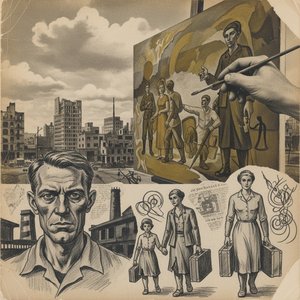
Born amidst the soot-stained landscapes of Sheffield, England, in 1940, Peter Booth’s early consciousness was forged in the crucible of industrial grit and wartime trauma. As the son of a metallurgy professional, he grew up surrounded by the blackened factories and the lingering scars of aerial bombings that defined his childhood. This environment—a world of decay, disruption, and the heavy presence of history—became the foundational palette for his later explorations of human anxiety.When his family emigrated to Australia in 1958, Booth carried this sense of industrial melancholy with him, eventually finding his voice through formal training at the National Gallery School in Melbourne. His journey from a laborer to a pivotal figure in late-20th-century Australian art is a testament to a vision deeply rooted in the tension between the observed world and the fractured psyche.
From Geometric Alienation to Visionary Surrealism
Booth’s artistic evolution is marked by a profound shift from the starkly minimal to the hauntingly complex. In the early 1970s, his work was defined by hard-edged abstractions—dark, imposing rectangles of black that served as visceral symbols of social alienation and isolation. However, the artist could not remain confined within geometric boundaries. Drawing inspiration from the visionary Romanticism of Francisco Goya and William Blake, he began to weave figurative elements into his compositions, creating a bridge between the abstract and the surreal.This transition allowed him to explore the psychological intensity of the subconscious, utilizing the gestural energy of Abstract Expressionism to breathe life into nightmare-like imagery. His work became a site where the release of form met the weight of existential dread, transforming the canvas into a window for the viewer's own deepest fears and most unsettling dreams.
The Apocalyptic Dreamscape
In his mature period, Booth turned his gaze toward the Australian landscape, yet he did not see it as a pastoral sanctuary. Instead, he reimagined the outback as an uninhabitable, apocalyptic territory—a prehistoric terrain populated by mutation and decay. His landscapes are often characterized by:- The presence of strange, humanoid figures that interact with sudden violence or wander in profound isolation.
- A recurring use of dead trees, thorn bushes, and animal skeletons to evoke a sense of post-disaster stillness.
- An atmosphere of cosmic anxiety, where the environment feels as though it is caught in the aftermath of a great catastrophe.
Vprašanja in odgovori
Katere barve je Peter Booth najpogosteje uporabljal/a?
Barvni profil del opusov umetnika Peter Booth je prikazan na njegovi strani Genom palete.
Koliko umetnin umetnika Peter Booth je na voljo za ogled?
Na strani Vsi umetniški slogi si lahko ogledate 3 umetnin del umetnika Peter Booth.
Kako se je umetnost umetnika Peter Booth skozi čas razvijala?
Zgodovina umetnosti umetnika Peter Booth je kronološka časovnica, ki s pomočjo drljanja prikazuje dela umetnika v kronološkem vrstnem redu, razdeljena v poglavja po obdobjih njegove kariere.
Kje se je rodil/a Peter Booth in v kateri državi?
Peter Booth se je rodil/a v mestu Sheffield v državi United Kingdom.