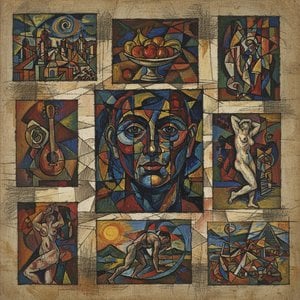
The Life and Artistic Journey of Kuno Veeber
Kuno Veeber was an Estonian painter and graphic artist whose career began in the late 1910s. Born Kuno Bernard Weber at Adila manor, he later Estonianized his surname from Weber to Veeber. His early artistic training commenced at the Ants Laikmaa Studio School in Tallinn in 1916. Following his studies at the Tallinn Nikolai I Gymnasium in 1917, he briefly studied medical science at the University of Tartu. During the Estonian War of Independence from 1919 to 1920, Veeber served as a cyclist in the Estonian Army. He also worked as a laborer on the construction of the new Estonian Parliament building on Toompea Hill in Tallinn.
Artistic Studies and Travels
Veeber studied with Nikolai Triik and sculptor Jaan Koort, and later entered the Higher Art School Pallas in Tartu, where he studied painting in Konrad Mägi's studio and graphic art techniques with Magnus Zeller. In 1923, he traveled to Germany with Zeller. Between 1924 and 1926, Veeber lived in Paris, becoming part of the School of Paris and studying under André Lhote and Demetrios Galanis. In 1927, supported by a grant from the Estonian Cultural Endowment Fine Arts Foundation, he traveled to Italy with his wife, Agaate. In Venice, he copied Tintoretto's Mercury and the Three Graces.
Veeber's works were exhibited in several locations, including:
- Paris
- Riga
- Kaunas
- Helsinki
- Cologne
- Copenhagen
- Moscow
- Rome
- Budapest
Vprašanja in odgovori
Koliko umetnin umetnika Kuno Veeber je na voljo za ogled?
Na strani Vsi umetniški slogi si lahko ogledate 1 umetninic del umetnika Kuno Veeber.
Katere barve je Kuno Veeber najpogosteje uporabljal/a?
Genom palete umetnika Kuno Veeber je stran, ki predstavlja barvni profil celotnega umetniškega dela tega avtorja.
Kako lahko ogledam vsa umetniška dela avtorja Kuno Veeber?
Vsa dela umetnika Kuno Veeber na platformi ta spletna stran si lahko ogledate na njegovi strani Vsi umetniški slogi.
V katerem zgodovinskem obdobju je delal/a Kuno Veeber?
Kuno Veeber je deloval v obdobju Modern. To obdobje umetnikovo dejavnost umešča v zgodovinski okvir.