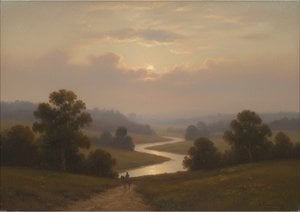
The Legacy of Jack Stuppin
In the vast tapestry of twentieth-century British art, few names evoke the quiet, profound beauty of the English landscape quite like Jack Stuppin. Born in 1933, Stuppin emerged as a master of capturing the ephemeral qualities of light and atmosphere, translating the physical world into a poetic dialogue between color and texture. His work does not merely depict scenery; it invites the viewer to inhabit a moment of stillness, where the boundaries between the earth and the sky seem to dissolve into a singular, emotive experience.
Stuppin’s artistic journey is deeply rooted in the traditions of British landscape painting, yet his approach possesses a modern sensibility that avoids mere imitation. His development as an artist was marked by a rigorous exploration of how light interacts with the natural elements—the way a morning mist clings to a valley or how the setting sun gilds the edges of a woodland canopy. Through his meticulous use of palette and brushwork, he achieved a sense of depth that feels both tangible and dreamlike, grounding his subjects in reality while elevating them to the realm of memory.
Technique and Visual Language
The brilliance of Stuppin’s oeuvre lies in his ability to manipulate medium and light to evoke specific emotional resonances. His technique is characterized by a sophisticated layering of tones, creating a luminous quality that suggests the breathing of the landscape itself. To observe a Stuppin painting is to witness a careful orchestration of several key elements:
- Atmospheric Perspective: The use of soft, receding tones to create an immense sense of scale and distance within the frame.
- Luminosity: A mastery over light that captures the fleeting transitions of time, from the cool clarity of dawn to the warm, heavy hues of twilight.
- Textural Nuance: The application of paint in a manner that mimics the organic textures of bark, water, and foliage, providing a tactile dimension to his visual narratives.
His work often avoids the jarring or the chaotic, opting instead for a harmonious balance that reflects a deep respect for the natural order. There is a rhythmic quality to his compositions, where every stroke serves to guide the eye through a carefully curated vista, ensuring that the viewer remains captivated by the subtle shifts in color and shadow.
Artistic Significance and Enduring Impact
As an artist belonging to the lineage of significant British landscape painters, Jack Stuppin has contributed to a tradition that celebrates the intrinsic value of the natural world. His paintings serve as a testament to the enduring power of observation and the ability of art to preserve the fleeting beauty of our environment. In an era often defined by rapid change and industrialization, his work offers a sanctuary of permanence and peace.
The historical significance of Stuppin’s contribution lies in his ability to bridge the gap between classical landscape traditions and a more personal, impressionistic expression. He did not seek to reinvent the landscape, but rather to deepen our perception of it. His legacy continues to resonate through his ability to evoke nostalgia and wonder, reminding us that even the most familiar vistas hold infinite mysteries waiting to be uncovered by a discerning eye.
Vprašanja in odgovori
Kje so dela umetnika Jack Stuppin razvrščena po barvni paleti?
Stran Po barvnih paletah grupirá dela umetnika Jack Stuppin po njihovih barvnih paletah.
Ali lahko dela umetnika Jack Stuppin brskam po vzdušju?
Na strani Soba razpoloženj umetnika Jack Stuppin so umetniška dela razvrščena glede na vzdušje.
Ali lahko dela umetnika Jack Stuppin razvrstim po barvah?
Delo umetnika Jack Stuppin lahko raziskujete po barvah na njegovi strani Spektralni pregled.
V katerem zgodovinskem obdobju je delal/a Jack Stuppin?
Jack Stuppin je deloval v obdobju Modern. To obdobje umetnikovo dejavnost umešča v zgodovinski okvir.