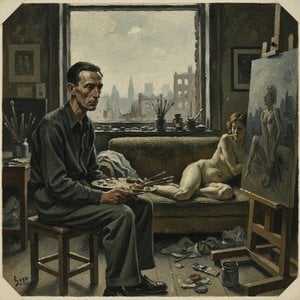
The Etcher of Vienna
Born in Vienna, Austria, in 1874, Friedrich Pontini lived a life defined by the precision of the line and the quietude of the landscape. He was a man of the studio, a painter and graphic artist who sought to capture the essence of form through both brush and needle. His early years were shaped by rigorous training, beginning at the school of Adalbert Brechler before moving to the Academy of Fine Arts in Vienna. There, he refined his ability to manipulate light and shadow, studying painting under Franz Rumpler and the technical intricacies of etching under Arthur William Unger.
His talent was recognized early by the academic establishment. During his years of study, he earned several distinctions, including the Gundel Prize and the Special School Prize, eventually receiving the prestigious golden Füger Medal in 1902. These accolades marked the rise of an artist who was as comfortable with the delicate textures of a figure study as he was with the expansive geometry of a landscape. He became a member of the Wiener Künstlerhaus in 1908, cementing his place within the artistic fabric of his home city.
Technical Mastery and Subject Matter
Pontini’s work was characterized by a versatility that allowed him to move between different mediums and themes with ease. He was particularly noted for his ability to translate the natural world and the human form into striking visual compositions. His output included:
- Detailed figure studies that explored the nuances of the human silhouette.
- Animal depictions that required a keen eye for anatomy and movement.
- Landscape scenes, such as his 1910 depiction of The Seebachtal near Franzensbad.
- Original etchings commissioned by the Viennese publisher "Vervielfältigende Kunst."
His etchings, often executed in color, demonstrated a sophisticated understanding of printmaking. Some of his most significant works found their way into the permanent collections of the Museum of Modern Art in Prague and the Albertina Museum in Vienna. He possessed a particular affinity for the landscapes of Franzensbad, a location that appeared frequently in his visual vocabulary.
A Life Cut Short
The trajectory of Pontini’s career was abruptly halted by personal tragedy and a sudden end. After the death of his wife, the artist took his own life in his studio in 1912. He was only thirty-eight years old. His death left behind a body of work that remains held in significant European collections, including the Österreichische Galerie Belvedere. Though his time was brief, his technical skill as an etcher and painter ensured that his vision of the Austrian landscape and the human form would be preserved.
Vprašanja in odgovori
Od kod prihaja Fritz Pontini?
Fritz Pontini se je rodil/a v državi Austria.
Kako lahko spremljam dela umetnika Fritz Pontini po letih?
Stran Kronologija del umetnika prikazuje dela umetnika Fritz Pontini razvrščena po datumu, leto za leto.
V katerem zgodovinskem obdobju je delal/a Fritz Pontini?
Fritz Pontini je deloval v obdobju Modern. To obdobje umetnikovo dejavnost umešča v zgodovinski okvir.
Koliko umetnin umetnika Fritz Pontini je na voljo za ogled?
Na strani Vsi umetniški slogi si lahko ogledate 1 umetninic del umetnika Fritz Pontini.