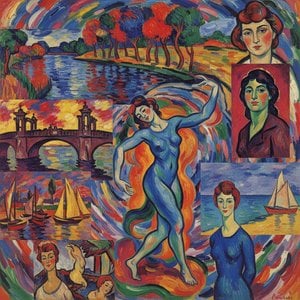
The Quiet Observer of Form
Ernst Hallop’s life was shaped by the movement of people and the shifting light of different landscapes. Born in Gatchina, his path eventually led him to the "Pallas" school, where he studied from 1926 to 1934 under A. Vabbe. This period of training provided the foundation for a career that would span several countries and cities. He spent time in England, France, and Italy, absorbing the visual languages of these places before returning to work as a freelance artist. His presence in the art world was felt in Võru, Tallinn, Chelyabinsk, and Moscow, and later, from 1945, he settled back into life in Estonia.
His work often carries a serious, slightly elegiac mood. It is a feeling found in the way he approached a canvas, whether he was working with oil, pastel, chalk, or charcoal. He did not shy away from the monotype, a technique that requires a certain decisiveness. His hands were often busy with the textures of the natural world or the stillness of a subject in a room.
Technique and Subject Matter
The way Hallop handled his materials reveals a preference for specific themes. He looked closely at the world through two primary lenses:
- Landscapes that captured the specific character of a place.
- Portraits that sought to hold a likeness.
His technical range allowed him to move between the heavy application of oil on canvas and the softer, more immediate touch of pastel on paper. In his later years, his creative reach extended toward the northern regions and Siberia, where the light and terrain offered new textures to explore. His exhibitions in Viljandi, Riga, and Kaunas showed a consistent interest in these quiet, observed moments.
A Life in Color and Line
The years he spent working in Estonia saw him refine his ability to capture both the grand and the intimate. He could move from the broad strokes of a landscape to the delicate detail of a still life. His work from the 1940s and 1950s shows a steady hand, whether he was documenting a self-portrait or the simple arrangement of white peonies. He remained a painter of the tangible, focusing on the weight of objects and the atmosphere of the spaces they occupied.
Vprašanja in odgovori
Ali lahko dela umetnika Ernst Hallop raziskujem po ključnih besedah?
Delo umetnika Ernst Hallop lahko raziščete po ključnih besedah na njegovi strani Po ključnih besedah, kjer vsaka ključna beseda združuje sorodna dela.
Kako lahko spremljam dela umetnika Ernst Hallop po letih?
Stran Kronologija del umetnika prikazuje dela umetnika Ernst Hallop razvrščena po datumu, leto za leto.
Kje lahko najdem dela umetnika Ernst Hallop, razvrščena glede na vzdušje?
Na strani Soba razpoloženj umetnika lahko najdete dela umetnika Ernst Hallop, razvrščena glede na njihovo vzdušje.
Ali lahko raziskujem dela umetnika Ernst Hallop po tematikah?
Delo umetnika Ernst Hallop lahko raziskujete po temah na njegovi strani Atlas motivov.