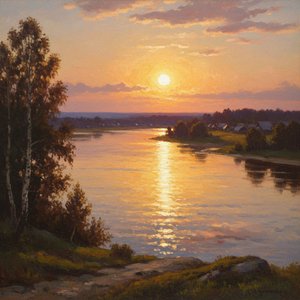
The Liptov Landscape and the Precision of Form
Eduard Tholt’s presence in Slovak art is defined by a grounded, unpretentious connection to the landscape. He did not seek to reinvent the horizon but rather to document the specificities of the Liptov region and the atmosphere of Malatíny. His work functions as a visual record of a particular geography, captured through a lens of direct observation. He was a painter and a graphic artist who understood the weight of a landscape, focusing on the structural reality of the terrain rather than mere decoration.
His technical foundation was built under the guidance of Ladislav Čemický and Jaroslav Masák. This training provided him with the discipline required to translate the physical world into two-dimensional space. His output was characterized by a steady, professional output that spanned several decades, moving between the urban energy of Bratislava and the rural stillness of Liptov. He was not a painter of grand abstractions; he was a painter of the earth, the seasons, and the specific light that hits a village in the morning.
A Record of Seasonal Shifts
Tholt’s catalog reveals a preoccupation with the cyclical nature of the environment. He captured the world in states of transition, focusing on how light and weather alter the perception of a place. His work is categorized by several key thematic focuses:
- The depiction of specific local settlements, such as Staré Malatíny and Vyšný Malatín.
- The study of seasonal changes, ranging from the starkness of winter to the aftermath of rain.
- The observation of agricultural and natural elements, including orchards and pastures.
His ability to isolate a moment—a snowy courtyard or a sun-drenched landscape—shows a commitment to the immediate reality of his surroundings. He avoided the trap of sentimentality, opting instead for a clear, structural reading of his subjects. His paintings from the 1970s and 1980s demonstrate a controlled approach to composition, where the weight of the land is felt through deliberate brushwork and a focused color palette.
The Weight of the Visual Record
The significance of Tholt’s work lies in its consistency and its refusal to drift into the ephemeral. He maintained a rigorous practice, participating in numerous exhibitions that solidified his place within the regional art scene. His legacy is held in collections like the Liptov Gallery of Peter Michal Bohúň, where his depictions of the Liptov landscape remain as evidence of his specific vision. He did not aim for the spectacular; he aimed for the accurate, providing a visual anchor for the changing landscapes of his time.
Vprašanja in odgovori
V katerem zgodovinskem obdobju je delal/a Eduard Tholt?
Eduard Tholt je deloval v obdobju Modern. To obdobje umetnikovo dejavnost umešča v zgodovinski okvir.
Koliko umetnin umetnika Eduard Tholt je na voljo za ogled?
Na strani Vsi umetniški slogi si lahko ogledate 4 umetnin del umetnika Eduard Tholt.
Ali lahko raziskujem dela umetnika Eduard Tholt po barvnem spektru?
Stran Spektralni pregled razvršča dela umetnika Eduard Tholt po barvah.
Ali lahko dela umetnika Eduard Tholt brskam po vzdušju?
Delo umetnika Eduard Tholt si lahko ogledate po razpoloženju na njegovi strani Soba razpoloženj, kjer so umetniška dela razvrščena glede na njihovo vzdušje.