A Scholar of the Northern Spirit
In the bustling streets of Bruges, a young man named Dominicus Lampsonius began a life that would weave together the threads of poetry, diplomacy, and the visual arts. He was a man of letters, shaped by the rigorous studies of arts and sciences at the University of Leuven. His path was not one of solitary studio work, but of movement and high-level service. In 1554, he traveled to England, where he took up the mantle of secretary to Cardinal Reginald Pole. This period in the service of such a prominent figure placed him at the very heart of the humanist movement, surrounded by the intellectual currents that were reshaping Europe.
After the passing of the Cardinal, Lampsonius found himself in Liège, serving successive prince-bishops including Robert of Berghes, Gerard of Grœsbeek, and Ernest of Bavaria. His life was defined by this administrative devotion, acting as a bridge between the halls of political power and the studios of creative minds. He lived a life of correspondence, maintaining a vast network of letters that reached across borders to the most learned men of his age. Through these exchanges, he did not merely observe history; he helped shape how the artists of the Low Countries would be remembered by future generations.
The Architect of a Canon
While many remember him as a secretary or a poet, Lampsonius possessed a deep, abiding passion for the painters of his homeland. He sought to provide a foundation for Netherlandish art that could stand alongside the celebrated traditions of Italy. His writings were instrumental in this effort, particularly his biographical account of Lambert Lombard. In this work, he explored the life and theoretical contributions of his friend and teacher, emphasizing an intellectual curiosity and a devotion to antiquity. He did not merely record facts; he sought to present a coherent history for a people finding their own cultural identity.
His most visible contribution to the visual record came in 1572 with the publication of a series of twenty-three engraved portraits. Titled Pictorum aliquot celebrium Germaniae inferioris effigies, this collection presented the faces of the great masters of the Low Countries. To accompany these metallic images, Lampsonius composed Latin verse that honored each subject. The project was a collaborative labor, involving the publisher Hieronymus Cock and various skilled engravers like Jan Wierix and Adriaen Collaert. Through these prints, he brought the likenesses of artists such as:
- Hubert van Eyck
- Jan van Eyck
- Hieronymus Bosch
- Rogier van der Weyden
- Pieter Bruegel the Elder
- Lucas van Leyden
These portraits were more than simple likenesses; they were an act of remembrance. Because many of these men had already passed into history, Lampsonius used his poetry to create a funeral procession of sorts, inviting readers to join him in mourning the masters of the past while celebrating their enduring skill.
A Bridge Between North and South
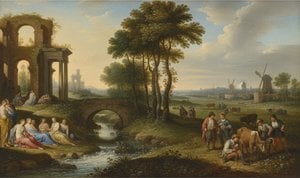
Lampsonius occupied a unique space between the Italian Renaissance and the Northern tradition. He maintained an active dialogue with Giorgio Vasari, providing essential notes regarding the life and works of painters like Lambert Lombard. In his letters, he was not afraid to defend the merits of Netherlandish art against disparaging remarks, arguing for its specific strengths. He observed that while the Italians might be praised for their mastery of human figures and divine subjects, the Netherlanders possessed a particular excellence in the depiction of landscapes.
He even looked toward the future of printmaking, suggesting that Northern engravers should work alongside Italian artists to better capture the brilliance of original works. His vision was one of technical improvement and cultural exchange. He proposed projects to engrave the works of Michelangelo so that those far from Rome might appreciate their grandeur. Though he remained a bureaucrat in Liège, his mind traveled through the lines of his Latin verses and the sharp edges of the engravings he championed, forever linking the diligent hands of the North with the intellectual heights of the South.
Vprašanja in odgovori
Od kod prihaja Dominicus Lampsonius?
Dominicus Lampsonius se je rodil/a v državi Belgium.
Kako lahko ogledam vsa umetniška dela avtorja Dominicus Lampsonius?
Vsa dela umetnika Dominicus Lampsonius na platformi ta spletna stran si lahko ogledate na njegovi strani Vsi umetniški slogi.
Ali lahko dela umetnika Dominicus Lampsonius raziskujem po ključnih besedah?
Stran Po ključnih besedah umetnika Dominicus Lampsonius povezuje njegova dela prek ključnih besed.