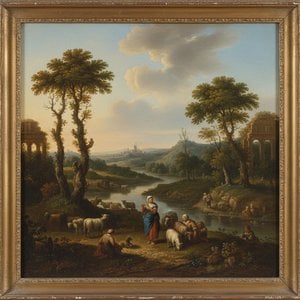
The Nuremberg Hand
Born in Nuremberg in 1897, Conrad Völkel was a man shaped by the disciplined traditions of German craftsmanship. His early years were defined by formal training, beginning with an apprenticeship at the Kunstgewerbeschule and continuing through the Offener Zeichensaal of his home city. He was a practitioner of many disciplines, moving between the delicate precision of engraving and the fluid expression of painting and drawing. His work was not a pursuit of mere decoration but a deep engagement with the physical world around him.
By 1945, Völkel had established himself as a freelance artist in Nuremberg, a period marked by the heavy atmosphere of a city rebuilding itself. His perspective was often fixed on the immediate, the local, and the tangible. He captured the quietude of landscapes and the stark reality of post-war life, finding subject matter in the very streets and fields that defined the Franconian identity.
A Life in Lines and Light
His technical versatility allowed him to navigate various genres with a consistent, observant eye. He was as comfortable with the heavy textures of a landscape as he was with the subtle nuances of a portrait or the anatomical clarity of a nude study. His output reflected a life spent observing the intersection of nature and human industry.
- Painter and draftsman
- Graphic artist and etcher
- Engraver
- Pastellist
His compositions often focused on the rhythms of labor and the stillness of the countryside. He documented the seasonal cycles through series such as his depictions of the harvest, and he turned his gaze toward the urban landscape, capturing the architecture of the Neumarkt and the trees of the Dorplatz. Even in the aftermath of conflict, his work remained grounded, noting the presence of women amidst the rubble of a war-torn landscape.
Institutional Presence
Völkel was deeply embedded in the artistic community of his region. He was a member of the artist group "Die Hütte" and eventually took on a leadership role as President of the Bundes Fränkischer Künstler. This involvement suggests a man who was not merely an observer of his culture but an active participant in its professional structure. His influence extended through his family, as he was the father of the painter Toni Völkel.
He remained active in his craft until his death in Freising in 1965. His legacy is found in the quiet strength of his etchings and the steady, unpretentious way he recorded the changing face of Germany through the middle of the twentieth century.
Vprašanja in odgovori
V katerih umetnostnih smereh je deloval/a Conrad Völkel?
Raziskujte dela umetnika Conrad Völkel po umetniškem slogu na njegovi strani Vsi umetnostni slogi.
Kje in leta se je rodil/a Conrad Völkel?
Conrad Völkel se je rodil/a v mestu Nuremberg leta 1897.
Koliko umetnin umetnika Conrad Völkel je na voljo za ogled?
Na strani Vsi umetniški slogi si lahko ogledate 6 umetnin del umetnika Conrad Völkel.
Kje lahko v 3D galeriji ogledam dela umetnika Conrad Völkel?
Možnost virtualnega obiska: stran 3D galerija umetnosti umetnika Conrad Völkel predstavlja njegova dela v trodimenzionalni galeriji.