


 Pošlji kot čestitko
 Deli
Deli
 Podrobnosti
 Priročnik

 Prenesi
 Podobni artefakti
 Predvajaj diaporama
 Statistika
Fancy
 Bronasta kip</a>
- Neo-Dada
 133.0 x 114.0 cm
 Chrysler Museum of Art
 Preberi več
Umetniška dela, prikazana na tej strani, so zaščitena z avtorskimi pravicami, kar pomeni, da po zakonu ne moremo ustvarjati ali prodajati identičnih reprodukcij. Ta zaščita se izvaja v skladu z mednarodnimi sporazumi, kot so Bernska konvencija in po nacionalnih zakonih, vključno s tistimi, ki jih določa Zakon o avtorskih pravicah ZDA – naslov 17.
Kot spoštljiva in zakonita alternativa ponujamo prilagojena, ročno slikana umetniška dela, navzornena na original. Naši sposobni in profesionalni umetniki skrbno preučijo stil, vzdušje in umetniško bistvo originala, da ustvarijo novo, edinstveno delo, ki vzbudi enak občutek – pri čemer ostaja popolnoma nova, samostojna izvirna stvar.
Ta način v celoti upošteva zakonodajo o avtorskih pravicah, saj ne vključuje kopiranja ali podvajanja zaščitena umetniškega dela. Namesto tega gre za kreativno preinterpretacijo – novo sliko, ki je navdihnjen rezultat originala, vendar ni z njim identična.
Ročno izdelana oljna reprodukcija
Ročno slikano olje na platnu v vaši izbiri velikosti in okvirja, izdelano po naročilu naših umetnikov. ( Preklop na tiskanine Preklop na digitalno sliko)




































Izberite eno od naših vnaprej določenih velikosti, ki ustrezajo prvotnim proporcijam umetničkega dela.

Svoje dimenzije lahko vnesete tako, da se prilagodite določenemu okvirju ali prostoru. Če izbrana velikost ne ustreza razmerjem originalne slike, bomo umetniško delo obrezali ali sliko dopolnili z dodatnimi ročno naslikanimi elementi. Pred začetkom proizvodnje vam bo poslan digitalni osnutek v odobritev.
Upoštevajte, da predogled na zaslonu ne odraža dejanskega obrezovanja ali podaljšanja. Le osnutek bo natančno prikazal končno kompozicijo.
Čeprav so na voljo velikosti po meri, priporočamo izbiro dimenzije s preddefiniranega seznama, da ohranimo originalne razmere.
Po oddaji naročila bo ekipa ArtsDot.com stranki po e-pošti poslala navodila in predogled digitalnega predogleda.
Mednarodna dostava () v 3/4 tednih namesto običajnih 5 tednov. (11 oktober). Brez kompromisov pri kakovosti.

Brezplačna ekspresna dostava po vsem svetu

Visokokakovostno laneno platno

Popolno zavarovanje pošiljke

Garancija povračila carine in uvoznih davkov

Garancija popolnega barvnega ujemanja

Politika vračila v 100 dneh (le v primeru okvar)

Garancija 100% povračila denarja

Popust pri večjem naročilu
 Možnost stekla je na voljo le za velikosti pod 110 cm

Fancy
Tehnika reprodukcije
Velikost reprodukcije
-


Skupna cena
€ 226
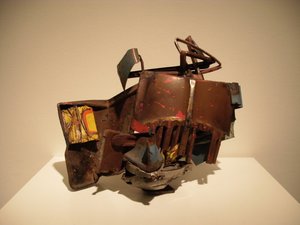
Fancy That: A Monumental Exploration of Assemblage
John Angus Chamberlain’s sculpture “Fancy That,” created around 1963, stands as an arresting testament to the transformative power of repurposing industrial detritus into profound artistic expression. More than just a visually striking assemblage—a deliberate juxtaposition of disparate materials—it embodies the core tenets of Neo-Dada and echoes the legacy of Abstract Expressionism, marking Chamberlain’s indelible contribution to American sculpture.
The artwork itself is dominated by a substantial red chair constructed from wood and metal. Its seat is crafted from solid timber, providing stability and grounding the piece, while a robust steel frame contributes structural integrity and hints at the machine age aesthetic prevalent during its creation. However, it’s the deliberate incorporation of crushed automobile parts—primarily fenders and hoods—that elevates “Fancy That” beyond conventional sculptural forms.
- Technique: Chamberlain's method involved meticulously crushing car bodies into fragments before welding them together with remarkable precision. This process wasn’t merely destructive; it was a calculated act of reimagining, transforming discarded objects into monumental sculptures that challenge notions of beauty and materiality.
- Style: Strongly influenced by Marcel Duchamp’s conceptual approach to art—specifically the readymade—Chamberlain deliberately eschewed traditional artistic skill in favor of embracing chance and improvisation. This stylistic choice aligns perfectly with the spirit of Abstract Expressionism, prioritizing emotional resonance over technical virtuosity.
- Historical Context: Produced during the mid-1960s, “Fancy That” reflects the broader cultural milieu of its time—a period marked by experimentation in art and design, fueled by anxieties about technological advancement and a desire to disrupt established artistic conventions. It’s a direct response to the prevailing trends of the era.
The sculpture's impact transcends mere visual appeal; it compels contemplation on themes of decay, transformation, and the relationship between nature and industry. The juxtaposition of organic wood against cold metal creates a dynamic tension that mirrors the complexities of the human experience. Chamberlain’s masterful manipulation of material invites viewers to consider the beauty inherent in imperfection and the potential for artistic innovation within unexpected sources.
“Fancy That” isn't simply an object; it’s a statement—a bold assertion of artistic freedom and a celebration of the transformative capacity of art. Its enduring presence in contemporary art discourse underscores Chamberlain’s position as a visionary artist who redefined sculpture and cemented his place within the canon of American modernism.
Vprašanja in odgovori
Kako si lahko ogledam predogled reprodukcije dela "Fancy" avtorja John Angus Chamberlain?
Predogled dela "Fancy" avtorja John Angus Chamberlain je na strani Predogled za to umetniško delo.
Kakšna je percepcija svetlobe pri delu "Fancy" avtorja John Angus Chamberlain?
Splošno je "Fancy" zabeleženo kot bliskajoč. Zaznana svetlina opisuje, kako svetlo ali temno delo deluje.
Kje lahko kupim tiskanino dela "Fancy" avtorja John Angus Chamberlain?
"Fancy" je na voljo kot umjetnička grafika na bombažnem platnu ali arhivskem papirju za platno. Naročila lahko oddate na ta stran, v izbrani velikosti.
Kje lahko kupim digitalno sliko dela "Fancy" avtorja John Angus Chamberlain?
Digitalno sliko dela "Fancy" avtorja John Angus Chamberlain lahko kupite na strani ta stran: prenos digitalne slike visoke ločljivosti.
Kdo prodaja ročno slikane kopije dela "Fancy" avtorja John Angus Chamberlain?
Ročno slikano reprodukcijo dela "Fancy" avtorja John Angus Chamberlain lahko naročite neposredno na ta stran: ročno slikana oljna reprodukcija na lnenem platnu, izdelano po naročilu.
Kdo je ustvaril "Fancy"?
"Fancy" pripisujemo John Angus Chamberlain.
V katero obdobje kariere John Angus Chamberlain pripada delo "Fancy"?
"Fancy" predstavlja Mature Period umetnika John Angus Chamberlain.
Sorodna umetniška dela


Biografija umetnika
The Alchemist of Automobilia: The Life and Legacy of John Angus Chamberlain
In the intersection of industrial decay and high art, few figures loom as large or as provocatively as John Angus Chamberlain. Born in 1927 in Rochester, Indiana, Chamberlain did not merely create sculpture; he orchestrated a metamorphosis of the discarded. To look upon his work is to witness a violent yet poetic dialogue between the mechanical past and the abstract present. He possessed a singular vision that allowed him to see not just rusted scrap, but a vocabulary of form, color, and texture. His journey from the son of a saloonkeeper in the American Midwest to a titan of the Neo-Dada movement is a testament to an unyielding creative impulse that sought to find beauty within the crushed and the broken.
Chamberlain’s artistic consciousness was forged through a diverse and rigorous educational odyssey. After serving in the United States Navy during the pivotal years of World War II, he utilized the GI Bill to immerse himself in the burgeoning avant-garde scenes of America. His time at the Art Institute of of Chicago provided him with a foundational mastery of form, but it was his tenure at the legendary Black Mountain College that truly expanded his intellectual horizons. At Black Mountain, he moved beyond the purely visual, studying under influential poets such as Charles Olson and Robert Creeley. This literary immersion profoundly shaped his sculptural language; he famously viewed his collection of automotive fragments as a reservoir of words, where the act of welding was akin to composing a stanza, seeking the perfect placement of one jagged edge against another to achieve a rhythmic, poetic resonance.
A Symphony of Steel and Spontaneity
The hallmark of Chamberlain’s oeuvre lies in his revolutionary technique of assemblage. While many of his contemporaries were exploring the flat planes of Abstract Expressionist painting, Chamberlain sought to bring that same gestural energy into three-dimensional space. He became a master of the "crushed" aesthetic, meticulously dismantling abandoned automobiles and extracting their vibrant, enamel-coated metal components. Through the intense processes of welding, bending, and compressing, he transformed these industrial remnants into monumental forms that pulsed with an almost organic vitality.
His work defies easy categorization, existing in a fluid state between several major movements:
- Abstract Expressionism: He translated the spontaneous, emotional brushstrokes of painters like Pollock into the physical manipulation of steel and chrome.
- Neo-Dada: By utilizing found objects and "readymades" from the industrial age, he challenged the sanctity of traditional sculptural materials like marble or bronze.
- Pop Art: His use of consumerist detritus—the very skin of the American automobile—connected his high-art ambitions to the burgeoning mass culture of the mid-20th century.
There is a palpable tension in his sculptures, a sense of captured motion and compressed energy. The bright flashes of Cadillac red or Chevrolet blue, often peeking through layers of rust and grime, create a chromatic intensity that mirrors the dynamism of urban life. He did not seek to represent the car, but rather to capture the spirit of its movement and the inevitable entropy of its decay.
Historical Significance and the Enduring Pulse of Art
Throughout his prolific career, Chamberlain’s presence was felt across the most significant art hubs of the world, from Manhattan and Los Angeles to Shelter Island and even Belgium. His ability to disrupt the boundaries between sculpture and painting left an indelible mark on the trajectory of modern art. He proved that the debris of the industrial revolution could serve as the medium for a profound spiritual and aesthetic inquiry. Critics often noted that while his materials were cold and hard, the emotional impact of his work was deeply visceral, aiming—as he himself desired—to "make the viewer’s heart beat."
As we reflect on his life, which concluded in 2011, Chamberlain remains a pivotal figure who bridged the gap between the mechanical and the lyrical. He taught us that art is not merely about the creation of something new, but about the radical reimagining of what already exists. His legacy lives on in every artist who looks at the wreckage of the world and sees the potential for a masterpiece, reminding us that even in the crushed and the discarded, there is an eternal, unyielding beauty waiting to be welded back together.
John Angus Chamberlain
1927 - 2011 , United States of America
Ključne informacije
- Full Name: John Angus Chamberlain
- Nationality: American
- Date Of Birth: 1927
- Date Of Death: 2011
- Place Of Birth: Rochester, United States of America
- Notable Artworks:
- Fancy
- Sleeping Giant
- Artistic Movement Or Style: Abstract Expressionism
- Artists Who Influenced This Artist:
- Robert Delaunay
- Jean Dubuffet
- Artists Or Movements Influenced By This Artist: ['Neo-Dada']
Sorodni članki

John Singer Sargent's 25 Masterpieces: Portraits & Beyond | ArtsDot
Explore 25 iconic John Singer Sargent paintings – from dazzling portraits to Impressionist landscapes. Discover the stories behind Madame X, El Jaleo & more! Find museum-quality art reproductions and elevate your home decor with ArtsDot.com.

Bronze Sculptures That Defined Art History | ArtsDot
Journey through art history with our Top 10 bronze sculptures! Explore masterpieces by Rodin, Michelangelo & more. Discover stories behind iconic statues and find museum-quality reproductions for your home decor at ArtsDot.com.

John Constable: 25 Mojstrovskih Del Angelskega Krajinarja | ArtsDot.com
Odkrijte 25 mojstrovskih del Johna Constabla, angleškega slikarja romantizma. Preučite zgodbe za ikoničnimi krajinami, tehniko in lepoto narave. Kvalitetne reprodukcije slik na ArtsDot.com – idealno za dekoracijo doma!

Absolutni Izrazi: 10 Mojstrin Del, Ki So Definirali Gibanje
Odkrijte 10 mojstrin del abstraktnega ekspresionizma! Pollock, Rothko & De Kooning - zgodbe za kulise ikoničnih umetnin. Inspirirajte se in poiščite reprodukcije na ArtsDot.com!

The Enduring Form: Exploring Themes & Techniques in Sculpture Across Historical Periods
Explore the rich history of sculpture from ancient masterpieces to contemporary innovations. Discover key techniques, influential artists & investment potential for discerning art collectors.
