


The picture follows your choices: , .
Opis zbirateljskega predmeta
Fernand Léger's "The Flower That Walks" (1953) is a vibrant modernist masterpiece, blending abstraction with nature’s forms. Explore the dynamic energy and playful spirit of this iconic sculpture.
 Preberi več
Biografija umetnika
Fernand Léger (1881–1955): pionir kubizma in 'tubizma'! Odkrijte njegove drzne slike, ki slavijo moderno življenje, stroje in človeško podobo – predhodnik pop arta.
Ročno izdelana oljna reprodukcija
Ročno slikano olje na platnu v vaši izbiri velikosti in okvirja, izdelano po naročilu naših umetnikov. ( Preklop na tiskanine Preklop na digitalno sliko)
More about this painting
 Predogled v realnem okolju
 Pošlji
 Deli
Deli
 Podrobnosti o delu
 Priročnik

 Prenesi sliko
 Podobni izdelki
 Rentgenski posnetek
 Predvajaj diaporama
 Q&A
Q&A Statistika
Order your painting in four simple steps
Take your time. You can change any answer; the price in your order card follows each choice.
1 Step one of four
Which size would you like?
These sizes keep the proportions of the original painting. The drawing shows your choice on a wall, above a two-metre sofa.
Or give your own measurements
Izberite eno od naših vnaprej določenih velikosti, ki ustrezajo prvotnim proporcijam umetničkega dela.

Vnesite širino in višino, ki jih potrebujete, da se slika prilega vašemu okviru ali steni. Ker je delo ročno slikano, lahko umetnik pri različnih oblikih slik pri robovih doda malo več barve ali pa jih malo odreže — izberite sami. Pred začetkom slikanja vam pošljemo digitalni predogled za potrditev. Slika, prikazana na tej strani, ni končni rezultat — le predogled prikazuje dejansko podobo.
2 Step two of four
How should it be prepared: rolled, stretched or framed?
The prices below are for the size you chose in step one.
Choose the edges of the stretched canvas
Choose your frame

White €1

Blurside €1

Extended €1

P118B €10

P118H €10

P118W €10

P438Z €10

P508JH €12

P508YH €12

P805H €10

P805Z €10

P919BZ €10

P919G €10

P919XJ €10

P959ZH €10

P968JZ €12

W106C €8

W218G €10

W218JH €8

W218Y €10

W307PJ €10

W316G €10

W316PJ €8

W316Y €10

W398PJ €8

W4111J €10

W500HY €15

W500JH €15

W692G €12

W849H €8

W940BG €15

W953PJ €8

H24-GOLD €30

H24-SILVER €30

H36-GOLD €45

H36-SILVER €45
V okviru
Moulding: . Overall size with the frame: .
3 Step three of four
Would you like anything changed in the painting?
Most people answer no. Because each painting is made by hand, our artist can also adapt it for you.
After order, ArtsDot.com team will email client for instructions and provide a mockup preview
4 Step four of four
A few finishing options
All of them are optional. The answers already selected cost nothing extra.
Who paints it?
Mednarodna dostava () v 3/4 tednih namesto običajnih 5 tednov. (29 oktober). Brez kompromisov pri kakovosti.
A nameplate, as in a museum?
Podrobnosti o gravirani bronasti plošči
This elegant plaque features the artist's name and the title of the artwork, finely engraved for a timeless presentation.
It is made from bronze with a refined, elegant finish. The text is precisely laser-engraved for a sharp and permanent result. Measuring 9x2 cm, the plaque is compact yet easy to read. It's built to be durable and scratch-resistant, offering a professional, museum-quality look. Mounting is simple thanks to the included adhesive backing.
Podrobnosti o transparentni akrilni plošči
The plaque includes essential engraved details such as the artist's name, the title of the artwork, the date it was created, the type of media used-like oil on canvas or watercolor-a brief description of the piece, and a QR code that links to the complete artwork information.
It is crafted from clear acrylic, offering a sleek, modern appearance. The text is UV-engraved in black to ensure strong visual contrast. With a size of 10x15 cm, it ensures optimal readability. It comes equipped with two metal hooks for secure wall mounting. The plaque is designed to be weather-resistant, making it suitable for various environments, and it includes interactive features that work seamlessly with smartphone scanning.
Podrobnosti o črni akrilni plošči
This elegant plaque includes engraved information such as the artist's name, the title of the artwork, the date it was created, the type of media used (like oil on canvas or watercolor), a short description of the artwork, and a QR code for quick access to more information.
The plaque itself is made from refined black acrylic with a premium finish. The text is laser-engraved in white for high contrast and readability. Its size is 10x15 cm, designed to be easy to read. It comes with two metal hooks for professional mounting. The design is sleek and fits any interior style. It is also weather-resistant and durable, with built-in digital integration for mobile compatibility.
A protective varnish?
When do you need it?
✓ Check and order
Your painting, as you ordered it

The flower that walks
Tehnik reprodukcije
Velikost reprodukcije
-

Izbor vrhunskih umetnikov
Več podrobnosti, dovršenosti in dodatnega časa za izdelavo
-

Okvir za reprodukcijo
-
-
Za umetniška dela ali reprodukcije, ki so po katerikoli strani širše od 105 cm (približno 41 palč), bo okvir poslan v razstavljeni obliki kot komplet. Ta metoda zagotavlja varno dostavo in preprečuje poškodbe med transportom.
Potrebna je profesionalna montaža – to ni izdelek za DIY izdelavo.
Komplet mora sestaviti in platno napeti izkušen profesionalni okvirjest, pri čemer bo uporabil lepil za les (ni vključeno), klešče za napetje platna in spone, da bi ohranil pravokotnost letev med sušenjem lepila. Nepravilna montaža ali neenakomerna napetost platna lahko trajno poškoduje umetniško del in
 Za umetniška dela ali reprodukcije, ki so po katerikoli strani širše od 105 cm (približno 41 palč), bo okvir poslan v razstavljeni obliki kot komplet. Ta metoda zagotavlja varno dostavo in preprečuje poškodbe med transportom.
Vključene so vse letve iz masivnega lesa, natančno izrezane po meri.
Montaža poteka s priloženimi vijaki, vendar je za kotiče potrebna lepil za les, ki ga ni v kompletu in ga mora zagotoviti vaš okvirnik.
Za uporabo so potrebna profesionalna orodja, ki niso vključena: klešče za napinjanje platna (napetnik) in sponke za ohranjanje pravokotnosti letev med sušenjem lepila.
Pomembno:
Za stike v kotih potrebujete lepil za les, nosilce je treba z

Značka z imenom
-
-

Zaščitni lak
Sijajni lak (poudarja barve ter zagotavlja zaščito pred svetlobo in vlago)
-

Prilagodi svoje umetniško delo
Primeri možnih prilagoditev: zamenjava obraza s fotografijo kupca; dodajanje hišnega ljubljenčka (npr. zamenjava mačke s psom); vključitev skritega sporočila v ozadje; sprememba krajšave ali elementov ozadja.
-

Hitra dostava
Mednarodna dostava () v 3/4 tednih namesto običajnih 5 tednov. (29 oktober). Brez kompromisov pri kakovosti.
-
Hitra dostava
Globalna dostava () v 5 tednih. (5 november).
Vključeno v ceno
Skupna cena
€ 232
Možnost stekla je na voljo le za velikosti pod 110 cm
Included with every order
- Brezplačna ekspresna dostava po vsem svetu
- Visokokakovostno laneno platno
- Popolno zavarovanje pošiljke
- Garancija povračila carine in uvoznih davkov
- Garancija popolnega barvnega ujemanja
- 100-dnevna politika vračil (le v primeru okvar)
- Garancija 100% povračila denarja
- Popust pri večjem naročilu


Fernand Léger’s “The Flower That Walks”: A Modernist Dance of Form and Color
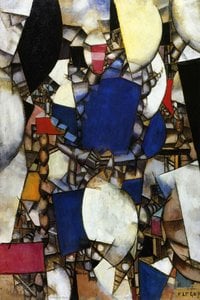
Fernand Léger's "The Flower That Walks," painted in 1953, isn’t merely a depiction of a flower; it’s an embodiment of the burgeoning modernist spirit grappling with the dynamism of the machine age. This vibrant canvas, brimming with bold geometric shapes and a playful energy, captures a pivotal moment in Léger's artistic evolution – his conscious effort to integrate the visual language of industry and technology into a distinctly personal aesthetic. Initially trained as an architect, Léger’s path shifted dramatically towards painting after arriving in Paris, drawn by the revolutionary currents swirling through the city’s avant-garde circles. Unlike many of his contemporaries who sought refuge in abstraction as a purely intellectual exercise, Léger embraced it as a means to represent the very essence of modern life – its rhythms, its structures, and its inherent movement.
The painting immediately commands attention with its audacious color palette: a joyous explosion of red, white, green, yellow, and orange. These aren’t delicate pastels; they're assertive, almost industrial hues, reminiscent of factory machinery and the vibrant signage that dominated the urban landscape of 1950s Paris. Léger deliberately avoided subtle gradations, favoring sharp contrasts and simplified forms. This stylistic choice reflects his fascination with the mechanics of the world around him – the precise angles of gears, the repetitive patterns of assembly lines, and the bold, unyielding structures of modern buildings. The central blue circle acts as a grounding element, a visual anchor amidst the swirling energy of the flower’s form.
Cubism and the “Tubist” Aesthetic
“The Flower That Walks” is deeply rooted in the principles of Cubism, a movement that Léger championed alongside Pablo Picasso and Georges Braque. However, Léger pushed beyond the purely analytical deconstruction of traditional forms characteristic of early Cubism. Instead, he sought to synthesize fragmented perspectives into a new, unified visual experience – a concept he termed “Tubism.” This approach involved reducing objects to their essential geometric components, often depicting them as if viewed from multiple angles simultaneously. The flower itself is rendered through this lens: its petals are not smoothly curved but rather broken down into angular planes, suggesting both the organic and the mechanical.
Léger’s interest in machinery profoundly influenced his artistic vision. He saw a beauty in the precision and efficiency of industrial design, and he sought to capture that same sense of order and dynamism in his paintings. The flower's stylized form, with its simplified shapes and bold colors, echoes the aesthetic of early 20th-century automobiles and airplanes – symbols of technological progress and modernity. The suggestion of movement is particularly striking; the flower appears to be actively “walking,” a deliberate gesture that imbues the painting with a sense of life and vitality.
Symbolism and the Human Form
While Léger’s work is often associated with industrial imagery, it's crucial to recognize the underlying human element. The "flower" isn't simply an abstract form; it subtly evokes the human figure, particularly the torso and limbs. The petals can be interpreted as arms reaching out, while the central circle represents a head or chest. This deliberate ambiguity invites viewers to project their own interpretations onto the painting, fostering a sense of personal connection.
Furthermore, the flower’s “walking” action carries symbolic weight. It suggests a journey, a progression, and perhaps even a striving for something beyond the confines of its immediate surroundings. Léger himself described his work as an attempt to capture "the spirit of the machine age," but also to express a sense of optimism about the future – a belief that technology could be harnessed to create a more beautiful and fulfilling world. “The Flower That Walks” is, therefore, not just a depiction of a flower; it’s a visual manifesto for a new era.
A Reproduction Worth Admiring
ArtsDot offers meticulously crafted hand-painted reproductions of Fernand Léger's "The Flower That Walks," allowing you to bring this iconic modernist masterpiece into your home or office. Our skilled artists replicate the painting’s vibrant colors, bold forms, and dynamic energy with exceptional attention to detail. Whether you are an art collector, interior designer, or simply someone who appreciates beautiful artwork, a ArtsDot reproduction of “The Flower That Walks” is a stunning addition to any space – a testament to Léger's genius and a celebration of the spirit of modernism.
Vprašanja in odgovori
Koliko je bil Fernand Léger let, ko je nastalo delo "The flower that walks"?
Fernand Léger je delo "The flower that walks" ustvaril v starostih 72 let. Umetnik se je rodil leta 1881, delo pa je datirano v leto 1953.
Kakšna je tehnika in datum nastanka dela "The flower that walks" avtorja Fernand Léger?
Tehnika dela "The flower that walks" avtorja Fernand Léger je Acrylic On Canvas, del pa je datiran v 1953.
Katera velikost reprodukcije se priporoča za "The flower that walks" avtorja Fernand Léger?
Za delo "The flower that walks" priporočamo tisk v velikosti Medium. Na voljo so tudi druge velikosti z istimi proporcijami.
Sorodna umetniška dela




Fernand Léger
1881 - 1955, Francija
Biografija umetnika
Fernand Léger: Izoblikovano v Oblikah – Življenje in Ustvarjanje
Joseph Fernand Henri Léger, rojen leta 1881 v Argentanu, Normandiji, je bil francoski slikar, kipar in filmski ustvarjalec, ki se je uveljavil kot ključna figura moderne umetnosti. Njegovo potovanje od ruralnega podeželja do epicentra pariškega avantgardizma priča o neomajni viziji in nenehni želji po zajemanju duha industrijske dobe. Za razliko od mnogih sodobnikov, ki so abstraktnost razumeli kot pobeg od realnosti, je Léger iskal integracijo moderne – njene dinamike, mehanskih oblik, bistva – v nov vizualni jezik, ki je bil hkrati močno abstrakten in globoko zakoreninjen v opazovalnem svetu. Njegovo zgodnje življenje, prežeto s fizičnostjo kmetijskega dela, mu je nudilo trdno podlago, ki jo je kontrirala strastna priprostranost industrijske prihodnosti, ki jo je tako navdušeno prikazoval. Sprva namenjen arhitekturi se je Léger po prihodu v Pariz leta 1900 usmeril k slikarstvu in si služil s tehnično risbo, medtem ko je izpopolnjeval svoje umetniške veščine. Ta čas je bil zaznamovan z akademskim usposabljanjem, vendar se je prava preobrazba začela šele ob srečanju z revolucionarnim delom Paula Cézanna.Tubizem in Razcvet Nove Estetike
Cézannova retrospektiva leta 1907 je bila katalizator, ki je Legerja osvobodil od konvencionalne reprezentacije in ga potisnil k bolj geometrijskemu in strukturnemu pristopu. Začel je razgrajevati oblike, analizirati njihove temeljne strukture in jih ponovno sestavljati na platnu s poudarkom na trdnosti in prostornosti. Ta raziskava ga je hitro pripeljala v orbiti kubizma, vendar Léger ni želel le posnemati stilov Picassa ali Braquea. Namesto tega je razvil svojo značilno idiom – osebno obliko kubizma, ki jo so kritiki šaljivo poimenovali "tubizem". Značilen za tubizem so cilindrične oblike, sploščene ravnine in krepke barvne kontraste. Ta stil je slavil mehansko estetiko še preden je postala razširjena umetniška obsedenost. Léger se je v tem obdobju aktivno udeleževal avantgardističnega okolja, združil s takratnimi pomembnimi umetniki kot so Jean Metzinger, Henri Le Fauconnier, Francis Picabia in Marcel Duchamp znotraj skupine Puteaux, znane tudi kot Section d’Or (Zlati prerezi). Skupina je raziskovala matematične načela harmonije in sorazmerja ter si prizadevala, da bi njihovo umetnost prežeta s čutom reda in racionalnosti.Vpliv Vojne in Razvoj Mehanskega Estetizma
Izbruh prve svetovne vojne je globoko vplival na Légerjevo življenje in delo. Služba na fronti od leta 1914 do 1916 ga je izpostavila brutalni resničnosti moderne vojne – topniški palubi, zračnemu boju in dehumanizacijskim učinkom mehaniziranega konflikta. Ta izkušnja ni vodila v razočarovanje ali zavrnitev modernosti; nasprotno pa je okrepila njegovo fascinacijo za stroje in njihovo moč. Skice, narisane med službo, so dokumentirale surovno lepoto vojaške tehnologije, ki jo je preobrazile v predmete umetniškega razmišljanja. Po vrnitvi v civilno življenje se je Légerjeva estetika še naprej razvijala. Njegove slike so začele odražati bolj racionalizirano mehansko občutljivost, ki je slavila dinamiko in učinkovitost industrijskega sveta. *Vojak s pištolo* (1916) to preslikavo uteleša, saj prikazuje poenostavljene oblike in krepke barve, ki evocirajo občutek mehanske natančnosti. To ni bila le estetska izbira; bil je filozofski izraz – potrditev potenciala moderne za napredek in obnovitveno moč, celo v odzvu uničujoče vojne.Zapuščina in Trajni Vpliv
V svojih povojnih letih je Léger še naprej raziskoval presek med umetnostjo in industrijo ter ustvarjal dela, ki so slavila moderno življenje s edinstvenim mešanico abstrakcije in figuracije. Njegova serija *Paysages animés* (Animirani kraji) iz leta 1921 je prikazala figure in živali brezhibno vključene v racionalizirane kompozicije, kar je zameglilo meje med organskimi in neorganskimi oblikami. Eksperimentiral je tudi s kiparstvom in filmom, razširivši svojo umetniško prakso izven tradicionalnega slikarstva. Légerjev vpliv na prihodnje generacije umetnikov je nesporno velik. Njegova drzna poenostavitev oblike, sprejetje industrijske tematike in praznovanje popularne kulture so napovedali nastanek pop arta desetletja kasneje. Umetniki kot Roy Lichtenstein in Andy Warhol dolgujejo jasen dolg Légerju in njegovem pionirskem delu. On je premostil razkorak med abstraktno umetnostjo in figurativno reprezentacijo, dokazal pa, da je mogoče ustvariti dela, ki so hkrati intelektualno rigorozna in vizualno privlačna. Danes se Légerjeva dela hranijo v pomembnih muzejih po vsem svetu, med drugim v Musée d'Art et d'Histoire na Franciji in Musée National Fernand Léger, posvečen izključno njegovemu delu. Ostaja kot velikan 20. stoletja – vizionar, ki se je upal najti lepoto v industrijski dobi in jo s brezprimerne drznosti in originalnosti prenesti na platno. Njegova zapuščina ni le slikarstva, temveč tudi preroka moderne. Pravi pionir, katerega delo še danes odzvanja pri občinstvu.


Sorodni članki

Fernand Léger: 25 Mojstrovin Modernizma za Vaš Dom | ArtsDot
Odkrijte 25 mojstrovin Fernanda Légerja – pionirja kubizma in tubizma. Raziskajte zgodbe, tehnike in navdih za ikonične slike tega modernističnega umetnika. Kvalitetne reprodukcije slik na ArtsDot.com.

The Enduring Form: Exploring Themes & Techniques in Sculpture Across Historical Periods
Explore the rich history of sculpture from ancient masterpieces to contemporary innovations. Discover key techniques, influential artists & investment potential for discerning art collectors.

Bronze Age to Modern Masters: 10 Sculptures That Redefined Art | ArtsDot
Journey through art history with 10 legendary bronze sculptures – from Michelangelo's David to Rodin’s Thinker. Explore the stories, techniques & timeless beauty of these masterpieces. Find museum-quality reproductions & elevate your home decor on ArtsDot.com.