- Domov

- Reprodukcija oljne slike
- Dante Gabriele Rossetti
- Morning music

 Kupi tiskanino Kupi digitalno sliko
 Pošlji
 Deli
Deli
 Details
 Dodaj v priljubljene

 Prenesi
 Podobni izdelki
 X-Ray
X-Ray
 Predvajaj diaporama
Morning music


Ročno izdelana oljna reprodukcija
Ročno slikano olje na platnu v vaši izbiri velikosti in okvirja, izdelano po naročilu naših umetnikov.




P118B $10

P118H $10

P118W $10

P438Z $10

P508JH $12

P508YH $12

P805H $10

P805Z $10

P919BZ $10

P919G $10

P919XJ $10

P959ZH $10

P968JZ $12

W106C $8

W218G $10

W218JH $8

W218Y $10

W307PJ $10

W316G $10

W316PJ $8

W316Y $10

W398PJ $8

W4111J $10

W500HY $15

W500JH $15

W692G $12

W849H $8

W940BG $15

W953PJ $8




 Preberi več
Izberite eno od naših vnaprej določenih velikosti, ki ustrezajo prvotnim proporcijam umetničkega dela.

Svoje dimenzije lahko vnesete tako, da se prilagodite določenemu okvirju ali prostoru. Če izbrana velikost ne ustreza razmerjem originalne slike, bomo umetniško delo obrezali ali sliko dopolnili z dodatnimi ročno naslikanimi elementi. Pred začetkom proizvodnje vam bo poslan digitalni osnutek v odobritev.
Upoštevajte, da predogled na zaslonu ne odraža dejanskega obrezovanja ali podaljšanja. Le osnutek bo natančno prikazal končno kompozicijo.
Čeprav so na voljo velikosti po meri, priporočamo izbiro dimenzije s preddefiniranega seznama, da ohranimo originalne razmere.
Po oddaji naročila bo ekipa ArtsDot.com stranki po e-pošti poslala navodila in predogled digitalnega predogleda.
Svetska dostava () za 3/4 nedelje umesto uobičajenih 5 nedelja. (1 julij). Bez kompromisa po pitanju kvaliteta.

Brezplačna ekspresna dostava po vsem svetu

Visokokakovostno laneno platno

Popolno zavarovanje pošiljke

Garancija povračila carine in uvoznih davkov

Garancija popolnega ujemanja barv

60-dnevna politika vračanja (le v primeru napak)

Garancija 100% povračila denarja

Popust pri večjem naročilu
 Možnost stekla je na voljo le za velikosti pod 110 cm

Morning music
Tehnika reprodukcije
Velikost reprodukcije
-


Skupna končna cena
-
Opis umetninine
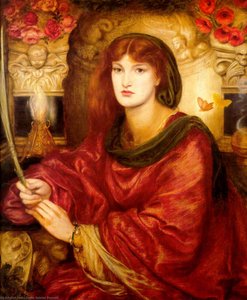
A Symphony of Color and Sensuality: Exploring Rossetti’s *Morning Music* (1864)
*Morning Music*, painted in 1864 by Dante Gabriel Rossetti, is a captivating example of Pre-Raphaelite artistry. This oil on canvas transports the viewer into an intimate domestic scene brimming with beauty, musicality, and veiled symbolism.Subject & Composition
The painting depicts a moment of private performance – a young woman with striking, fiery red hair is the focal point, attended by two male musicians. A small table laden with a vase (likely holding flowers, symbols of fleeting beauty) and a mirror adds to the sense of refined domesticity. Rossetti masterfully arranges these three figures within a shallow space, creating a layered composition that feels both enclosed and expansive. The arrangement isn’t about realistic spatial representation; instead, it prioritizes the interplay between forms and colors.Style & Technique
Rossetti's style in *Morning Music* is distinctly Pre-Raphaelite. He rejects the academic conventions of his time, embracing a looser, more painterly approach. Luminous color is paramount, achieved through extensive layering and blending of oil paints. The abundant use of impasto – thick brushstrokes that create texture – gives the painting a tactile quality, inviting close inspection. Lines are soft and blurred, contributing to an almost dreamlike, impressionistic effect. The organic shapes—flowing drapery, rounded faces, and loosely rendered instruments—enhance this sense of fluidity and romance.Historical Context & The Pre-Raphaelite Brotherhood
Dante Gabriel Rossetti (1828-1882) was a pivotal figure in the Pre-Raphaelite Brotherhood, founded in 1848 with William Holman Hunt and John Everett Millais. This group rebelled against what they perceived as the artificiality of post-Renaissance art, seeking to return to the detail, intense colors, and sincerity found in Italian art *before* Raphael. Rossetti’s work embodies this ethos, prioritizing emotional resonance and aesthetic beauty over strict realism. He was also a poet and illustrator, and these influences are clearly visible in the narrative quality of his paintings.Symbolism & Interpretation
Beyond its surface beauty, *Morning Music* is rich with symbolism. The musical performance itself can be interpreted as an allegory for artistic creation or romantic expression. The red-haired woman – a recurring figure in Rossetti’s work, often modeled by his wife and muse Elizabeth Siddal – embodies both physical allure and intellectual depth. Mirrors, frequently used by Rossetti, represent themes of reflection, illusion, and the complexities of identity. The overall atmosphere evokes a sense of private indulgence and the captivating power of art.Emotional Impact & Aesthetic Appeal
*Morning Music* is more than just a visually stunning painting; it’s an experience. The warm, diffused lighting, vibrant colors, and intimate subject matter create a mood of tranquility and sensual delight. The flattened perspective and dreamlike quality invite contemplation, drawing the viewer into Rossetti's romantic vision. This artwork would be a striking addition to any collection, lending sophistication and artistic depth to both classic and contemporary interiors.- Ideal for: Collectors of Pre-Raphaelite art, those seeking evocative wall décor, and interior designers aiming to create spaces with romantic or Victorian aesthetics.
- Keywords: Pre-Raphaelite, Dante Gabriel Rossetti, Victorian Art, Romanticism, Music, Portraiture, Symbolism, Red Hair, Oil Painting
Sorodna umetniška dela


Biografija umetnika
A Life Immersed in Beauty: The World of Dante Gabriel Rossetti
Dante Gabriel Rossetti, born Gabriel Charles Dante Rossetti in 1828 London, was a figure profoundly shaped by the currents of his time—a Romantic spirit blossoming into the Victorian era. His lineage itself hinted at the artistic destiny that awaited him; his father, an Italian political refugee and scholar of Dante Alighieri, instilled within young Gabriel a deep reverence for literature and the arts. This early exposure, coupled with a mother who nurtured his intellectual curiosity, laid the foundation for a life dedicated to creative expression. Though initially considering a clerical career, Rossetti’s true calling lay in the realm of aesthetics—a path he would forge as a poet, illustrator, and, most notably, a painter whose works continue to captivate audiences today. His formative years were steeped in the literary giants of his age – Shakespeare, Dickens, Scott, Byron – all contributing to a rich imaginative landscape that would later define his artistic vision.The Pre-Raphaelite Rebellion and Artistic Awakening
Rossetti’s name is inextricably linked with the Pre-Raphaelite Brotherhood, a revolutionary movement he co-founded in 1848 alongside William Holman Hunt and John Everett Millais. This wasn't merely an artistic shift; it was a rebellion against the perceived artificiality of academic painting prevalent at the time. The Brotherhood sought to return to the detailed realism, vibrant colors, and spiritual intensity found in Italian and Flemish art *before* the High Renaissance – hence “Pre-Raphaelite.” This meant rejecting the idealized forms and conventional compositions favored by the Royal Academy, instead embracing a meticulous observation of nature and a commitment to truthful representation. Rossetti’s early works, such as *The Girlhood of Mary Virgin*, exemplify this dedication, showcasing an almost photographic level of detail alongside symbolic imagery drawn from religious texts. The Brotherhood’s manifesto wasn’t just about *how* to paint, but *what* to paint – focusing on themes of morality, spirituality, and beauty with an intensity that challenged Victorian sensibilities. He championed the Pre-Raphaelite ideal—a rejection of academic conventions in favor of a return to artistic inspiration from earlier masters—and his unwavering commitment to this vision solidified his place as one of the most influential figures in British art history. Rossetti’s meticulous attention to detail, combined with his profound understanding of symbolism and mythology, distinguished him from his contemporaries and established him as a pioneer of Aestheticism.Evolving Styles: Symbolism, Sensuality, and the Female Muse
As Rossetti's career progressed, his artistic style underwent a fascinating evolution. While initially adhering to the strict tenets of Pre-Raphaelite realism, he gradually moved towards more symbolic and dreamlike imagery. His paintings became increasingly infused with sensuality, exploring themes of love, loss, and spiritual longing with an emotional depth that resonated deeply with audiences. This shift was partly influenced by his personal life, particularly his complex relationships with the women who served as his models and muses – Elizabeth Siddal, Fanny Cornforth, and Jane Morris. These women weren’t merely passive subjects; they embodied a particular aesthetic ideal for Rossetti—often depicted with flowing red hair, melancholic expressions, and an air of enigmatic beauty. Paintings like *Proserpine* are prime examples of this later style, showcasing his mastery of symbolism and his ability to evoke a sense of otherworldly allure. The rich colors, dramatic lighting, and evocative poses all contribute to the painting’s haunting atmosphere. He also began to seamlessly blend poetry and visual art, often writing sonnets to accompany his paintings, creating a unified artistic experience that engaged both the eye and the mind. *Behold the handmaid of the Lord! (The Annunciation)* is a testament to this integrated approach. Rossetti's exploration of psychological depth—a characteristic that distinguishes him from many of his peers—reflected the broader intellectual currents of Victorian England, where thinkers wrestled with questions of morality, spirituality, and the role of art in shaping human consciousness.Major Achievements and Legacy
Rossetti achieved considerable acclaim during his lifetime as a poet and painter, establishing himself as one of the foremost artists of his era. His poems—particularly *The House of Life*, which delves into themes of mortality, memory, and artistic creation—are considered masterpieces of Victorian lyricism. He captivated audiences with his evocative imagery and profound emotional resonance, cementing his reputation as a visionary artist who challenged conventional norms. Beyond his literary accomplishments, Rossetti’s paintings—including *Ophelia*, *Ecstasy*, and *Sleeping Beauty*—remain iconic representations of Pre-Raphaelite art and continue to inspire artists today. His meticulous technique—characterized by painstaking detail and vibrant color palettes—demonstrates a mastery of artistic craft that transcends time. Furthermore, Rossetti profoundly influenced subsequent generations of artists and writers, shaping the aesthetic sensibilities of movements such as Aestheticism and Symbolism. He championed beauty in all its forms—from the sublime grandeur of nature to the delicate intricacies of human emotion—leaving behind a legacy that celebrates creativity and spiritual contemplation. Dante Gabriel Rossetti’s enduring influence testifies to his ability to capture the essence of the Victorian spirit—a spirit marked by both intellectual curiosity and artistic fervor.Historical Significance: A Catalyst for Artistic Change
Rossetti's contribution to British art history extends beyond mere stylistic innovation; he served as a catalyst for transformative change within the artistic landscape of his time. His defiance of academic conventions—his insistence on prioritizing emotional expression over formal imitation—challenged the prevailing aesthetic standards and paved the way for new artistic explorations. He helped usher in an era of Symbolist art, where artists sought to convey complex psychological states through evocative imagery and poetic language. Rossetti’s unwavering commitment to his artistic vision—a vision rooted in Pre-Raphaelite ideals—established him as a pivotal figure in shaping British culture and intellectual life. His legacy continues to inspire artists and scholars alike, reminding us of the importance of questioning assumptions and embracing creativity as a means of confronting existential questions. Dante Gabriel Rossetti remains an unforgettable artist whose work embodies the spirit of Romanticism and heralds the dawn of Symbolism—a testament to his enduring influence on the course of art history.
Dante Gabriele Rossetti
1828 - 1882 , Združeno kraljestvo
Hitri podatki
- Artistic Movement Or Style: Pre-rafaelitska umetnost
- Artists Who Influenced This Artist:
- John Keats
- William Blake
- Date Of Birth: 12. maj 1828
- Date Of Death: 9. april 1882
- Full Name: Dante Gabriel Rossetti
- Nationality: Britanski
- Notable Artworks:
- Proserpine
- Joan of Arc
- King Rene's Honeymoon
- Place Of Birth: London, UK
Sorodni članki

Dante Gabriel Rossetti: 25 Mojstrovin Pre-Rafaelitskega Romantika | ArtsDot
Odkrijte 25 mojstrovin Dante Gabriela Rossettija, pre-rafaelitskega slikarja ljubezni in simbolizma. Pre-rafaeliti, portreti, mitologija – navdih za vaš dom na ArtsDot.com! Raziskajte reprodukcije slik visoke kakovosti.

Anthony Frederick Sandys: Pre-Raphaelite Vision & Victorian Aesthetic Exploration
Discover the captivating Pre-Raphaelite world of Anthony Frederick Sandys (1829-1904). Explore his mythological scenes, portraits & Victorian artistry. Learn about his influences and lasting legacy.

Ford Madox Brown: Pre-Raphaelite Visionary & Victorian Social Commentary
Explore the life & art of Ford Madox Brown, a pivotal Pre-Raphaelite painter renowned for his powerful social commentary and masterpiece 'Work'. Discover his lasting influence on British art history.

John Collier: Pre-Raphaelite Realism & Victorian Psychological Portraiture
Explore the captivating world of John Collier, a leading Pre-Raphaelite painter renowned for his psychologically insightful Victorian portraits. Discover his masterpieces and lasting artistic legacy.

Sir John Everett Millais: Pre-Raphaelite Rebellion & Victorian Narrative Detail
Explore the revolutionary art of Sir John Everett Millais & the Pre-Raphaelite Brotherhood. Discover their radical realism, symbolic narratives, and lasting impact on Victorian aesthetics. A deep dive into 19th-century masterpieces.