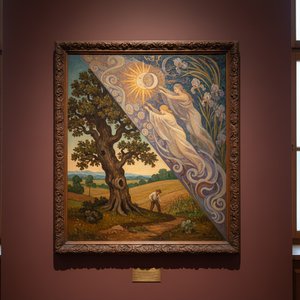
The Legacy of Julius Schrader: A Master of the Düsseldorf School
In the grand tapestry of nineteenth-century European art, few threads are as intricately woven as those belonging to Julius Friedrich Antonio Schrader. Born on June 16, 1815, in Berlin, Schrader emerged as a pivotal figure within the prestigious Düsseldorf school of painting, a movement renowned for its technical precision and dramatic narrative depth. His journey began under the rigorous tutelage of the Prussian Academy of Arts in Berlin, but it was his immersion in the Kunstakademie Düsseldorf that truly forged his artistic identity. Under the guidance of the esteemed Schadow, Schrader refined a style that balanced classical discipline with an evocative, emotive power that would become his hallmark.
Schrader’s artistic evolution was not confined to the borders of Germany; it was a nomadic pursuit of light and color. His travels through Italy between 1845 and 1847 allowed him to absorb the timeless grandeur of classical antiquity, while subsequent journeys through England, the Netherlands, and Belgium introduced him to new aesthetic horizons. It was in Belgium that he encountered the vibrant influence of colorists such as Louis Gallait and Édouard De Bièfve, a meeting that breathed a new, luminous vitality into his palette. This synthesis of German structural rigor and Belgian chromatic richness allowed him to transcend mere academicism, moving toward a more atmospheric and soulful representation of his subjects.
Narrative Grandeur and Historical Resonance
The works of Julius Schrader are often characterized by their profound sense of drama and historical weight. He possessed a rare ability to transform historical milestones into intimate, breathing moments of human tension. His canvases frequently explored themes of surrender, sacrifice, and the heavy mantle of leadership. In masterpieces such as Surrender of Calais to Edward III and Frederick the Great after the Battle of Kolin, one does not merely observe history; one feels the palpable weight of the atmosphere—the dust of battle, the somber silence of defeat, and the stoic resolve of monarchs.
Beyond the battlefield, Schrader’s brush captured the quiet, often tragic, intersections of life and legend. His depictions of the Death of Leonardo da Vinci and Milton and His Daughters demonstrate a profound empathy for the human condition, blending biographical reverence with a poetic sensibility. This mastery extended to his portraiture, where he rendered the intellectual giants of his era, such as Baron Alexander von Humboldt and the historian Leopold von Ranke, with a dignity that captured both their physical presence and their enduring historical significance.
A Professorial Legacy and Enduring Influence
Schrader’s contributions to the art world were not limited to the canvas; he was also a vital custodian of artistic tradition. In 1851, his reputation for excellence led to his appointment as a professor at the Berlin Academy, a position that allowed him to shape the next generation of German painters. His influence permeated both large-scale public works and intimate academic studies. His fresco work, including the Consecration of the Church of Saint Sophia in Constantinople, stands as a testament to his ability to command vast, sacred spaces with architectural grace and spiritual depth.
As we reflect on the life of Julius Schrader, who passed away on February 16, 1900, we see an artist whose work serves as a bridge between the classical traditions of the past and the burgeoning emotionalism of the modern era. His legacy remains preserved in the halls of great institutions like The Metropolitan Museum of Art, reminding us of a time when painting was a profound vessel for history, myth, and the enduring human spirit.
Otázky a odpovede
Ako môžem sledovať tvorbu umelca Julius Schrader chronologicky?
Stránka Chronológia diel prezentuje diela umelca Julius Schrader zoradené chronologicky, rok po roku.
Kde si môžem pozrieť diela umelca Julius Schrader zoradené podľa atmosféry?
Stránka Izba nálad umelca zobrazuje diela Julius Schrader usporiadané podľa ich atmosféry.
Koľko umelých diel od Julius Schrader si môžete v katalógu prehliadnuť?
Na stránke Všetky diela umelcov si môžete prelistovať 6 umelých diel diel od umelca Julius Schrader.