The Antwerp Transition
Amsterdam, around 1500. A child is born into the North Netherlandish landscape. This is Jan van Amstel, though history often whispers his name as Jan de Hollander. The early years remain obscured by the fog of the sixteenth century, yet the trajectory is clear. By 1528, the movement begins. He leaves the familiar streets of Amsterdam for Antwerp, a city pulsing with trade and creative friction. In that same year, he secures his place within the Guild of Saint Luke, marking his official entry into the professional ranks of the Antwerp art scene.
Life in Antwerp takes on a structured rhythm. He becomes a poorter, a recognized citizen, by 1535/6. His personal life intertwines with the local fabric through his marriage to Adriane van Doornicke. The connections are deep and familial; he is likely the older brother of Pieter Aertsen and the brother-in-law of Pieter Coecke van Aelst. Even after his death, his presence lingers in the lineage of painters, as his widow would later give birth to Gillis van Coninxloo II.
A Dual Vision
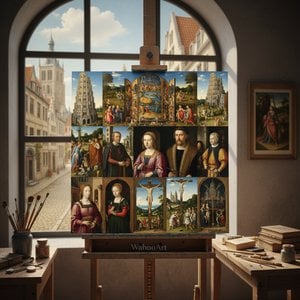
The brushwork of Jan van Amstel does not settle on a single subject. He navigates between the sacred and the profane with ease. One moment, the viewer encounters religious scenes, heavy with the weight of scripture. The next, the scene shifts to the grit of secular merriment. There is no hesitation in his transition from the solemnity of biblical narratives to the chaotic energy of tavern scenes and brothels. This duality defines his output.
His hand leaves traces that scholars still debate. The signature J. V. AMSL appears on works like The Feeding of the Poor, leading many to link him to the identity of the Master of the Brunswick Monogram. Whether he is truly this mysterious figure or a separate entity remains a point of intense investigation among art historians. His work carries the seeds of what would later bloom in the hands of Pieter Bruegel the Elder.
The Legacy of the Monogram
The end comes in Antwerp, around 1542. The physical man departs, but the stylistic influence remains embedded in the Northern Renaissance. His ability to blend landscape elements with human drama provides a blueprint for the generations that followed him. He does not merely paint figures; he places them within a world that feels inhabited and active.
- Identity: Often associated with the Master of the Brunswick Monogram.
- Key Subjects: Religious parables, tavern scenes, and secular festivities.
- Artistic Lineage: A precursor to the style of Pieter Bruegel the Elder.
Otázky a odpovede
V akom historickom období tvoril/a Jan van Amstel?
Jan van Amstel tvoril v období Renaissance. Toto obdobie zasazuje umeleckú činnosť umelca do historického kontextu.
Môžem si prehliadnuť diela umelca Jan van Amstel podľa farebnej palety?
Diela umelca Jan van Amstel si môžete prehliadnuť podľa farby na jeho stránke Spektrálny výber.
Ako sa tvorba umelca Jan van Amstel časom vyvíjala?
Chronologický prehľad tvorby umelca Jan van Amstel nájdete na jeho stránke Chronológia, kde sú diela usporiadané podľa dátumu ich vzniku v jednotlivých tvorivých etapách.