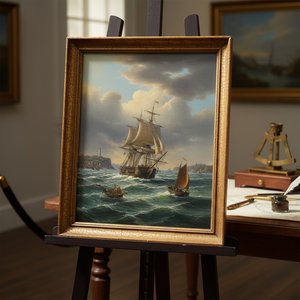
The Life and Artistic Evolution of Everett Warner
Born in Vinton, United States, Everett Warner was an American Impressionist painter and printmaker. His early education included studies at the Corcoran Museum and the Washington Art Students League, followed by training at the Art Students League in New York under George Bridgman and Walter Clark. Warner's work gained recognition through selection for prestigious competitions at the Art Institute of Chicago, the Pennsylvania Academy of the Fine Arts, and the National Academy of Design. He also served as an art critic for the Evening Star in Washington, D.C.
Warner's career was marked by significant contributions to maritime history. During World War I, he developed the Warner System, a ship camouflage method designed to break up a vessel's silhouette to make it difficult for enemies to obtain a range. He served as a lieutenant in the US Naval Reserves, managing a design-based subdivision in Washington, D.C. He later returned to serve as Chief Civilian Aid to Commander Charles Bittinger during World War II to assist in the design of ship camouflage.
Artistic Experiments and Later Years
Beyond his maritime work, Warner explored unique perspectives through aerial painting. Following the end of World War I, he utilized military seaplanes to observe New York City and the Eastern seaboard from above, becoming one of the first artists to sketch and paint from an aerial view. He even experimented with anamorphosis, displaying his large-scale paintings flat on the floor to be viewed from an oblique angle to enhance the sense of depth.
In his later professional life, Warner held a position as an associate professor of painting and design at the Carnegie Institute of Technology in Pittsburgh, Pennsylvania, for eighteen years. After retiring from teaching, he settled in Westmoreland, New Hampshire. He eventually transitioned from painting to writing articles for publication before his death in 1963.
Otázky a odpovede
Kde si môžem pozrieť diela umelca Everett Warner zoradené podľa atmosféry?
Stránka Izba nálad umelca zobrazuje diela Everett Warner usporiadané podľa ich atmosféry.
Kde si môžem pozrieť farebnú paletu tvorby umelca Everett Warner?
Spôsob využitia farieb u umelca Everett Warner v rámci diel uvedených na táto webstránka si môžete preskúmať na stránke Genetika palety umelca.
Existuje chronologický prehľad tvorby umelca Everett Warner?
Chronológia umelca Everett Warner je interaktívna časová os, ktorá prezentuje diela umelca v chronologickom poradí, rozdelené do kapitol podľa období jeho kariéry.
V akom meste a v ktorej krajine sa narodil/a Everett Warner?
Everett Warner sa narodil v meste Vinton v krajine United States.