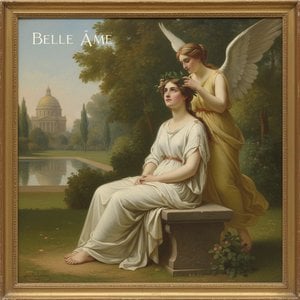
A Life Devoted to the Brush and the Cloth
In the quiet corners of Quebec City, a life unfolded that bridged the gap between the earthly duties of a teacher and the spiritual devotion of a religious sister. Born in 1862, Marie-Elmina Lefebvre lived a life defined by a dual calling. While the world knew her through her vocation within the Soeurs de la Charité de Québec, her hands were equally dedicated to the pigments and brushes that allowed her to express her faith. She was a woman of many roles: a painter, an illustrator, a restorer, and a poet, all while navigating the disciplined life of a religious community.
Her artistic development was shaped by the guidance of Eugène Hamel, who provided the technical foundation upon which her later works were built. This training allowed her to move beyond simple devotion into a prolific period of creation. Over fifty years, she produced more than 300 paintings, a volume of work that speaks to a relentless creative spirit. Her art was not a mere hobby but a profound extension of her religious identity, often finding its way into the most sacred spaces of her community.
The Sacred Subjects of her Canvas
The themes of her work were deeply rooted in the Catholic tradition, focusing on the figures and stories that anchored the spiritual life of Quebec. Her paintings often occupied the altars of churches or the halls of the Archevêché and the Hôtel-Dieu, serving as visual conduits for prayer. Her output included various types of religious imagery, such as:
- Altar paintings of Sainte Thérèse de l'Enfant Jésus and Sainte Anne
- Portraits of religious figures like Monseigneur Joseph-Omer Plante
- Devotional works such as Saint Joseph ouvrier et l'Enfant-Jésus
- Interpretations of classical religious themes, including works after Giacinto Brindi
Through these subjects, she translated the intangible aspects of her faith into tangible forms. Her ability to produce such a vast quantity of work suggests a disciplined hand and a mind constantly occupied by the divine. She did not merely paint; she documented the spiritual landscape of her time through a lens of deep personal conviction.
A Legacy in Quebec
The presence of her work in the Musée de la civilisation and various churches throughout Quebec City ensures that her contribution to the local visual history remains intact. Even as she lived a life of seclusion and service, her hand left a permanent mark on the cultural fabric of the region. She passed away in 1946, leaving behind a body of work that remains a significant part of the religious and artistic history of Quebec.
Otázky a odpovede
Ako je kariéra umelca Elmina Lefebvre rozdelená do jednotlivých období?
Kariéra umelca Elmina Lefebvre sa na jeho stránke Chronológia odvíja obdobie po období v podobe horizontálnej časovej osi diel, ktoré sú rozdelené do kapitol podľa jednotlivých období jeho tvorby.
Existuje časová os diel umelca Elmina Lefebvre?
Pre Elmina Lefebvre existuje časová osť diel: stránka Chronológia diel zobrazuje diela usporiadané podľa dátumov ich vytvorenia.
Koľko umelých diel od Elmina Lefebvre si môžete v katalógu prehliadnuť?
Na stránke Všetky diela umelcov si môžete prelistovať 1 dielo diel od umelca Elmina Lefebvre.
Aké farby používal/a Elmina Lefebvre najčastejšie?
Farebný profil tvorby umelca Elmina Lefebvre si môžete pozrieť na jeho stránke Genetika palety.