


The picture follows your choices: , .
Popis zberateľského predmetu
Pozrite si obraz Troubled Queen od Jacksona Polloka – dynamické abstraktné expresionistické dielo plné chaotickej energie a vrstievanej textúry. Temné zelené, hlboké čierne a geometrické tvary vyjadrujú vnútorný rozpoloženie.
 Zobraziť viac
Biografia umelca
Paul Jackson Pollock (1912-1956) bol americký maliar, ktorý sa stal inovatívnym predstaviteľom abstraktného expresionizmu a techniky "drip painting". Jeho ikonické diela, ako "Číslo 1" a "Modré polia", odrážajú dynamiku, emócie a revolučný prístup k tvorbe.
Ručne maľovaná olejová reprodukcia
Ručne maľovaný olej na plátne vo vašej zvolenej veľkosti a v ráme, vyrobený na mieru našimi umelcami. ( Prepnúť na tlač Prepnúť na digitálny obraz)
More about this painting
 Náhľad v interiéri
 Odoslať ako digitálnu kartu
 Zdieľať
 Podrobnosti o dielo
 Príručka

 Stiahnuť obraz
 Podobné položky
 RTG skúška
 Prehliadanie diapozoje
 Q&A
Q&A Štatistiky
Order your painting in four simple steps
Take your time. You can change any answer; the price in your order card follows each choice.
1 Step one of four
Which size would you like?
These sizes keep the proportions of the original painting. The drawing shows your choice on a wall, above a two-metre sofa.
Or give your own measurements
Vyberte si z našich preddefinovaných rozmerov, ktoré zodpovedajú pôvodným pomeroḿ diela.

Zadajte šírku a výšku, ktoré potrebujete, aby sa dielo hodilo k vášmu rámu alebo stene. Keďže ide o ručnú maľbu, pri rozmeroch s odlišným pomerom strán môže umelec namalovať o niečo viac okolo obrázka alebo ho mierne orezatú — výber patrí vám. Pred začatím maľovania vám pošleme digitálnu ukážku na schválenie. Obrázok zobrazený na tejto stránke nenahrádza reálny výsledok — ten zobrazuje iba digitálna ukážka.
2 Step two of four
How should it be prepared: rolled, stretched or framed?
The prices below are for the size you chose in step one.
Choose the edges of the stretched canvas
Choose your frame

White €1

Blurside €1

Extended €1

P118B €10

P118H €10

P118W €10

P438Z €10

P508JH €12

P508YH €12

P805H €10

P805Z €10

P919BZ €10

P919G €10

P919XJ €10

P959ZH €10

P968JZ €12

W106C €8

W218G €10

W218JH €8

W218Y €10

W307PJ €10

W316G €10

W316PJ €8

W316Y €10

W398PJ €8

W4111J €10

W500HY €15

W500JH €15

W692G €12

W849H €8

W940BG €15

W953PJ €8

H24-GOLD €30

H24-SILVER €30

H36-GOLD €45

H36-SILVER €45
V rámoch
Moulding: . Overall size with the frame: .
3 Step three of four
Would you like anything changed in the painting?
Most people answer no. Because each painting is made by hand, our artist can also adapt it for you.
After order, ArtsDot.com team will email client for instructions and provide a mockup preview
4 Step four of four
A few finishing options
All of them are optional. The answers already selected cost nothing extra.
Who paints it?
Celosvetová doprava () za 3 až 4 týždne namiesto štandardných 5 týždňov. (30 október). Bez kompromisov v kvalite.
A nameplate, as in a museum?
Detaily vygravírovaného bronzového pláka
This elegant plaque features the artist's name and the title of the artwork, finely engraved for a timeless presentation.
It is made from bronze with a refined, elegant finish. The text is precisely laser-engraved for a sharp and permanent result. Measuring 9x2 cm, the plaque is compact yet easy to read. It's built to be durable and scratch-resistant, offering a professional, museum-quality look. Mounting is simple thanks to the included adhesive backing.
Detaily transparentnej akrylovej plăty
The plaque includes essential engraved details such as the artist's name, the title of the artwork, the date it was created, the type of media used-like oil on canvas or watercolor-a brief description of the piece, and a QR code that links to the complete artwork information.
It is crafted from clear acrylic, offering a sleek, modern appearance. The text is UV-engraved in black to ensure strong visual contrast. With a size of 10x15 cm, it ensures optimal readability. It comes equipped with two metal hooks for secure wall mounting. The plaque is designed to be weather-resistant, making it suitable for various environments, and it includes interactive features that work seamlessly with smartphone scanning.
Detaily čiernej akrylovej plăty
This elegant plaque includes engraved information such as the artist's name, the title of the artwork, the date it was created, the type of media used (like oil on canvas or watercolor), a short description of the artwork, and a QR code for quick access to more information.
The plaque itself is made from refined black acrylic with a premium finish. The text is laser-engraved in white for high contrast and readability. Its size is 10x15 cm, designed to be easy to read. It comes with two metal hooks for professional mounting. The design is sleek and fits any interior style. It is also weather-resistant and durable, with built-in digital integration for mobile compatibility.
A protective varnish?
When do you need it?
✓ Check and order
Your painting, as you ordered it

Troubled Queen
Technika reprodukcie
Veľkosť reprodukcie
-

Výborne skúsený umelec
Viac detailov, jemnosti a dodatočného času na výrobu
-

Rámovanie reprodukcie
-
-
V prípade umeleckých diel alebo reprodukcií, ktorých ktorákoľvek strana je väčšia ako 105 cm (cca 41 palcov), sa rám dodáva v rozloženom stave ako sada. Táto metóda zabezpečuje bezpečnú доставu a chráni pred poškodením počas prepravy.
Vyžaduje sa odborná montáž – toto nie je produkt na vlastnú prípravu (DIY).
Sada musí byť zmontovaná a plátno napnuté skúseným profesionálnym rámovaníkom, s použitím drevárneho lepidla (nie je súčasťou sady), klieš na napínanie plátna a svoriek na udržanie prav角的 rámov počas schnutia lepidla. Nesprávna montáž alebo nerovnomerné napnutie plátna môže trvalo poškodiť umelecké dielo, čo nie je kryté našou zárukou.
 V prípade umeleckých diel alebo reprodukcií, ktorých ktorákoľvek strana je väčšia ako 105 cm (cca 41 palcov), sa rám dodáva v rozloženom stave ako sada. Táto metóda zabezpečuje bezpečnú доставu a chráni pred poškodením počas prepravy.
Všetky lišty z masívneho dreva sú súčasťou balenia, presne narezané na mieru.
Montuje sa pomocou súčasťou balenia dodaných skrutiek, plus drevolepu na spoje v rohoch, ktorý nie je súčasťou balenia a musí si ho zabezpečiť váš montážnik.
Vyžadujú sa profesionálne nástroje, ktoré nie sú súčasťou sady: kliešte na napínanie plátna (napínací nástroj) a svorky na udržanie pravých uhlov rámov počas schnutia lepidla.
Dôležité:
Spoje v rohoch si vyžadujú lepidlo na drevo, tyče je potrebné upevniť pomocou svoriek, kým lepidlo úplne newyschne, a napnutie plátna na zostavený rám si vyžaduje klieže na napínanie plátna. Žiadna z týchto pomôcok nie je súčasťou sady. Pred objednaním tejto veľkosti si, prosím, zabezpečte skúseného odborníka na zakladanie rámov.

Popisné označenie
-
-

Ochranný lak
Lesklý lak (zvýrazňuje farby, chráni pred svetlom a vlhkosťou)
-

Prispôsobiť moje dielo
Príklady možností úprav: nahradenie tváre vlastnou fotografiou; pridanie domáceho zvieraťa (napr. nahradenie mačky psom); vloženie skrytého odkazu do pozadia; zmena krajiny alebo prvkov v pozadí.
-

Prioritné doručenie
Celosvetová doprava () za 3 až 4 týždne namiesto štandardných 5 týždňov. (30 október). Bez kompromisov v kvalite.
-
Rýchle doručenie
Celosvetová doprava do za 5 týždňov. (6 november).
V cene
Celková cena
€ 233
Možnosť skla je dostupná len pri rozmeroch pod 110 cm
Included with every order
- Bezplatná expresná doprava po celom svete
- Vysokokvalitné lnianske plátno
- Kompletné poistenie prepravy
- Záruka vrátenia colného poplatku
- Záruka presného farebného zhodnutia
- 100-dená politika vrátenia tovaru (iba pri vadách)
- 100% záruka vrátenia peňazí
- Zľava pri väčšom množstve


A Realm of Inner Turmoil: Exploring Jackson Pollock’s Abstract Vision
Jackson Pollock's "Troubled Queen," created in 1945, stands as a cornerstone of Abstract Expressionism—a movement that fundamentally challenged conventional artistic norms and prioritized emotional expression over representational accuracy. More than just pigment splashed onto canvas, this artwork embodies the profound psychological landscape of its time, reflecting anxieties surrounding postwar existence and embodying Pollock’s pioneering approach to painting. The piece's enduring fascination stems from its ability to convey complex feelings without resorting to recognizable imagery—a feat achieved through a masterful blend of technique and symbolism.Style & Technique: Pioneering the Drip
Pollock revolutionized artistic practice with his “drip” method, rejecting brushstrokes in favor of pouring and splattering paint onto a horizontal surface. This innovative technique allowed him to engage with the canvas from all angles—a deliberate departure from easel painting—and fostered an intuitive process driven by gesture and chance. Unlike traditional art forms, Pollock’s focus wasn't on meticulously replicating reality; instead, he sought to distill emotion into pure visual form. The heavily impastoed surface – built up with visible brushstrokes and overlapping layers of paint – creates a tactile dimension that invites contemplation and emphasizes the physicality of artistic creation. Furthermore, subtle influences from Cubism can be discerned in the painting’s flattened perspective and intersecting lines, demonstrating Pollock's engagement with contemporary movements while forging his distinctive artistic voice.Color & Composition: An Earthy, Unsettling Harmony
The artwork’s color palette—dominated by dark greens, browns, yellows, and blues—contributes significantly to its evocative mood. These earthy tones ground the composition but simultaneously prevent any sense of tranquility. The absence of strong highlights or shadows amplifies this murky atmosphere, drawing the viewer's gaze into the depths of swirling forms. Angular shapes like triangles and rectangles clash with more organic, vortex-like patterns, generating visual tension that mirrors the emotional turmoil suggested by the piece. Pollock’s deliberate arrangement of elements—a calculated disruption of conventional compositional rules—underscores his commitment to conveying feeling directly onto the canvas.Historical Context: Post-War Anxiety & Abstract Expressionism
Pollock emerged as a leading figure within Abstract Expressionism following World War II, an era marked by pervasive uncertainty and existential questioning. Artists like Pollock responded to these anxieties through visceral artistic explorations—rejecting representational art in favor of subjective emotional expression. The movement’s impetus was fueled by disillusionment with the horrors of war and a desire to grapple with fundamental questions about human existence. Pollock's work resonated deeply with this cultural milieu, articulating feelings of anxiety, disorientation, and vulnerability without relying on literal depiction.Symbolism & Emotional Impact: The Weight of a Crown
The painting’s title, “Troubled Queen,” adds another layer of intrigue—suggesting a figure burdened by responsibility or perhaps internal conflict. While Pollock rarely offered explicit narratives to his audience, the imagery itself speaks volumes about psychological struggle. The chaotic composition embodies the unraveling of order and stability—a queen dethroned not by external forces but by her own inner demons. “Troubled Queen” remains a powerful testament to the enduring capacity of abstract art to communicate profound emotions without resorting to visual symbols or narratives, inviting viewers to contemplate the complexities of human experience.- Style: Abstract Expressionism with Cubist influences
- Artist: Jackson Pollock (1912-1956)
- Medium: Oil on Canvas (presumed)
Otázky a odpovede
Akú saturáciu a intenzitu má dielo „Troubled Queen“ od Paul Jackson Pollock?
Saturácia farieb diela „Troubled Queen“ je na úrovni Jemná farba a ich intenzita je Monochromatický.
Aká sýta je paleta diela „Troubled Queen“?
„Troubled Queen“ od Paul Jackson Pollock je zachytené s Jemná farba saturáciou.
Je možné si dielo „Troubled Queen“ pozrieť v rozšírenej realite?
Pre dielo „Troubled Queen“ je k dispozícii náhľad v rozšírenej realite: stránka Náhľad v AR vám umožní zobraziť toto umenie vo vašom vlastnom priestore pomocou kompatibilného zariadenia.
Podobné diela


Paul Jackson Pollock
1912 - 1956, Spojené štáty americké
Biografia umelca
Early Life and the Seeds of Innovation
Paul Jackson Pollock, born in Cody, Wyoming, in 1912, was a restless spirit from the very beginning. His early life was marked by constant movement; his father, LeRoy Pollock, pursued work as a land surveyor across the vast landscapes of the American West, relocating the family frequently. This itinerant existence instilled in young Pollock a deep connection to the natural world and an exposure to diverse cultures – particularly through encounters with Native American art during those surveying trips. These early experiences, filled with the raw energy of the frontier and the traditions of indigenous peoples, subtly shaped his artistic vision later in life, though he never explicitly imitated these styles. Despite the challenges of a nomadic upbringing, Pollock’s mother, Stella May McClure, recognized and nurtured her son's creative potential, fostering an appreciation for art within the family. Pollock’s formal artistic training began at the Manual Arts High School in Los Angeles, where he developed a foundational understanding of drawing and design. Following this, he continued his studies at the Art Students League of New York under the guidance of Thomas Hart Benton, a prominent figure in the Regionalist movement. Benton emphasized rhythmic composition and narrative themes rooted in American life – a style that initially influenced Pollock’s work, encouraging him to explore dynamic forms and tell stories through visual elements. However, Pollock's inherent inclination leaned towards more abstract explorations, seeking ways to express emotions and ideas beyond representational imagery. Furthermore, he was profoundly impacted by Mexican muralists like José Clemente Orozco, whose powerful depictions of social struggle resonated deeply with his own sense of justice and the human condition. These early influences – the rugged beauty of the American West, the traditions of Native Americans, and the dramatic narratives of Regionalist art combined with the passionate social commentary of Mexican murals – laid a foundation for Pollock’s unique artistic voice.The Birth of Action Painting and a Revolutionary Technique
The 1930s witnessed a period of experimentation for Pollock as he sought alternatives to traditional brushwork, driven by a desire to capture spontaneity and emotion in his art. He began exploring various techniques, including pouring paint directly onto the canvas – an unconventional approach that would ultimately revolutionize painting. Around 1947, however, Pollock’s artistic trajectory underwent a radical transformation. Abandoning the easel entirely, he laid canvases directly on the floor of his studio, initiating what would become known as his “drip technique.” This involved dripping, splashing, and flinging paint onto the canvas from above, orchestrating a dynamic dance between artist, medium, and surface. This wasn’t merely about applying paint; it was about embodying the act of creation itself. Pollock's canvases became arenas for physical expression, capturing the immediacy of his gestures and emotions. The resulting paintings are characterized by their “all-over” composition – a lack of central focus that invites the viewer to explore the entire surface as a unified field of energy. Intricate networks of lines and colors intertwine, creating a visual complexity that is both captivating and challenging. He employed unconventional tools—sticks, knives, even syringes—to manipulate the paint in unpredictable ways, further emphasizing the spontaneous nature of his process. This innovative approach positioned Pollock as a central figure in the burgeoning Abstract Expressionist movement, which emerged in post-World War II New York City.Iconic Works and Lasting Legacy
Pollock’s most celebrated works—such as Number 1, 1950 (Lavender Mist), One: Number 31, 1950, Blue Poles: Number 11, 1952, and *Convergence*—are testaments to his revolutionary technique. These paintings are not simply images; they are records of a performance, imbued with the artist’s physical presence and emotional intensity. The dynamic energy that emanates from these canvases is palpable, drawing viewers into a world of pure abstraction. Works like *Blue Poles*, with its vibrant blue hues and swirling patterns, became instantly iconic, capturing the public's imagination and solidifying Pollock’s reputation as a groundbreaking artist. Beyond the technical aspects of his technique, Pollock’s work explored profound themes related to human experience – anxiety, spirituality, and the search for meaning in a rapidly changing world. His paintings are often described as “action paintings,” reflecting the physical energy and process involved in their creation. The scale of these works—often monumental in size—further emphasized the immersive nature of Pollock’s artistic practice, inviting viewers to engage with his art on a visceral level.Influence and Historical Significance
Jackson Pollock's impact on the history of art is immeasurable. He fundamentally altered the way artists approached painting, breaking free from easel-based methods and embracing a more performative approach. His work helped solidify New York City’s position as a global center for modern art, shifting the focus away from European dominance. Pollock's influence can be seen in the work of countless artists who followed, including those associated with Color Field painting and later forms of abstract expressionism. He wasn’t simply creating beautiful images; he was redefining what it meant to be an artist in the 20th century. His legacy continues to inspire artists today, demonstrating the power of experimentation, spontaneity, and emotional honesty in artistic creation. Despite initial skepticism from some critics, Pollock's work has since been recognized as a cornerstone of modern art, securing his place among the most important and influential figures in the history of painting.


Súvisiace články

Top 10 majstrov geometrickej abstrakcie: Umění pre váš domov s ArtsDot.com
Ponorte sa do sveta geometrickej abstrakcie! Objavte 10 majstrovských diel od Mondriana, Kandinského a ďalších. História umenia, techniky a farebné kompozície na ArtsDot.com – reprodukcie obrazov pre váš domov.
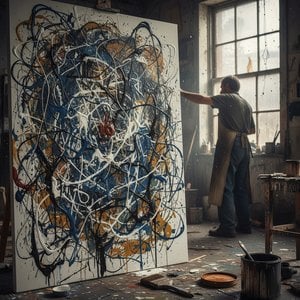
Paul Jackson Pollock: A Radical Departure – Exploring Abstract Expressionism's Pioneering Figure and His Enduring Legacy
Explore the revolutionary art of Jackson Pollock & Abstract Expressionism. Discover his iconic drip paintings, lasting impact, and considerations for collecting this pivotal American artist. Expert insights at ArtsDot.

Wassily Kandinsky: Top 25 diel pre milovníkov umenia a dokonalý dizajn interiéru
Ponorte sa do sveta Wassilyho Kandinského s ArtsDot.com! Objavte top 25 diel abstraktného umenia, expresionizmu a farebných kompozícií. Kúpiť reprodukcie obrazov pre dokonalý dizajn interiéru. Explore the full collection online.