


 Zobraziť v interiéri
 Odoslať
 Zdieľať
 Podrobnosti
 Príručka

 Stiahnuť
 Podobné položky
 RTG skúška
 Prehliadanie diapo\]
 Štatistiky
Noah's Ark
 Acrylic On Paper
- Naïve Art (Primitivism)
 1963
1963 30.0 x 23.0 cm
 Prečítať si viac
Umelecké dielo zobrazené na tejto stránke je chránené autorským zákonom, čo znamená, že nemôžeme legálne vytvárať ani predávať jeho identickú reprodukciu. Táto ochrana je vymáhaná na základe medzinárodných dohôd, ako napríklad Bernská konvencia a národnými zákonmi, vrátane tých, ktoré sú stanovené v Autorské právo USA – Title 17. Všetky práva vyhradené.
Táto metóda plne dodržiava autorské práva, pretože nezahŕňa kopírovanie ani duplikovanie chráneného diela. Ide skôr o kreatívnu reinterpretáciu – nový obraz, ktorý je ovplybnený originálom, no nie je s ním identický.
Giclée / Umenotlač
Giclée tlač alebo plátno múzeálnej kvality s rýchlou výrobou a rôznymi možnosťami povrchovej úpravy. ( Objednať ručne maľovanú reprodukciu Prepnúť na digitálnu verziu obrazu)




P118B €10

P118H €10

P118W €10

P438Z €10

P508JH €12

P508YH €12

P805H €10

P805Z €10

P919BZ €10

P919G €10

P919XJ €10

P959ZH €10

P968JZ €12

W106C €8

W218G €10

W218JH €8

W218Y €10

W307PJ €10

W316G €10

W316PJ €8

W316Y €10

W398PJ €8

W4111J €10

W500HY €15

W500JH €15

W692G €12

W849H €8

W940BG €15

W953PJ €8




Vyberte si z našich preddefinovaných rozmerov, ktoré zodpovedajú pôvodným pomeroḿ diela.

Zadajte šírku a výšku, ktoré potrebujete, aby sa reprodukcia hodila k vášmu rámu alebo stene. Print možno len orezávať, nikdy však nemennú veľkosť zvětšiť oproti pôvodnému obrázku, preto pri inom formáte stráca časť obrazu. Pred samotným vytlačiacím procesom vám pošleme digitálny náhľad na schválenie. Obrázok zobrazený na tejto stránke nezobrazuje reálny rez — len digitálny náhľad ukazuje presný výsledok.
Celosvetová doprava () do 2 týždňov namiesto štandardných 4 až 5 týždňov. (20 október)

Bezplatná expresná doprava po celom svete

Vysokokvalitné lnianske plátno

Úplné poistenie prepravy

Záruka vrátenia colného poplatku

Záruka presného farebného zhodnutia

100-dená politika vrátenia tovaru (iba pri vadách)

100% záruka vrátenia peňazí

Ponuka množstevnej zľavy
 Možnosť skla je dostupná len pri rozmeroch pod 110 cm

Noah's Ark
Giclée / Umenotlač
Veľkosť reprodukcie
-


Celková cena
€ 54
A Dreamscape of Salvation: Marc Chagall’s “Noah’s Ark”
Marc Chagall's "Noah’s Ark," painted in 1963, isn’t merely a depiction of the biblical flood; it’s an immersion into a world brimming with memory, faith, and the artist’s deeply personal vision. This pastel on paper sketch and study, housed within WikiArt’s extensive collection, offers a glimpse into Chagall's unique artistic universe—a realm where folklore intertwines with profound spirituality and childhood recollections dance alongside grand narratives. The work immediately captivates with its vibrant palette and the seemingly chaotic yet harmonious arrangement of figures and animals, reflecting the artist’s signature style of Naïve Art (or Primitivism). It’s a piece that invites prolonged contemplation, revealing layers of meaning beneath its surface exuberance.
The Roots of a Dream: Chagall's Artistic Influences
Born Moishe Shagal in 1887 in Liozna, Belarus—a town he would always consider his emotional center—Chagall’s artistic development was profoundly shaped by his upbringing within a Hasidic Jewish community. The vibrant rituals, storytelling traditions, and deeply ingrained folklore of Vitebsk permeated his work, manifesting as recurring motifs of flying figures, whimsical animals, and the evocative hues of remembered landscapes. This connection to his past is powerfully evident in “Noah’s Ark.” The painting echoes the artistic sensibilities of a region where Orthodox churches stood alongside bustling Jewish marketplaces—a potent blend of cultures that informed Chagall's distinctive aesthetic. He initially received formal training as a sign painter, but quickly abandoned academic constraints for a more intuitive and expressive approach, one deeply rooted in his personal experiences.
A Symphony of Color and Form: Technique and Style
Executed in pastel on paper, “Noah’s Ark” exemplifies Chagall's characteristic use of flattened perspective and simplified forms. The figures are not rendered with meticulous realism but rather as stylized representations imbued with emotional weight. Notice the loose, gestural strokes that define the animals—a dog lounging casually, a pair of birds soaring upwards, a horse standing proudly—each rendered with an almost childlike directness. The composition is deliberately dynamic, creating a sense of movement and overflowing abundance. The colors are intensely saturated – blues, reds, yellows, and greens collide in a joyous explosion, reflecting the energy and vitality of Chagall’s artistic vision. This technique, rooted in Naïve Art, prioritizes emotional expression over precise representation, allowing the viewer to connect with the painting on an intuitive level.
Symbolism Within the Flood: Biblical Narrative and Personal Resonance
Beyond its surface vibrancy, “Noah’s Ark” is rich in symbolic meaning. The ark itself—a vessel of salvation—becomes a stage for a multitude of figures, representing not just Noah and his family but also the diverse creatures entrusted to his care. The rainbow, prominently featured above the scene, symbolizes God's covenant with humanity after the flood, a promise of renewal and hope. However, Chagall’s interpretation transcends a purely literal reading of the biblical story. The painting feels less like a historical account and more like a dream—a personal meditation on themes of faith, memory, and the enduring power of the human spirit. The inclusion of figures reminiscent of Chagall's own family and friends adds another layer of intimacy to the scene, suggesting that the flood narrative is ultimately a metaphor for life’s challenges and the importance of finding refuge in love and connection.
A reproduction of this captivating artwork offers a beautiful addition to any collection. Its vibrant colors and evocative imagery will bring a touch of Chagall's dreamlike world into your home, serving as a constant reminder of the enduring power of faith, hope, and artistic expression.
Otázky a odpovede
Môžem si pozrieť RTG pohľad diela „Noah's Ark“ od Marc Chagall?
Dielo „Noah's Ark“ je možné skúmať vrstvu po vrstve na stránke RTG skenovanie, ktorá slúži ako interaktívny prehliadač inšpirovaný konzervačným svetelným stolom a ponúka jednaásť optických náhľadov na obraz.
Ako môžem získať print diela „Noah's Ark“ od Marc Chagall?
Ak si chcete objednať print diela „Noah's Ark“ od Marc Chagall, stačí si ho objednať priamo na jeho stránke Výškovotlač fine art: umelecká tlač na bavlnenom plátne alebo archivnom plátnovom papieri.
Prečo je autorskoprávny status diela „Noah's Ark“ taký, aký je?
Autorské práva k dielu „Noah's Ark“ – stále chránené autorským právom – vyplývajú zo smrti umelca v roku 1985.
Súvisiace diela


Biografia umelca
A Life Painted in Dreams: The World of Marc Chagall
Marc Chagall, born Moishe Shagal in 1887 in the small Belarussian town of Liozna near Vitebsk, wasn’t merely a painter; he was a poet of color, a weaver of dreams, and a chronicler of memory. His life, spanning nearly a century, mirrored the tumultuous currents of the 20th century, yet his art remained steadfastly rooted in a deeply personal vision—one infused with the folklore of his Hasidic Jewish upbringing and an unwavering belief in the power of imagination. Vitebsk itself was more than just a birthplace; it became the emotional core of his artistic universe, a recurring motif populated by flying figures, whimsical animals, and the vibrant hues of remembered landscapes. The town’s unique blend of cultures—Russian Orthodox churches alongside bustling Jewish marketplaces—forged an aesthetic sensibility that would defy easy categorization throughout his long career. Though he sought formal training first with a local sign painter and later in St. Petersburg under Léon Bakst, and then in Paris at the Académie de la Grande Chaumière, Chagall never fully embraced any single artistic movement. He absorbed elements of Cubism, Symbolism, and Fauvism, but always filtered them through his own intensely personal lens, creating a style that was uniquely, unmistakably Chagall.Early Years and Artistic Formation
Chagall’s formative years were marked by hardship and displacement. Born into a Jewish family in Vitebsk—a town steeped in Orthodox tradition—he experienced firsthand the challenges faced by Jews living under Tsarist rule. Despite limited formal education, he possessed an innate artistic talent that quickly blossomed. His initial training began with a local sign painter, honing his skills in draftsmanship and color theory. Subsequently, he pursued studies at St. Petersburg’s Zvantseva School of Drawing and Painting, where he encountered the influential teachings of Léon Bakst—a pioneer of theatrical design who championed avant-garde aesthetics. This exposure to Bakst's ideas profoundly shaped Chagall’s artistic sensibilities, introducing him to the principles of Cubism and fostering his fascination with geometric abstraction. Recognizing the importance of broadening his horizons, he traveled to Paris in 1908, immersing himself in the vibrant intellectual and artistic milieu of the École de Paris—a collective of artists who rejected academic conventions and embraced experimentation. During this period, he befriended fellow artists like Pablo Picasso and André Derain, absorbing their stylistic innovations and refining his own visual language.The Symbolist Vision
Chagall’s early paintings—such as I and the Village (1911)—demonstrate a distinctive preoccupation with symbolism and memory. Unlike traditional landscapes that strive for objective representation, Chagall's depictions of Vitebsk are fragmented recollections imbued with emotional significance. Figures float amidst stylized forms, conveying feelings of longing and nostalgia—a characteristic trait that would define his artistic style throughout his career. The artist’s palette is bold and expressive, employing vibrant hues to communicate emotion rather than literal accuracy. This stylistic approach reflects Chagall's deep connection to Jewish folklore and mythology, as well as his profound engagement with the spiritual traditions of his upbringing. His use of color—particularly yellows, blues, and reds—is deliberately unconventional, creating a dreamlike atmosphere that transcends rational perception.The Turbulent Years: Revolution and Exile
The Russian Revolution dramatically altered Chagall’s life trajectory. Returning to Vitebsk in 1917 amidst the upheaval of Bolshevik rule, he became involved in cultural initiatives aimed at revitalizing Belarusian art and culture. He established an Art School in Vitebsk—a bold experiment in artistic education that briefly flourished before succumbing to political pressures. During this period, Chagall wrestled with conflicting ideological impulses—embracing socialist ideals while simultaneously cherishing his Jewish heritage. The outbreak of World War I forced him into exile, disrupting his creative pursuits and propelling him back to Paris. Despite the hardships endured during wartime, Chagall continued to produce artwork that reflected the anxieties and uncertainties of the era. His painting White Crucifixion (1938)—a poignant meditation on suffering and persecution—stands as a testament to this period’s emotional intensity.International Recognition and Artistic Legacy
Chagall achieved international acclaim during World War II, escaping occupied France with his wife in May 1941. He found refuge in New York City, where he resided for seven years, fostering collaborations with fellow artists and engaging in prolific creative activity. His work gained prominence during the Abstract Expressionist movement, cementing his reputation as one of the most influential figures in modern art. Following the war, Chagall returned to France, continuing to paint until his death in 1985 at Saint-Paul-de-Vence—a picturesque Provençal village that served as his artistic sanctuary for decades. His enduring legacy resides not only in his stunning paintings and stained glass windows but also in his unwavering commitment to artistic integrity and imaginative vision—a vision that continues to inspire artists and audiences alike. Chagall’s art transcends cultural boundaries, conveying universal themes of love, loss, faith, and remembrance—a testament to the transformative power of creativity and the enduring beauty of dreams.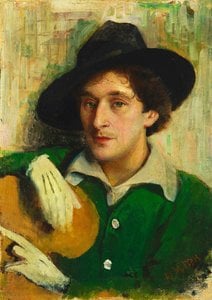
Marc Chagall
1887 - 1985 , Bielorusko
Rýchle fakty
- Artistic Movement Or Style: Modernizmus, Kubizmus
- Artists Or Movements Influenced By This Artist:
- Surrealizmus
- Cubizmus
- Artists Who Influenced This Artist:
- Leon Bakst
- Pablo Picasso
- Jean Metzinger
- Date Of Birth: 7. júl 1887
- Date Of Death: 28. marec 1985
- Full Name: Marc Chagall
- Nationality: Rusínsky-Francúzsky
- Notable Artworks:
- I a dedina
- Žltý osol
- Kôň s tiennikom
- Place Of Birth: Ľozna, Bielorusko
Súvisiace články

The Subdued Radiance of Pastel: Exploring Nuance & Emotion in Art
Explore the nuanced world of pastel art! Discover its history, techniques & emotional power with expert insights from ArtsDot.com. Find museum-quality reproductions and learn about collecting this delicate medium.

The Subdued Radiance of Pastel Palettes: Exploring Emotional Resonance in Art History
Explore the emotional power of pastel palettes in art history! Discover Impressionism, Post-Impressionism & color psychology insights. Find museum-quality reproductions at ArtsDot.

Top 10 majstrovských diel nemeckého expresionizmu pre váš domov | ArtsDot
Ponorte sa do sveta nemeckého expresionizmu s ArtsDot! Objavte 10 majstrovských diel Kandinského, Muncha a ďalších. Luxusné reprodukcie obrazov pre váš domov – emotívne umenie online. Explore the full collection on ArtsDot.com

The Subdued Radiance of Pastel Palettes: Exploring Emotional Resonance in Art History
Explore the emotional power of pastel palettes in art history! Discover Impressionism, Post-Impressionism & color psychology insights. Find museum-quality reproductions at ArtsDot.

The Subtleties of Pastel: A Comprehensive Exploration of Technique, History & Emotional Resonance
Explore the captivating world of pastel art! Discover its rich history, Impressionistic masters like Degas, emotional power & unique techniques. Find museum-quality reproductions at ArtsDot.


