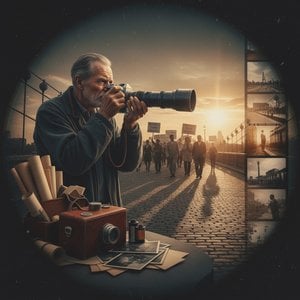
The Visionary Lens: The Life and Legacy of Stephen Deutsch
To look through the lens of Stephen Deutsch is to witness a profound dialogue between the structured world of commerce and the raw, beating heart of mid-century America. Born in Chicago in 1908, Deutsch’s artistic identity was forged in a crucible of international influence and disciplined craftsmanship. His journey began not with the shutter, but with the tactile intimacy of sculpture; his early studies in woodcarving and form at Budapest University instilled in him a structural sensibility that would later define his photographic compositions. This foundational understanding of volume and light allowed him to approach the two-dimensional plane with the eye of a maker, treating every frame as a sculpted space where shadow and subject dance in perfect equilibrium.
The trajectory of his career took a transformative turn when he moved to Paris, immersing himself in the vibrant, avant-garde photographic culture of the era alongside his wife, Helene Deutch. It was in the streets and studios of Paris that Deutsch refined his ability to capture the ephemeral. This European sensibility—marked by a meticulous attention to detail and an appreciation for the poetic nuances of light—became the hallmark of his work when he eventually settled in Chicago. By the 1930s, he had established a formidable commercial studio that would serve as a cornerstone of the city's visual landscape, bridging the gap between high art and the burgeoning demands of editorial media.
A Narrative of Light and Steel
Deutsch’s professional repertoire was remarkably diverse, navigating the shifting tides of the 20th-century media landscape with unparalleled grace. He possessed a rare ability to satisfy the rigorous requirements of commercial clients while maintaining an unmistakable artistic soul. His collaborations with prestigious publications like Coronet magazine and his commissions for industrial giants such as Inland Steel Workers demonstrated a mastery of visual storytelling. In these works, he did not merely document industry or fashion; he elevated them, finding the sculptural beauty in steel and the dramatic narrative in the everyday.
His photographic subjects ranged from the iconic to the intimate, creating a sprawling tapestry of Chicagoan life. Through his camera, legendary figures such as Duke Ellington, Joe Louis, and Nelson Algren were rendered with a dignity that transcended simple portraiture. He captured the kinetic energy of the city—from the bustling banking halls of LaSalle Street to the rhythmic grace of ballet dancers like Zora. As the celebrated writer Studs Terkel once noted, Deutsch possessed a singular instinct: he could see it, feel it, and snap it, capturing the very essence of his surroundings with a sensitivity that made the fleeting moment permanent.
The Sculptural Soul and Artistic Endurance
While his photography earned him widespread acclaim, Deutsch’s creative spirit was never confined to a single medium. His roots in sculpture remained a vital part of his artistic DNA, manifesting in works that explored themes of form, texture, and the principles of European Modernism. Influenced by the rigorous geometry of the Bauhaus movement, his sculptural endeavors provided a physical counterpoint to his photographic explorations. These pieces, often characterized by their structural integrity and modern aesthetic, found homes in significant institutions such as St. Stephen’s House and St. Stephen’s Cathedral, cementing his status as a multi-dimensional creator.
The historical significance of Stephen Deutsch lies in his ability to act as a visual chronicler of an era. His archives serve as a vital window into the social and industrial evolution of Chicago and the broader American experience. Whether through the silver gelatin prints that documented the faces of the mid-century or the tactile presence of his sculptures, Deutsch’s work remains a testament to the power of observation. He leaves behind a legacy defined by an unwavering commitment to authenticity—a career spent finding the extraordinary within the ordinary, and the eternal within the momentary.
Вопросы и ответы
Где и в каком году родился Stephen Deutch, Photographer?
Stephen Deutch, Photographer родился в Chicago, 1908 год.
В какой исторический период работал(а) Stephen Deutch, Photographer?
Stephen Deutch, Photographer работал в период Modern. Эта эпоха позволяет определить место творчества художника в истории.
Можно ли посетить виртуальный музей работ Stephen Deutch, Photographer?
Возможен виртуальный визит: на странице 3D-музей работы Stephen Deutch, Photographer представлены в трехмерной галерее.