The Quiet Observation of Light and Form
Caja Prytz lived a life that left behind a specific, quiet record of the spaces she inhabited. Her work focuses on the way light settles in a room or rests upon a face, often moving between the familiar interiors of Denmark and the open landscapes of Italy. There is a certain stillness in her approach, a way of looking at a subject that feels unhurried and observant. She did not seek to dramatize her subjects, but rather to capture the subtle shifts in tone that define a moment.
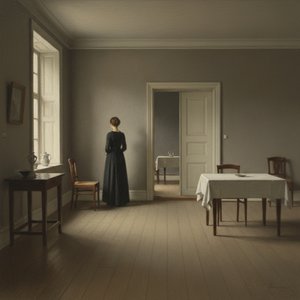
In her portraits, the light and shadow are handled with a certain sobriety. She avoids unnecessary flourish, opting instead for a directness that reveals the character of the sitter. This clarity is particularly evident when she turns her attention to the interior, where she uses a soft, gentle tonal palette to trace the movement of light across a domestic scene. These paintings feel less like staged performances and more like captured breaths.
Subject Matter and Technique
Her brushwork and choice of subject reveal a painter deeply interested in the nuances of atmosphere. The way she handled oil on canvas allowed for a delicate layering of color, especially when depicting the interplay of light in a room. Her interests were varied, spanning from the intimate to the expansive:
- Portraits that emphasize the starkness of light and shadow.
- Interiors that explore soft, tonal shifts in domestic settings.
- Landscapes drawn from her time in Denmark and Italy.
- Group compositions that reflect the influence of Symbolist currents.
One can see this range in her 1905 work, Interior with mother and daughter, where the focus remains on the quietude of the setting. Even when her work takes on a more symbolic quality, as seen in her group portrait Forventning, the focus remains on the figures and their placement within the light.
A Legacy in Tone and Shadow
The work of Caja Prytz remains a study in restraint. She moved through the art world of her time by focusing on the essential qualities of her subjects, whether they were the rolling hills of a landscape or the steady gaze of a portrait sitter. Her ability to balance the soft, tonal qualities of an interior with the more sober, direct rendering of a face shows a painter who understood the different ways light can tell a story. Her presence in the art of the early twentieth century is felt in these quiet, deliberate observations of life.
Вопросы и ответы
К какой исторической эпохе относится Caja Prytz?
Caja Prytz работал в эпоху Modern. Этот период позволяет определить место творчества художника в истории.
Насколько популярны произведения Caja Prytz?
Страница со статистикой Статистика просмотров для Caja Prytz содержит данные, рассчитанные на основе произведений этого художника, представленных на данный сайт.
Где я могу увидеть работы Caja Prytz в хронологическом порядке?
На странице Хронология работ представлены работы Caja Prytz, упорядоченные по датам, год за годом.