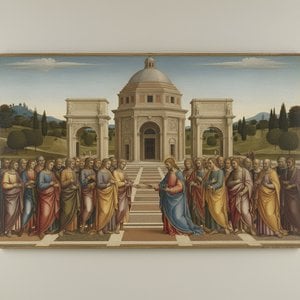
The Genoese Transition
Antonio Semini represents a specific, necessary shift in the late Renaissance landscape of Genoa. He did not merely replicate the traditions of his predecessors; he modernized them. Trained under Ludovico Brea, Semini took the established visual language of his mentor and pushed it toward a new sensibility. His work reflects a deliberate move away from the rigidities of the earlier period, favoring a style that leaned into the grace and clarity popularized by Perugino. This was not a passive inheritance. It was a calculated stylistic evolution that helped define the Genoese school during a period of significant artistic transition.
His technical approach was characterized by this ability to absorb external influences and make them local. While his training was rooted in the specific traditions of Genoa, his output shows a clear awareness of the broader Italian currents moving through the peninsula. He was a painter of precision and intent, working within a collaborative environment that was typical of the era but executed with a distinct personal clarity.
Technical Collaborations and Lineage
Artistic production in the sixteenth century was rarely a solitary endeavor, and Semini’s career highlights the importance of professional partnerships. He operated within a network of skilled painters, often working alongside his contemporaries to fulfill the demands of religious commissions. His professional life was defined by these connections and the subsequent training of the next generation.
- Collaborated with Teramo Piaggio on various projects.
- Worked alongside Terarno di Zoagli, a fellow pupil of Ludovico Brea.
- Trained his sons, Andrea and Ottavio Semini, ensuring his stylistic influence continued through his immediate family.
Legacy and Movement
Semini’s significance is found in the continuity he provided. By modernizing the style of Ludovico Brea, he ensured that the Genoese school did not become a stagnant relic. His work, such as the Nativity created for S. Domenico in Savona, demonstrates his ability to integrate the Peruginesque manner into the local aesthetic. This was a practical, effective way to keep Genoese art relevant in a rapidly changing Italian art market. He died in Milan after a career that bridged the gap between the strictures of the early Renaissance and the more fluid developments of the mid-sixteenth century.
Вопросы и ответы
Где можно найти работы Antonio Semini, сгруппированные по ключевым словам?
Чтобы найти работы Antonio Semini на определенную тему, воспользуйтесь страницей По ключевым словам, где произведения художника сгруппированы по ключевым словам.
В каком городе и стране родился(ась) Antonio Semini?
Antonio Semini родился в Genoa, Italy.
Под какими еще именами известен Antonio Semini?
Antonio Semini также известен под именами Antonio Semino.
Как я могу проследить творческий путь Antonio Semini по годам?
Существует хронология работ Antonio Semini: на странице Хронология работ произведения художника расположены в порядке даты их создания.