


 Предпросмотр
 Поделиться
 Поделиться
 Детали произведения

 Скачать
 Похожие работы
 Рентгенография
 Слайд-шоу
Self-Portrait
 Oil On Canvas
- WallArt
- Mannerism
 1558
1558 63.0 x 51.0 cm
 Эрмитаж
 Читать далее
Жикле / Арт-принт
Печать (жикле) или холст музейного качества с быстрыми сроками изготовления и широким выбором вариантов отделки. ( Купить картину ручной работы Купить изображение)




P118B $10

P118H $10

P118W $10

P438Z $10

P508JH $12

P508YH $12

P805H $10

P805Z $10

P919BZ $10

P919G $10

P919XJ $10

P959ZH $10

P968JZ $12

W106C $8

W218G $10

W218JH $8

W218Y $10

W307PJ $10

W316G $10

W316PJ $8

W316Y $10

W398PJ $8

W4111J $10

W500HY $15

W500JH $15

W692G $12

W849H $8

W940BG $15

W953PJ $8




Выберите один из наших стандартных размеров, соответствующих оригинальным пропорциям произведения искусства.

Вы можете указать свои собственные размеры, чтобы репродукция идеально подошла под конкретную раму или пространство. Если выбранный вами размер не будет соответствовать пропорциям оригинала, мы либо обрежем произведение, либо дополним изображение зеркальным отражением краев или однотонной заливкой. Перед началом производства вам будет отправлен цифровой макет для утверждения.
Пожалуйста, обратите внимание, что предварительный просмотр на экране не отображает фактическую обрезку или расширение изображения. Только макет точно покажет финальную композицию.
Несмотря на возможность заказа индивидуальных размеров, мы рекомендуем выбирать размер из предопределенного списка, чтобы сохранить оригинальные пропорции.
Доставка по всему миру () за 2 недели вместо стандартных 4/5 недель. (25 Август)

Бесплатная экспресс-доставка по всему миру

Высококачественный льняной холст

Полное страхование доставки

Гарантия возмещения таможенных пошлин

Гарантия точного соответствия цветов

Политика возврата в течение 60 дней (только при наличии дефектов)

Гарантия возврата 100% средств

Предложение оптовых скидок
 Вариант со стеклом доступен только для размеров менее 110 см

Self-Portrait
Жикле / Арт-принт
Размер репродукции
-


Итоговая стоимость
$ 62
Описание предмета коллекционирования
The Enigmatic Self: Paolo Veronese’s Portrait of a Master
Paolo Veronese's 1558-1563 self-portrait, a remarkably intimate and subtly defiant work housed within the Hermitage Museum in St. Petersburg, offers a profound glimpse into the mind of one of Venice’s most celebrated Renaissance painters. More than simply a likeness, it’s a carefully constructed statement about artistic identity, ambition, and the very act of representation itself. The painting immediately draws the viewer in with its direct gaze – Veronese appears to meet our eye across centuries, radiating an air of quiet confidence and intellectual curiosity.
Executed in oil on canvas, the portrait is a masterclass in controlled restraint. The palette is muted yet luminous, dominated by deep browns, blacks, and subtle greens—colors that speak to Veronese’s Venetian roots and his understanding of light and shadow. He eschews flamboyant displays of wealth or ostentation, instead favoring a simple, dark garment adorned with understated buttons – a deliberate choice that suggests a focus on the artist's intellect and skill rather than material possessions. The meticulous rendering of his beard and hair, the delicate modeling of his face, reveals an extraordinary level of technical proficiency, showcasing Veronese’s mastery of chiaroscuro and anatomical detail.
A Venetian Visionary: Context and Influences
To fully appreciate Veronese's self-portrait, it’s crucial to understand the artistic landscape in which he operated. Born in Verona in 1528, Veronese spent his formative years absorbing the classical influences of the Veneto region – the grandeur of Roman architecture, the elegance of Renaissance sculpture. However, his move to Venice in the 1550s marked a pivotal shift, exposing him to the vibrant artistic currents of the city and fostering a distinctive style that blended Venetian realism with Mannerist sophistication.
The influence of Titian is undeniable; Veronese’s masterful use of color and dramatic lighting owes much to the Venetian master. Yet, Veronese possessed a unique sensibility—a penchant for theatricality, an inclination towards elaborate compositions, and a remarkable ability to infuse his paintings with a sense of opulent spectacle. He was part of a “trio” of great Venetian painters – alongside Tintoretto and Giorgione – who shaped the artistic identity of Venice during the 16th century. His work reflects the city’s thriving mercantile culture, its embrace of luxury, and its fascination with both classical antiquity and contemporary life.
Symbolism and the Act of Representation
The self-portrait is not merely a depiction of Veronese; it's an exploration of the artist’s role within the broader context of Renaissance art. The direct gaze invites a dialogue, challenging the viewer to consider the act of representation itself. Is Veronese presenting himself as he truly is, or constructing an idealized image? The subtle smirk playing on his lips hints at a knowing awareness of the power of portraiture – its ability to shape perceptions and convey status.
Furthermore, the background—a dark, undefined space—suggests a deliberate detachment from the material world. It’s as if Veronese is prioritizing the act of painting itself over any specific setting or circumstance. This focus on the process of creation underscores his identity as an artist – a craftsman dedicated to capturing beauty and conveying meaning through visual language.
A Legacy of Spectacle
Veronese's later works, such as “The Wedding at Cana” and “The Feast in the House of Levi,” exemplify this penchant for grand spectacle. These monumental paintings—often depicting biblical scenes with an astonishing array of figures—demonstrate Veronese’s extraordinary skill in creating immersive environments and conveying a sense of overwhelming abundance. His self-portrait, however, offers a more intimate and introspective glimpse into the mind of the artist – a reminder that even within the most elaborate compositions, there lies a profound understanding of human nature and the complexities of artistic creation.
Похожие произведения


Биография художника
A Venetian Visionary: The Life and Art of Paolo Veronese
Paolo Caliari, universally known as Paolo Veronese, emerged from the vibrant artistic landscape of 16th-century Venice as a master of color, composition, and breathtaking spectacle. Born in Verona in 1528, the son of a stonecutter, his early life was deeply intertwined with the visual richness of his surroundings – the classical architecture, sculpted forms, and burgeoning humanist ideals that defined the region. His initial training under Antonio Badile and Giovanni Francesco Caroto provided him with a solid foundation in traditional techniques, but it was his relocation to Venice in the 1550s that truly ignited his artistic genius. The city itself became his muse, its bustling marketplaces, magnificent palazzi, and shimmering waterways profoundly shaping the scale and dramatic intensity of his work. He quickly absorbed the influences of established Venetian masters like Titian, whose mastery of color exerted a powerful impact on Veronese’s palette, yet he forged a distinctive style characterized by an unparalleled sense of theatricality and grandeur.The Painter of Feasts and Grand Narratives
Veronese's enduring legacy rests primarily upon his monumental paintings, particularly those depicting lavish feasts and biblical scenes reimagined as dazzling displays of Venetian life. The *Wedding at Cana*, completed in 1563 for the Benedictine monastery of San Giorgio Maggiore, stands as a testament to his extraordinary skill. This colossal canvas transcends mere illustration; it’s a vibrant panorama of 16th-century society, teeming with elegantly dressed figures, musicians, and architectural details rendered with astonishing precision. The painting isn't simply about *what* happened at Cana but rather *how* it would have appeared if enacted in Venice during Veronese’s time – a remarkable feat of historical reconstruction. Similarly, *The Feast in the House of Levi*, originally titled *The Last Supper*, provoked considerable controversy with the Inquisition due to its inclusion of contemporary figures and an atmosphere that seemed almost irreverent. Veronese defended his artistic choices, asserting that painters possessed the same creative liberty as poets and jesters – a bold declaration reflecting his belief in art’s capacity to interpret and reimagine sacred narratives. These works weren't merely religious depictions; they were celebrations of life, wealth, and the splendor of Venice itself. He prioritized capturing the joy and abundance of existence over austere spirituality.Influences and Artistic Development
While Titian’s influence on Veronese’s color palette is undeniable, his artistic development was a complex synthesis of various influences. The architectural precision evident in his compositions draws heavily from the classical traditions prevalent in Verona during his formative years, particularly the work of architects like Michele Sanmicheli. He also absorbed elements from Central Italian masters such as Raphael and Parmigianino, reflected in the graceful lines and harmonious arrangements within his paintings. However, Veronese didn’t merely imitate these influences; he skillfully integrated them into a uniquely Venetian style characterized by its dramatic use of light, vibrant color schemes, and meticulous attention to detail. He excelled at creating illusions of space and depth, employing perspective techniques to draw viewers directly into the heart of his elaborate scenes. His mastery of oil painting allowed him to achieve an unparalleled luminosity and richness of texture – a hallmark of his distinctive style. He also maintained a large workshop, with contributions from his brother Benedetto and sons Gabriele and Carlo (or ‘Carletto’), ensuring that his artistic vision continued to flourish even after his death in 1588.Major Achievements and Notable Works
Veronese’s career was marked by a succession of significant commissions and masterpieces. His decoration of the Venetian church of S. Sebastiano between 1555 and around 1570 is considered one of his most important achievements, showcasing his ability to create immersive environments filled with dynamic movement and vibrant color. The ceiling and wall paintings for the library of S. Marco (1556-57) and the Ducal Palace (early 1550s and 1575-82) further demonstrated his skill in grand scale and opulent design. Perhaps most famously, he created a series of mythological pictures for an international clientele, including *Venus and Adonis* and *The Judgment of Paris*. His *Last Supper*, painted for a Dominican friar in 1573 (now housed in the Accademia di Venezia), stands as a particularly striking example of his innovative approach to religious narrative. The painting’s inclusion of contemporary figures and its seemingly irreverent atmosphere caused considerable controversy, leading to a title change – *Supper in the House of Levi* – reflecting Veronese's determination to defend his artistic freedom.Legacy and Historical Significance
Paolo Veronese’s impact extends far beyond the realm of Renaissance art. His work has resonated through centuries, inspiring artists across various disciplines. His dramatic compositions and vibrant color schemes have been cited as influences on everything from Baroque painting to modern cinema – even finding echoes in the visual aesthetics of Spaghetti Westerns. He was a key figure within the “great trio” of Venetian painters—alongside Titian and Tintoretto—each contributing uniquely to the city’s artistic legacy, yet Veronese often stands apart for his sheer exuberance and celebration of earthly pleasures. His paintings continue to captivate audiences with their grandeur and spectacle, offering a glimpse into the opulent world of 16th-century Venice. Veronese's legacy remains a testament to his artistic genius, his ability to capture the essence of an era, and his enduring contribution to the history of art.
Паоло Веронезе
1528 - 1588 , Италия
Основные сведения
- Artistic Movement Or Style: Ренессанс, Маньеризм
- Artists Or Movements Influenced By This Artist: ['Рафаэль']
- Artists Who Influenced This Artist: ['Тициан']
- Date Of Birth: 1528
- Date Of Death: 1588
- Full Name: Паоло Веронезе
- Nationality: Итальянец
- Notable Artworks:
- Свадьба Канны
- Пир в доме Леви
- Place Of Birth: Верона, Италия
Похожие статьи
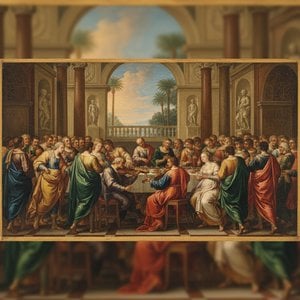
Paolo Veronese: A Renaissance Master of Color, Composition, and Venetian Splendor
Explore the vibrant world of Paolo Veronese, a Renaissance master renowned for his opulent compositions, masterful use of color, and dramatic Venetian scenes. Discover key artworks & legacy.

Reflecting the Self: A History of Portraiture & Psychological Insight
Explore the fascinating history of self-portraiture from Renaissance masters like Dürer & Rembrandt to modern interpretations. Discover the psychological insights and artistic techniques behind these iconic works. Expert analysis for art enthusiasts.

Топ-25 шедевров Тинторетто: Венецианская драма и свет в вашем интерьере
Погрузитесь в мир драматизма и света с 25 шедеврами Тинторетто! Узнайте историю создания легендарных картин эпохи Возрождения. Репродукции высокого качества для вашего интерьера на ArtsDot.com.

The Echo of Self: Reflectivity as a Core Theme in Art History & Contemporary Practice
Explore the rich history of self-representation in art, from Renaissance masters to modern innovators. Discover how artists use portraiture to reveal identity, emotion & the depths of the human psyche. Expert insights for collectors.

The Inner Landscape: Exploring Themes of Introspection in Visual Art Across Movements & Eras
Explore the captivating world of introspective art! Discover how artists across eras – from Rembrandt to Kahlo – used self-portraiture to reveal their inner worlds and emotional depths. A journey through art history & psychology.



