

 Предпросмотр
 Поделиться
 Поделиться
 Детали произведения
 Руководство

 Скачать
 Похожие предметы
 Рентгенография
 Слайд-шоу
 Вопросы и ответы
 Статистика просмотров
Grapes

- 47.0 x 55.0 cm


 Читать далее
Жикле и арт-принты
Печать (жикле) или холст музейного качества с быстрыми сроками изготовления и широким выбором вариантов отделки. ( Купить картину ручной работы Перейти к цифровым изображениям)




P118B $10

P118H $10

P118W $10

P438Z $10

P508JH $12

P508YH $12

P805H $10

P805Z $10

P919BZ $10

P919G $10

P919XJ $10

P959ZH $10

P968JZ $12

W106C $8

W218G $10

W218JH $8

W218Y $10

W307PJ $10

W316G $10

W316PJ $8

W316Y $10

W398PJ $8

W4111J $10

W500HY $15

W500JH $15

W692G $12

W849H $8

W940BG $15

W953PJ $8




Выберите один из наших стандартных размеров, соответствующих оригинальным пропорциям произведения искусства.

Введите необходимую ширину и высоту, чтобы репродукция подошла к вашей раме или стене. При печати изображение можно только уменьшить, но нельзя увеличить больше оригинала, поэтому при выборе другого формата часть изображения может быть обрезана. Перед печатью мы отправим вам цифровой макет на утверждение. Изображение на этой странице не отображает реальную обрезку — ее можно увидеть только на макете.
Доставка по всему миру () за 2 недели вместо стандартных 4–5 недель. (7 Ноябрь)

Бесплатная экспресс-доставка по всему миру

Высококачественный льняной холст

Полное страхование при доставке

Гарантия возмещения таможенных пошлин

Гарантия точного цветового соответствия

100-дневная гарантия возврата (только при обнаружении дефектов)

Гарантия возврата 100% средств

Скидка при оптовом заказе
 Вариант со стеклом доступен только для размеров менее 110 см

Grapes
Жикле и арт-принты
Размер репродукции
-


Итоговая стоимость
$ 63
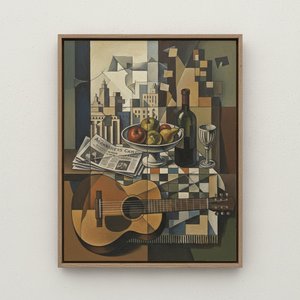
Juan Gris’s “Grapes”: A Symphony of Geometric Light
“Grapes,” painted in 1916 by Juan Gris, isn't merely a still life; it’s a meticulously constructed exploration of form, color, and the very nature of perception. Emerging from the heart of early Cubism, this work represents a pivotal moment in Gris’s artistic evolution, showcasing his burgeoning mastery of geometric abstraction while retaining a profound sensitivity to light and texture. The painting depicts a simple arrangement – a bowl overflowing with plump grapes, a newspaper partially obscured by a hand, and a glass reflecting the scene—yet within this apparent simplicity lies a complex interplay of visual elements that demand careful observation.
Gris’s approach during this period leaned heavily into Synthetic Cubism, a style characterized by its incorporation of collage elements – in this case, fragments of newspaper – alongside meticulously rendered geometric shapes. Unlike the Analytical Cubism of Picasso and Braque, which sought to dissect objects into their constituent parts, Gris employed a more integrated approach, building his compositions from interlocking planes and facets. The newspaper, strategically placed, isn’t merely an added element; it actively disrupts the traditional representation of space, introducing a sense of dynamism and fragmentation that mirrors the artist's own evolving worldview.
The Language of Light and Color
The color palette of “Grapes” is remarkably restrained yet profoundly evocative. Gris utilizes muted tones – ochres, browns, and deep blues – to create a sense of quiet intimacy. However, these seemingly simple colors are carefully modulated, layered upon one another to generate subtle shifts in value and hue. The reflective surface of the glass introduces a crucial element: light itself becomes a subject of the painting. Gris masterfully captures the way light bounces off the grapes, the newspaper, and the bowl, creating an illusion of depth and volume that defies traditional perspective. Notice how the shadows are not dark voids but rather areas of subtle color variation, contributing to the overall sense of luminosity.
Gris’s technique is characterized by a remarkable precision and control. He employs a pointillist approach – using small, distinct dots of color – to build up surfaces with incredible texture and vibrancy. This method allows him to capture the subtle nuances of light and shadow with astonishing accuracy. The meticulous application of paint creates a shimmering effect, as if the grapes themselves are radiating warmth and vitality.
A Reflection of Modernity
“Grapes” was created during a period of immense social and artistic upheaval in Europe. The rise of industrialization, urbanization, and technological advancements were fundamentally altering people’s perceptions of reality. Cubism, with its fragmented forms and rejection of traditional representation, reflected this sense of disorientation and uncertainty. Gris's work can be interpreted as an attempt to grapple with these changes, offering a new way of seeing the world—one that is both intellectually stimulating and emotionally resonant.
The inclusion of the newspaper – a ubiquitous symbol of modern life – further underscores this theme. It suggests a blurring of boundaries between art and everyday experience, inviting the viewer to consider the role of media in shaping our understanding of reality. The painting’s quiet intimacy contrasts sharply with the frenetic pace of urban life, offering a moment of contemplative stillness.
Capturing the Essence: A High-Quality Reproduction
Owning a reproduction of “Grapes” is more than simply acquiring a beautiful image; it's an opportunity to bring a piece of art history into your home. TOPofART’s hand-painted reproductions meticulously recreate Gris’s original techniques, capturing the subtle nuances of color, texture, and light with unparalleled fidelity. Each reproduction is created by experienced European artists trained in academic painting methods, ensuring that every detail—from the delicate brushstrokes to the shimmering reflections—is faithfully reproduced. The canvas is stretched on a high-quality linen surface, providing a timeless and elegant presentation.
Consider this artwork not just as decoration, but as a window into the mind of a visionary artist – a testament to the power of geometric abstraction and the enduring beauty of light and color.
Вопросы и ответы
Насколько насыщенны цвета в работе "Grapes"?
В работе «Grapes», Хуан Грис запечатлена Subtle Color насыщенность и Monochromatic интенсивность цвета.
Для каких целей и в каком интерьере рекомендуется использовать «Grapes»?
Для работы «Grapes», Хуан Грис предусмотрены две рекомендации: по способу использования (Statement) и по размещению в интерьере (Living Room).
Какое настроение передает «Grapes», Хуан Грис?
В работе «Grapes» Calm настроение сочетается с Reflective эмоцией.
Похожие произведения


Биография художника
A Spanish Visionary of Cubism: The Life and Art of Juan Gris
José Victoriano González-Pérez, a name that would become synonymous with artistic innovation, was born in Madrid on March 23, 1887. This young man, destined to be known as Juan Gris, embarked on a journey that would not only establish him as one of the most significant figures of early 20th-century art but also profoundly reshape our understanding of visual perception. Initially pursuing an engineering degree at the School of Arts and Sciences in Madrid, a logical mind began to develop alongside a burgeoning creative spirit. Even during his studies, glimpses of his artistic talent emerged – contributions to local periodicals hinted at a future dedicated to capturing the world through a unique lens. It was in 1905 that he adopted the pseudonym Juan Gris, a name imbued with a newfound sense of identity and purpose, marking a deliberate step towards embracing his artistic aspirations.Parisian Awakening and the Embrace of Cubism
The year 1906 proved to be a pivotal moment in Gris’s life – he relocated to Paris, a city then brimming with an unparalleled concentration of artistic energy. This move was not merely a geographical shift; it represented a complete immersion into a vibrant cultural landscape. He quickly established connections with luminaries such as Henri Matisse, Georges Braque, and Fernand Léger, forging friendships that would profoundly influence his artistic development. Initially, Gris engaged in the demanding world of satirical illustration for publications like *L'Assiette au Beurre*, honing his observational skills and developing a keen eye for detail – a skill he would later translate into his groundbreaking paintings. However, it was Pablo Picasso who exerted the most significant impact on his artistic trajectory. Around 1910, Gris began to dedicate himself wholeheartedly to painting, moving away from caricature and embracing the revolutionary language of Cubism. This wasn’t simply imitation; it was a deliberate quest to distill the essence of form and space, seeking a new visual order – a radical departure from traditional representation.The Geometry of Perception: Style and Key Works
Juan Gris's artistic output is characterized by an extraordinary clarity and intellectual rigor. He didn’t merely deconstruct objects; he meticulously reconstructed them, emphasizing geometric forms and employing a carefully considered palette. This approach led to what became known as his “crystal period,” exemplified in masterpieces such as *Still Life Before an Open Window* (1912) and *Place Ravignan* (1915). These works showcase a remarkable interplay of planes and angles, creating a sense of depth and solidity while simultaneously challenging conventional notions of perspective. The influence of Picasso is undeniable, yet Gris developed his own distinct style – one characterized by a precise geometric structure, a harmonious color scheme, and an innovative use of *papier collé* (collage). He incorporated real-world materials like newspaper clippings and textured papers into his compositions, blurring the boundaries between painting and sculpture. Notable examples include *Guitar in front of the sea* (1925), a testament to his simplified forms and adherence to cubist principles, and *Homage à Pablo Picasso* (1912), which signaled his growing recognition within the avant-garde art world.Synthetic Cubism and Lasting Influence
Following the initial explorations of Analytical Cubism, Gris transitioned to Synthetic Cubism around 1913, a period marked by a shift towards greater simplification and a vibrant use of color. He pioneered the extensive use of *papier collé*, incorporating fragments of everyday life – advertisements, fabrics, and even pieces of fruit – into his paintings. This technique added layers of complexity and tactile richness to his work, transforming his canvases into dynamic visual dialogues. Unlike Picasso and Braque, whose Cubist works were often monochromatic, Gris employed bold, harmonious color palettes, creating a distinctive aesthetic that resonated with the principles of Matisse’s art. His emphasis on geometric forms, combined with his innovative use of collage, established him as a pivotal figure in 20th-century art. His legacy extends beyond mere stylistic innovation; he brought a unique intellectual depth and structural clarity to the movement, profoundly influencing the Purist style championed by Amédée Ozenfant and Charles Edouard Jeanneret (Le Corbusier). Juan Gris’s work continues to inspire artists today, demonstrating the enduring power of Cubism and the visionary genius of a Spanish master who reshaped our understanding of perception and representation.Key Facts
- Full Name: José Victoriano González-Pérez
- Born: March 23, 1887, Madrid, Spain
- Died: May 11, 1927, Paris, France
- Artistic Movement: Cubism (Analytical and Synthetic)
- Influenced By: Pablo Picasso, Henri Matisse
- Notable Works: *Still Life Before an Open Window*, *Place Ravignan*, *Guitar in front of the sea*, *Homage à Pablo Picasso*

Хуан Грис
1887 - 1927 , Испания
Об авторе
- Artistic Movement Or Style: Кубизм, Синтетический кубизм
- Artists Or Movements Influenced By This Artist:
- Пуризм
- Озенфан
- Artists Who Influenced This Artist:
- Пикассо
- Матисс
- Брак
- Date Of Birth: 23 марта 1887
- Date Of Death: 11 мая 1927
- Full Name: José Victoriano González-Pérez
- Nationality: Испанский
- Notable Artworks:
- «Гитара перед морем»
- «Художественный коллаж»
- «Дом с сине-зелеными окнами»
- Place Of Birth: Мадрид, Испания
Похожие статьи

25 Шедевров Поля Сезанна: Открывая Новую Эру в Искусстве | ArtsDot
Откройте для себя 25 величайших шедевров Поля Сезанна! Узнайте истории создания картин импрессионизма и постимпрессионизма, технику художника и вдохновение для вашего интерьера. Репродукции картин Сезанна высокого качества на ArtsDot.com.

Deconstructing Reality: Cubism's Revolutionary Impact on 20th-Century Art
Explore the revolutionary world of Cubism with ArtsDot. Discover Picasso & Braque's groundbreaking techniques, its philosophical roots, and lasting impact on modern art. Expert insights for collectors.

Жорж Брак: 25 шедевров кубизма для ценителей искусства и интерьера
Откройте для себя 25 шедевров Жоржа Брака – пионера кубизма! Узнайте историю создания культовых картин, технику и влияние французского художника на искусство XX века. Репродукции высокого качества для вашего интерьера на ArtsDot.com.

Deconstructing Identity: A Comprehensive Exploration of Cubist Portraiture
Explore the revolutionary world of Cubist portraiture with our comprehensive guide. Discover Picasso, Braque, Gris & the movement's impact on modern art. Expert analysis for collectors and enthusiasts.
Juan Gris: Cubist Deconstruction & Synthesis – A Comprehensive Exploration
Explore the revolutionary art of Juan Gris – a master of Cubism. Discover his unique approach to deconstruction, vibrant Synthetic Cubist works, and lasting influence on modern art. Expert analysis for collectors.


